


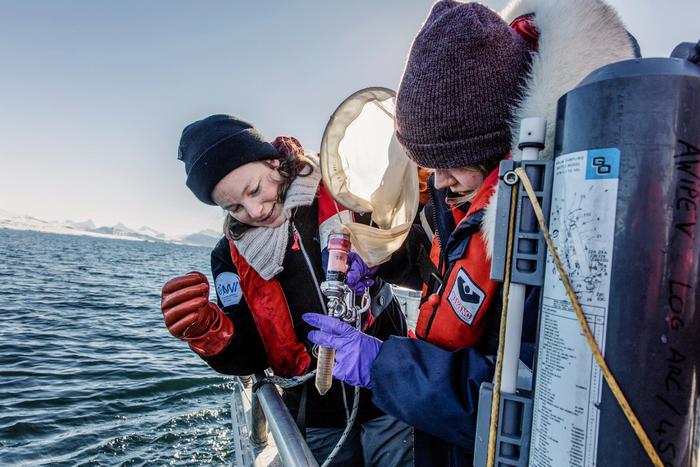
The basis of the marine food web in the Arctic, the phytoplankton, responds to heatwaves much differently than to constantly elevated temperatures. This has been found by the first targeted experiments on the topic, which were recently conducted at the Alfred Wegener Institute’s AWIPEV Station. The phytoplankton’s behaviour primarily depends on the cooling phases after or between heatwaves, as shown in a study just released in the journal Science Advances.

Credit: Alfred-Wegener-Institut / Paolo Verzone
The basis of the marine food web in the Arctic, the phytoplankton, responds to heatwaves much differently than to constantly elevated temperatures. This has been found by the first targeted experiments on the topic, which were recently conducted at the Alfred Wegener Institute’s AWIPEV Station. The phytoplankton’s behaviour primarily depends on the cooling phases after or between heatwaves, as shown in a study just released in the journal Science Advances.
Heatwaves, which we’ve increasingly seen around the globe in recent years, are also becoming more and more common in the Arctic. During a heatwave, not only the air but also the ocean grows warmer – the temperature is substantially higher than the seasonal mean value for at least five consecutive days. But how these short-term temperature fluctuations affect polar organisms remains largely unclear. To shed light on this aspect, a team led by Dr Klara Wolf (Universities of Hamburg and Konstanz) and Dr Björn Rost from the Alfred Wegener Institute, Helmholtz Centre for Polar and Marine Research (AWI) has now used experiments to investigate how single-cell algae, the phytoplankton, respondact to these extreme events. Given the phytoplankton’s role as the basis of the marine food web, changes in it could resonate throughout the entire Arctic ecosystem.
In incubation experiments at the AWIPEV Station in Svalbard, the researchers allowed natural phytoplankton communities from nearby Kongsfjorden to grow for 20 days under various conditions – normal and increased but constant temperatures (2° C, 6° C, 9° C). For comparison, they subjected the phytoplankton to repeated heatwaves of varying intensity (6° C, 9° C) , each lasting five days with a three-day cooling phase at the seasonal mean temperature (2° C) in between. Different types of samples were collected at defined intervals in order to characterise the physiological responses and any potential species shifts.
“Under stable temperatures, even an extreme increase of +7° C led to accelerated growth and higher productivity, with surprisingly small changes in the composition of species, even over weeks,” says Klara Wolf regarding the experiments’ outcomes. “In contrast, the effects of heatwaves are considerably more complex and don’t follow the same pattern. This implies that our knowledge about constant temperature increases cannot readily be applied to these short-term warm phases, which normally only last a few days.” One reason for the difference is apparently that not just the exposure to increased temperatures has a major impact on productivity, but also and especially the cooling phases after or between heatwaves – and very little is known about these effects.
“We’re only just starting to gain a mechanistic understanding of how heatwaves can impact the polar regions,” says AWI biologist Björn Rost. “Our study represents an important first step and shows which aspects of heatwaves and which phytoplankton-related processes we need to take a closer look at. In addition, our study shows that what we know about the processes and effects of constantly higher temperatures can’t simply be applied one-to-one.” In fact, scenarios involving fluctuating temperatures can produce a broad range of effects, which is why predicting their implications is more complicated than for continuous warming.
Accordingly, in order to develop better projections and models regarding how primary production and the Arctic ecosystem will change in response to climate change, it won’t suffice to investigate the effects of mean temperatures; the effects of temperature fluctuations need to receive more attention. While stable warming up to a certain temperature increases productivity, some heatwaves can decrease it, while others increase it. A better grasp of the effects of variable temperatures, especially the cooling phases, is therefore essential to improving forecasts on potential biodiversity changes. Investigations on phytoplankton are hereby most crucial, since changes at the basis of the food web can impact all higher trophic levels, all the way up to fisheries.
Journal
Science Advances
Method of Research
Experimental study
Subject of Research
Not applicable
Article Title
Heatwave responses of Arctic phytoplankton communities are driven by combined impacts of warming and cooling
Article Publication Date
17-May-2024
Cite Scienmag News
Violet Maxwell. (May 17, 2024). How heatwaves are affecting Arctic phytoplankton. Scienmag. https://scienmag.com/how-heatwaves-are-affecting-arctic-phytoplankton/
Violet Maxwell. "How heatwaves are affecting Arctic phytoplankton." Scienmag, 17 May 2024, https://scienmag.com/how-heatwaves-are-affecting-arctic-phytoplankton/. Accessed 5 September 2026.
Violet Maxwell. "How heatwaves are affecting Arctic phytoplankton." Scienmag. May 17, 2024. https://scienmag.com/how-heatwaves-are-affecting-arctic-phytoplankton/

