

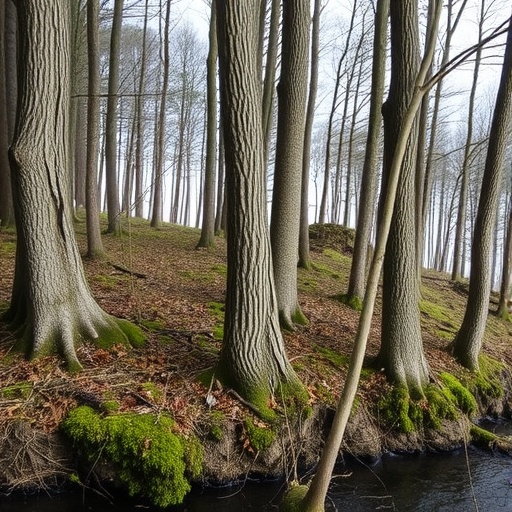
Along the eastern seaboard of the United States, a silent transformation is emerging under the shadow of rising sea levels—an environmental phenomenon ominously termed “ghost forests.” These haunting landscapes are defined by clusters of standing dead or dying trees, overtaken by encroaching saltwater intrusion that starves salt-intolerant species of the fresh water they need to survive. What once were vibrant coastal woodlands are now marked by bare, grey skeletons of trees, visually manifesting the relentless impact of climate change. Recent research conducted by a team from the University of Delaware sheds new light on how these ghost forests may be signaling deeper shifts in coastal ecosystem resilience through changes in hydrological and biochemical cycles.
This research, presented at the American Chemical Society’s (ACS) Spring 2026 meeting, dives into the often-overlooked role of stemflow—in essence, the rainwater that runs down tree branches and trunks—in regulating nutrient transfer within these altered coastal environments. Samantha Chittakone, an undergraduate environmental engineering student leading this study, emphasizes the urgency of understanding stemflow as it intimately connects above-ground tree health with subterranean biochemical processes. By analyzing the rainwater pathway from branches to soil, the team sought to unravel the complex feedback loops altered by sea level rise and saltwater intrusion that ultimately disrupt carbon and nutrient cycling within forest soils.
Stemflow acts as a natural funnel concentrating precipitation runoff along tree stems and depositing it into the soil around roots, a process critical to sustaining the forest microbiome and enabling the transfer of essential nutrients. In coastal forests experiencing rising groundwater tables and saltwater intrusion, this flow may be significantly perturbed. The research focused on sweetgum trees (Liquidambar styraciflua), a species prevalent in mid-Atlantic coastal forests, measuring both healthy and moribund or dead trees to document how their stemflow differed chemically and quantitatively. Findings revealed a striking reduction in the volume of stemflow reaching the forest floor beneath ghost trees—a disruption that could cascade through the ecosystem’s nutrient and water dynamics.
Perhaps more notably, the chemical composition of the stemflow demonstrated dramatic variations in dissolved organic carbon (DOC) content, particularly with stressed and dead sweetgum trees exporting surprisingly high sugar concentrations through stemflow. The implications are profound: dead trees, previously assumed to merely wither away, continue to influence soil chemistry by absorbing rather than funneling water and nutrients. These “sponging” trees intercept stemflow, essentially cutting off vital nutrient and carbon inputs to the soil microbiome. This disruption alters the delicate balance of subterranean organisms and the broader forest floor ecosystem, potentially accelerating ecosystem degradation before total forest collapse occurs.
Co-investigator Dr. Yu-Ping Chin articulates the importance of stemflow beyond its water transport function, describing it as an essential vehicle for injecting nutrients and chemical signals critical for microbiological communities. The observed variation in stemflow color—from the appearance of rich coffee to weak tea—corresponds directly to differences in bark texture and the concentration of organic compounds and minerals. This variability further hints at a dynamic chemical environment altered by tree health, which in turn modulates nutrient availability and microbial function within coastal forests.
Groundwater interaction with stemflow emerged as another critical focus of this study, given that coastal forest groundwater tables frequently sit near the surface. By placing monitoring wells adjacent to both healthy and stressed sweetgum trees, researchers measured variances in water table levels and chemical tracers following rainfall events. Consistently, groundwater levels rose near tree bases with intact stemflow, indicating significant subterranean infiltration. Fluorescence indices of dissolved organic matter in groundwater revealed crucial differences: groundwater impacted by stemflow showed fluorescence signatures indicative of recently introduced, plant-derived organic compounds, whereas groundwater less influenced by stemflow had more microbially processed DOM.
To trace the origins of organic compounds, the team measured dissolved lignin concentrations within groundwater samples—lignin being a major component of woody plant tissue. Results demonstrated elevated dissolved lignin concentrations in groundwater influenced by stemflow near healthy trees compared to unaffected groundwater sources. This finding bolsters the hypothesis that stemflow acts as a conduit for transporting plant-derived carbon compounds directly into groundwater, thereby influencing belowground carbon cycling pathways and potentially affecting broader biogeochemical feedbacks to climate change.
Dr. Delphis Levia, a supervisor on the project, emphasized the significance of these findings in redefining how coastal forests serve as carbon sinks in a changing climate. The transition from vibrant green canopies to ghost forests does not just represent a loss of aboveground biomass but signals altered fluxes of carbon and nutrients at the soil interface. This disruption in carbon inputs via stemflow has cascading implications for soil microbial communities, decomposition rates, and ultimately, the ability of these ecosystems to sequester carbon effectively in the face of ongoing sea level rise.
These internal forest dynamics, not readily discernable from satellite or aerial imagery, highlight the necessity of detailed mechanistic studies such as this to predict forest vulnerability accurately. Understanding how stemflow and tree health shape soil water chemistry provides new avenues to forecast which coastal forest sites may succumb first or exhibit resilience under predicted climate scenarios. The team’s work represents an important step forward in linking visible physiological symptoms of stress in coastal forests to hidden yet vital belowground ecological processes.
The researchers note their continuing investigations aim to expand the context of these findings, including examining the influence of episodic environmental disturbances such as wildfires on stemflow mechanics and chemistry. As wildfires increasingly threaten forested ecosystems globally, elucidating how altered water and nutrient transport during and after fires affect forest regeneration and carbon cycling will be essential.
This study underscores the complex interplay of hydrological and biochemical mechanisms by which climate change is influencing coastal forest ecosystems. Stemflow emerges not just as a passive process but a critical nexus integrating aboveground tree health with belowground carbon cycling and microbial ecology. Recognizing the hidden role of stemflow provides new insight and urgency to conserve coastal forests, whose capacity to mitigate climate change by storing carbon is imperiled by rising seas.
Ultimately, this research highlights ghost forests as not only stark visual indicators of climate change but also transformative ecosystems where shifts in water and nutrient pathways foreshadow broader ecological consequences. The unique chemical signatures carried by stemflow could serve as important tracers for monitoring forest health and resilience, helping scientists and policymakers detect early warning signs and develop targeted conservation strategies for these vulnerable landscapes.
Subject of Research: The influence of stemflow on carbon cycling and groundwater chemistry in coastal “ghost forests” affected by rising sea levels.
Article Title: Linking stemflow to groundwater in ghost forests: Accessing tracers and impacts of tree health on dissolved organic carbon composition
News Publication Date: March 26, 2026
Web References:
https://acs.digitellinc.com/live/36/page/1271
Image Credits: Samantha Chittakone
Keywords: ghost forests, stemflow, coastal forests, dissolved organic carbon, rising sea levels, saltwater intrusion, groundwater chemistry, sweetgum trees, carbon cycling, microbial ecology, climate change, coastal resilience


