


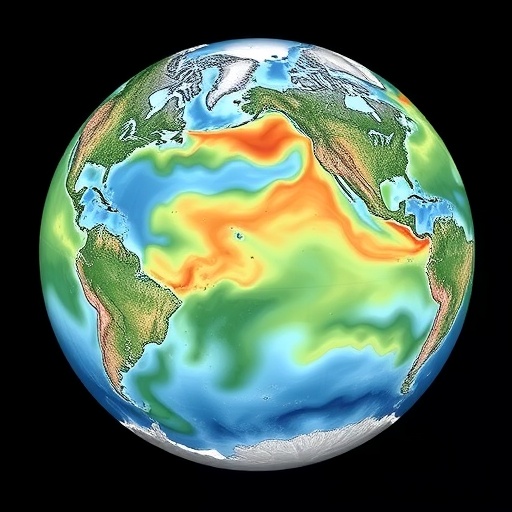
A subtle flaw in climate models may be making one of Earth’s most important ocean circulations look safer than it really is. New simulations suggest that systematic errors in how models distribute freshwater across the Indian and Atlantic oceans can substantially alter the stability of the Atlantic Meridional Overturning Circulation, or AMOC—a vast system of currents that transports heat northward through the Atlantic and returns cold, dense water toward the deep ocean. If the simulated freshwater biases resemble those found in many Earth system models, the AMOC may be too stable on computers, potentially causing projections to underestimate the likelihood of a future collapse under continued greenhouse-gas emissions.
The AMOC is not a single current but a planetary-scale circulation powered by differences in temperature and salinity. Warm, salty surface water flows northward, releasing heat to the atmosphere. In the subpolar North Atlantic, cooling increases the water’s density, allowing it to sink and join a deep southward flow. This overturning helps regulate climate around the North Atlantic, influences rainfall and wind patterns, redistributes carbon and heat, and affects sea level and marine ecosystems. A major weakening would not simply mean a slower Gulf Stream; it would represent a reorganization of the climate system with consequences extending across both hemispheres.
Scientists have long known that the AMOC can, in some models, exist in more than one stable state. Under broadly similar external conditions, the circulation may occupy a vigorous “on” state or a much weaker “off” state. The possibility of these alternative equilibria makes the AMOC a potential climate tipping element: a system that can shift abruptly when a gradual change in forcing pushes it beyond a critical threshold. Freshwater entering the ocean is especially important because it dilutes seawater, reduces density, and can interfere with the formation of deep water in the North Atlantic. The resulting slowdown can itself alter salt transport, creating feedbacks that either stabilize or destabilize the circulation.
The new study, by Amber A. Boot of Utrecht University and the Technical University of Denmark and Henk A. Dijkstra of Utrecht University, tests whether earlier findings from a relatively simple climate model also hold in a more detailed ocean model. The researchers compared simulations from CLIMBER-X, an intermediate-complexity Earth system model with a coarse 5-degree ocean grid, with simulations from the Parallel Ocean Program version 2, or POP2. POP2 represents the ocean at a nominal horizontal resolution of 1 degree, includes 40 vertical layers, and incorporates parameterized processes such as mesoscale mixing and overflow in the North Atlantic and Southern Ocean. It is also used as an ocean component in the Community Earth System Model family.
The comparison was designed to isolate the influence of freshwater errors rather than reproduce a perfect modern climate. The researchers established baseline simulations and then imposed artificial freshwater biases in the Indian Ocean, the Atlantic Ocean, or both basins. The perturbations were deliberately large enough to expose the circulation’s response: a change of 1.50 millimeters per day, equivalent to roughly 0.24 to 0.27 sverdrups over the affected regions. One sverdrup represents one million cubic meters of water flowing every second. The added freshwater was balanced elsewhere so that the overall salt budget remained conserved.
The models were then subjected to a controlled “hosing” experiment, in which freshwater was added to the North Atlantic between 20 and 50 degrees north. This forcing was increased gradually until the AMOC collapsed. In the faster experiments, the model was allowed to adjust for 600 years after the bias was introduced, and the freshwater forcing rose at 0.30 sverdrups per thousand years. The researchers also ran slower CLIMBER-X experiments, allowing 10,000 years for adjustment and increasing the forcing six times more slowly. Such long integrations are necessary because ocean salinity and circulation respond over centuries to millennia, and a simulation that appears settled after a few decades may still be evolving internally.
Despite their different resolutions and physical complexity, POP2 and CLIMBER-X produced the same broad result. A negative freshwater bias in the Indian Ocean—effectively making that ocean saltier—tended to weaken and destabilize the AMOC. A positive Indian Ocean bias, which freshened the region, generally strengthened and stabilized it. The Atlantic response was reversed: adding freshwater to the Atlantic tended to weaken the AMOC, while removing it had a stabilizing effect. The researchers traced these responses to how salinity anomalies move through the connected ocean basins and alter the density contrast that helps drive overturning.
The physical chain is counterintuitive. When the Indian Ocean becomes saltier, the anomaly can influence the South Atlantic, changing the density structure there and reducing the north–south density difference across the Atlantic. A weaker density gradient means less pressure-driven overturning. The weakened circulation then transports less salt northward, leaving the North Atlantic fresher and further reducing the density of water available for sinking. In the Atlantic itself, additional freshwater directly lowers salinity and density, making deep convection more difficult. These processes are reflected in the freshwater transport of the overturning circulation across roughly 34 degrees south, a diagnostic measure tied to the salt-advection feedback.
That feedback is central to the study’s warning. Observational estimates generally indicate freshwater export characteristics associated with a destabilizing salt-advection feedback, whereas many climate models simulate the opposite sign. In those models, the feedback helps restore the AMOC after a disturbance, making the circulation appear more resistant to collapse. The discrepancy is linked partly to salinity errors and surface freshwater forcing, including precipitation patterns. One well-known example is the “double Intertropical Convergence Zone” bias, in which models produce two overly strong tropical precipitation bands. Such errors can redistribute freshwater between ocean basins and alter the large-scale salinity field that controls circulation stability.
The simulations did not show that every freshwater bias causes an immediate or inevitable collapse. Instead, the biases shifted the amount of additional North Atlantic freshwater required to reach the tipping point. In POP2, most experiments collapsed under less freshwater forcing than the baseline case. The main exception was the simulation with positive freshwater biases in the Indian Ocean, which required stronger forcing before collapse. The slower CLIMBER-X experiments showed a similar pattern. Some Atlantic-bias cases collapsed in two stages: first, deep convection in the subpolar gyre weakened, then the system entered a weak, oscillating state before a complete collapse under still stronger forcing.
One especially complex result emerged when opposing biases were applied across both the Indian and Atlantic oceans. In the POP2 simulation with negative biases in both basins, the AMOC became unusually variable and then highly sensitive to additional freshwater near a forcing of about 0.155 sverdrups. The researchers linked the behavior to a reorganization of the South Atlantic circulation, including changes in mixed-layer depth, sea-surface temperature and sea-surface salinity. Rossby waves generated near the Mid-Atlantic Ridge grew in amplitude as freshwater forcing increased, while changes in gyre transport amplified the weakening. This case illustrates why the circulation cannot be understood from a single regional salinity value: basin geometry, waves, gyres and density feedbacks can interact in nonlinear ways.
The team also separated the simulated AMOC decline into several mechanisms, including surface freshwater forcing, gyre transport, northern-boundary freshwater transport and the salt-advection feedback. Before the tipping point, direct surface freshwater forcing produced most of the weakening, with gyre changes contributing several sverdrups of additional decline. The salt-advection feedback played only a minor role at first but became the mechanism that drove the final collapse after the threshold was crossed. POP2 differed from a previous Community Earth System Model analysis mainly in the behavior of the gyre feedback, which was more destabilizing before the tipping point. Yet the gyre response was broadly similar among the different freshwater-bias experiments, suggesting that it did not erase the central effect of the biases.
The researchers caution that POP2 is still not a complete Earth system model. It is an ocean-only simulation driven by prescribed atmospheric conditions, and therefore lacks two-way interactions with a dynamic atmosphere and sea ice. In the real world, a weakening AMOC would reduce northward ocean heat transport, potentially expanding Arctic sea ice. More ice could insulate the ocean from the atmosphere, alter heat loss and suppress deep convection. Atmospheric changes in wind, moisture and heat transport could either reinforce or counteract the circulation’s decline. Southern Ocean winds are also important because they drive upwelling and help shape the pathways that connect the Atlantic to the global ocean.
The study likewise does not calculate a precise date or probability for an AMOC collapse. Its experiments use idealized freshwater forcing under preindustrial conditions, while the actual climate is being pushed away from equilibrium by rising greenhouse-gas concentrations. Real-world tipping could involve several processes at once, including gradual forcing, random fluctuations and changes in the background stability of the circulation. Freshwater variability itself may also contain model biases in its amplitude and distribution. The authors therefore present their results as evidence of a structural vulnerability in current modeling rather than as a forecast of imminent collapse.
To help test that vulnerability in more expensive Earth system models, Boot and Dijkstra propose a streamlined experiment. A model would first be run under baseline conditions, then branched before the tipping point. A freshwater bias would be introduced gradually over several centuries, allowing the ocean to adjust without triggering artificial rate-dependent effects. The simulation would then resume increasing North Atlantic freshwater forcing. In their POP2 proof-of-concept, a negative Indian Ocean bias was added over 400 years after a 500-year equilibration period. The modified simulations tipped within decades of renewed forcing and before the unbiased baseline, supporting the proposed protocol.
The broader implication is that model resolution alone may not solve the AMOC problem. The same qualitative response appeared in a coarse coupled model and a substantially more detailed 1-degree ocean model, indicating that the mechanism survives increased ocean complexity. Yet the authors stress that only experiments in fully coupled Earth system models can establish whether the bias pattern consistently makes the AMOC too stable. Until then, projections showing no complete collapse this century should not be interpreted as proof that the risk is negligible. If models are systematically giving the circulation an overly strong safety margin, correcting freshwater distributions could turn a seemingly remote tipping possibility into a more serious climate risk.
Cite Scienmag News
Sloane Callahan. (August 29, 2026). How Freshwater Biases Affect AMOC Stability Across Climate Model Complexity. Scienmag. https://scienmag.com/how-freshwater-biases-affect-amoc-stability-across-climate-model-complexity/
Sloane Callahan. "How Freshwater Biases Affect AMOC Stability Across Climate Model Complexity." Scienmag, 29 August 2026, https://scienmag.com/how-freshwater-biases-affect-amoc-stability-across-climate-model-complexity/. Accessed 3 September 2026.
Sloane Callahan. "How Freshwater Biases Affect AMOC Stability Across Climate Model Complexity." Scienmag. August 29, 2026. https://scienmag.com/how-freshwater-biases-affect-amoc-stability-across-climate-model-complexity/


