

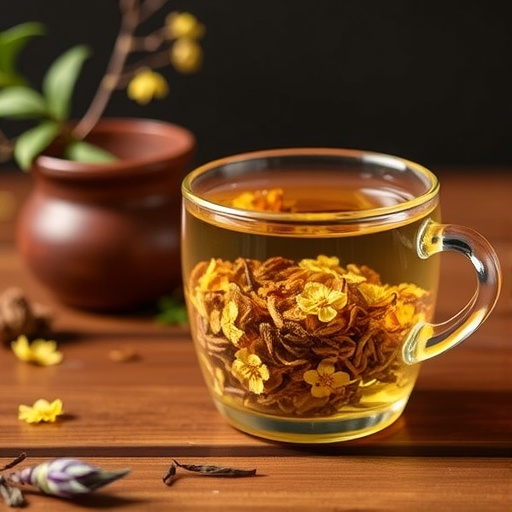
In a groundbreaking study published in the prestigious journal Beverage Plant Research, scientists have unveiled the intricate biochemical transformations that define the unique aroma profile of golden flower white tea. This novel tea product, cherished for its distinctive sensory characteristics, owes its complex flavor largely to a traditional microbial flowering process applied to white tea leaves. The research, conducted by Yuefang Gao and Bin Xiao’s team at Northwest A & F University, marks a significant leap forward in decoding the volatile compound dynamics that sculpt the sensory experience of this emerging beverage.
Golden flower white tea emerges from a sophisticated process traditionally used for Fu brick tea but innovatively adapted for white tea production. This process encompasses steaming, pressing, microbial fermentation driven primarily by Eurotium cristatum, and drying. Each stage initiates distinct biochemical cascades, collectively endowing the tea with a multifaceted flavor profile. While previous investigations mainly employed gas chromatography-mass spectrometry (GC-MS) to study tea aromas, this research overcomes the inherent limitations of single-method approaches by integrating GC-MS with gas chromatography-ion mobility spectrometry (GC-IMS). This dual-platform methodology offers unprecedented resolution and sensitivity, capturing both abundant and trace volatile compounds lost in prior analyses.
The research team undertook systematic sampling at five critical junctures across the production timeline: freshly harvested raw material, post-steaming, after four days and eight days of microbial flowering, and following final drying. By juxtaposing data from GC-IMS and headspace solid-phase microextraction GC-MS (HS-SPME-GC-MS), the scientists identified 59 volatile compounds via GC-IMS and 152 compounds through GC-MS, signifying the complementary nature of these techniques in characterizing aroma complexity. They further employed relative odor activity value (ROAV) analysis to ascertain the compounds most influential in shaping the sensory profile.
Sensory evaluation conducted by trained panels revealed a clear progression in aroma character throughout production. Initially dominated by pronounced green notes, the aroma evolved toward fruitier dimensions during intermediate fermentation stages, culminating in the development of rich mushroom-like, creamy, floral, fruity, and woody characteristics in the later flowering and dried samples. This sensory transition was closely matched by the volatile compound profiles. Early stages exhibited high concentrations of low-boiling aldehydes such as hexanal, conferring fresh and green notes that diminished markedly during fermentation.
Among the critical volatile markers identified, 1-octen-3-ol emerged as a key highlight. This compound, intrinsically linked to mushroom aroma, surged to its peak concentration at the eight-day flowering stage, a finding corroborated by both GC-IMS and GC-MS data. Its dynamic concentration profile underscores its role as a signature metabolite of Eu. cristatum fermentation. Concurrently, 2,3-butanedione increased during later stages, imparting creamy and buttery nuances that balance the developing aroma complexity. Additionally, 2-methylpentanal, correlated with fruity and green notes, factored prominently in the evolving aroma bouquet.
Further chemical analyses revealed a marked rise in methyl salicylate, which likely contributes to the distinct “fungal flower” fragrance detected by sensory panels. This contrasts sharply with the depletion of green-note aldehydes, illustrating how microbial fermentation drives a coordinated replacement of fresh vegetal volatiles with fermentation-derived aroma compounds. The nuanced interplay of these molecules together crafts the singular identity of golden flower white tea.
Statistical modeling provided invaluable insight into the stages exerting the greatest influence on aroma development. Notably, the steaming process and the critical mid-to-late flowering window—from days 4 to 8—emerged as decisive phases where volatile profiles underwent profound restructuring. Steaming initiates enzymatic inactivation and moisture regulation, setting the stage for microbial activity, while extended fermentation fosters the biosynthesis of characteristic volatiles through complex metabolic networks orchestrated by Eu. cristatum.
Taken as a whole, these findings underscore that the traditional flowering process is not a mere conditioning step but a transformative event that redefines white tea’s aromatic landscape. The hallmark of golden flower white tea quality lies in the systematic attenuation of initial green notes and the corresponding emergence of mushroom-like, creamy, and woody aroma facets linked to microbial metabolism. This research offers a mechanistic blueprint for flavor regulation, enabling producers to fine-tune processing conditions for optimized sensory outcomes and product diversification.
Beyond its immediate contributions to tea science, the research exemplifies the power of pairing complementary analytical technologies to illuminate volatile compound dynamics with unparalleled clarity. The fusion of GC-IMS with HS-SPME-GC-MS extends the detection range from trace aroma-active molecules to abundant volatiles, ensuring a holistic characterization of aroma evolution. This integrated approach sets a new standard for studying complex fermented foods and beverages.
Moreover, this study paves the way for targeted breeding and fermentation strategies aimed at enhancing specific aroma compounds within golden flower white tea. Understanding the compound-specific timelines and concentration peaks not only facilitates process control but also invites innovation in creating new tea variants with tailored sensory profiles. Through such innovations, the white tea category may witness expanded appeal and elevated market presence globally.
In essence, the investigation provides the much-needed molecular narrative behind golden flower white tea’s unique aroma journey, bridging sensory perception with biochemical phenomena. As tea researchers and producers seek to unravel the intricacies of flavor formation, this work stands as a landmark contribution, illuminating how microbial mediation during traditional flowering engenders a rich aroma system that captivates consumers and connoisseurs alike.
The future of tea innovation will undoubtedly benefit from these revelations, as they empower precise modulation of volatile chemistry to sculpt aromatic experiences. Such precision not only enhances quality consistency but also fosters sustainable practices by optimizing microbial fermentation steps. The aroma metamorphosis revealed herein exemplifies how ancient processing wisdom and modern analytical prowess can converge to elevate the science and art of tea.
Subject of Research: Not applicable
Article Title: Dynamic aroma compounds in golden flower white tea based on the traditional flowering process
News Publication Date: 11-Feb-2026
References:
DOI: 10.48130/bpr-0025-0037
Keywords: Agriculture, Biochemistry


