


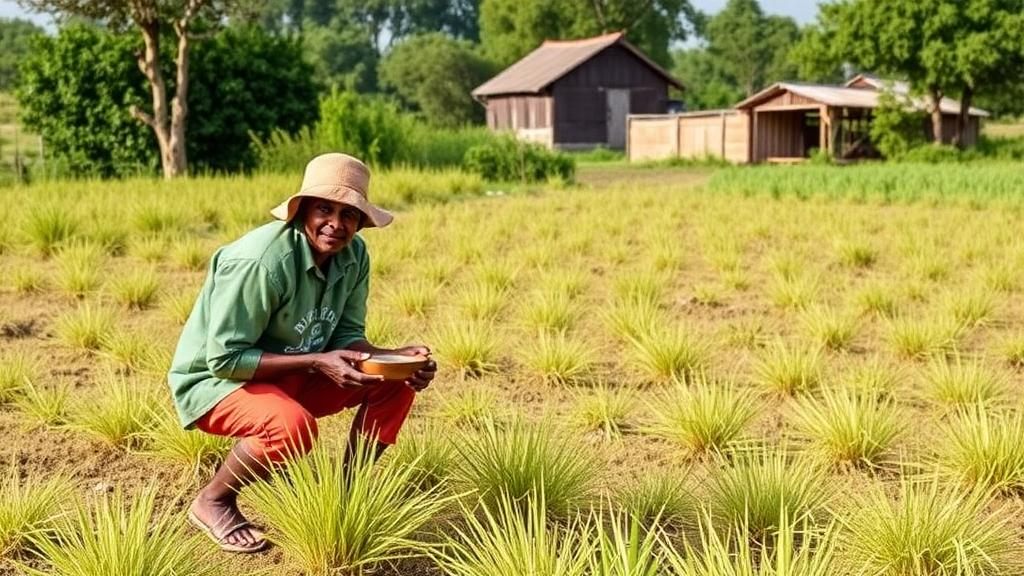
Agricultural extension services, the advisory networks that carry scientific knowledge from research institutions to the world’s smallholder farmers, have long been treated as a simple pipeline for delivering better seeds and better techniques. A new systematic review published in BMC Agriculture argues that this picture is far too narrow. Drawing on 45 studies published between 2014 and 2024, researchers Wycliffe Ongachi and Ivy Belinder of SKUAST-Kashmir and the University of Nairobi find that extension services are doing something far more ambitious than boosting crop yields: they are functioning as engines of livelihood diversification, helping rural families across the Global South build income streams that stretch well beyond the farm gate. In an era when climate variability, pest outbreaks and policy shocks can wipe out a single season’s harvest, that broader role may be the difference between resilience and ruin for hundreds of millions of people.
The review is anchored in the sustainable livelihood framework, a theory of change that describes how five forms of capital shape a household’s ability to adapt and thrive. Human capital covers knowledge, skills and perceptions; social capital captures networks, trust and partnerships; financial capital means credit, savings and financial literacy; physical capital includes infrastructure, tools and market access; and natural capital encompasses land, water and biodiversity. The authors’ central insight is that extension services act on all five simultaneously. When an advisory program teaches a farmer how to diagnose a pest, it is building human capital. When it brokers a relationship with a microfinance institution, it is unlocking financial capital. When it connects farmers to each other through digital platforms, it is weaving the social fabric that makes collective action possible.
The evidence for these effects is strikingly concrete. In Kenya, video-mediated extension training improved the knowledge and skills of 77.5 percent of participating farmers in striga weed and soil management, which in turn increased adoption of sustainable farming practices and motivated farmers to join groups. In Tanzania, the KilimoKwanza digital platform facilitated farmer-to-farmer interaction and multistakeholder engagement that culminated in the adoption of climate-smart practices and a 30 percent reduction in crop failure during dry spells. These are not marginal gains. They represent the difference between a family that can absorb a drought and one that is displaced by it, and they illustrate how knowledge transfer, properly designed, cascades into behavioral and economic change across entire communities.
The review also documents how extension services open doors to financial capital, arguably the most direct route to diversification. By providing platforms for partnerships with financial institutions, extension programs have given rural families access to microcredit that can be invested in both farm and nonfarm activities. The numbers tell a consistent story: 52.7 percent of respondents who gained access to financial services from microfinance institutions reported engaging in nonfarm income sources. In one study, access to financial capital increased farmers’ diversification strategies by 53 percent, contributing to a decline in poverty from 71.35 percent to 67.92 percent. Financially stable households, the authors note, are better positioned to invest in ventures that are riskier but offer higher returns, whether that means value-adding food processing, vending, or retail enterprises that generate income when the harvest does not.
Digital technology emerges as a recurring theme throughout the synthesis, and its effects cut in both directions. On the positive side, e-voucher systems in Zambia and Nigeria have bridged gender disparities by delivering targeted extension messaging to women, improving their access to timely agricultural information and their capacity to make informed decisions about diversification. Platforms such as Esoko in Kenya and Ghana deliver weather forecasts and market prices directly to farmers’ phones, enabling them to time planting and sales more strategically. DigiFarm in Kenya has facilitated access to loans and savings that support the transition into nonfarm activities. Yet the review is candid about the limits of digital optimism: in Kenya, coffee farmers using an e-voucher system reported a 22.8 percent loss in yields, and statistical testing found no significant difference between users and nonusers. Digital delivery, the authors warn, is not a substitute for well-designed content.
Gender dynamics receive particularly careful treatment. Women are, according to multiple studies cited in the review, more likely than men to engage in diversified income-generating activities, making them critical anchors of rural economic stability. But structural barriers persist. Being a woman is significantly associated with a lack of income diversification into nonfarm activities, and only 24.5 percent of female-headed households engage in nonfarm work compared with 37.5 percent of male-headed households. The bottleneck, the authors suggest, is often not knowledge but physical capital: poor roads and inadequate market access constrain women’s ability to capitalize on opportunities even when their skills are strong. The review calls for gender-responsive capacity building and infrastructure investment as prerequisites for equitable diversification, not optional add-ons.
The synthesis also surfaces a counterintuitive finding that complicates the standard narrative. Some studies show that improved access to extension offices can actually reduce diversification, because farmers who receive timely, well-guided professional assistance tend to intensify agricultural production rather than pursue other income streams. This is not necessarily a failure; intensification can raise incomes. But it highlights a tension at the heart of extension policy. Programs designed to maximize productivity of a single commodity, reinforced by minimum support prices and crop-specific subsidies for staples like rice and maize in Asia and Africa, have driven specialization that limits on-farm diversification. Overreliance on subsidized agrochemicals has likewise reduced farmers’ willingness to adopt sustainable practices. The lesson, the authors argue, is that extension must balance productivity goals against the broader portfolio logic of household survival.
Case studies from across the Global South give the review its most vivid texture. In Ghana’s Upper East region, a study of 419 rural families empowered through credit access, market-oriented strategies and improved infrastructure found that 73 percent had diversified into nonfarm activities. In Uganda, a landscape and revenue diversification project integrating coffee into agroforestry systems has created more than 2,500 jobs for youth and supplied subsidized inputs to over 600 coffee farmers. Near Kenya’s Maasai Mara National Reserve, families adopting a joint strategy of livestock breeding and off-farm activities increased per capita income by 38.1 to 80 percent. In Bangladesh, rural families engaged in nonfarm activities increased their production by 36.5 percent compared with families that did not, demonstrating that off-farm income can feed back into on-farm investment rather than competing with it.
The review does not shy away from structural problems that extension alone cannot solve. Nonfarm employment opportunities in rural areas remain scarce, pushing many families into seasonal migration to cities that cannot absorb them; Hawassa city in Ethiopia recorded an urban unemployment rate of 29 percent. Private extension providers often focus on profitable segments of agriculture while neglecting natural capital stewardship. And the authors found no quantitative studies directly linking extension-driven human capital gains to measured poverty reduction, a gap they flag for future research. Land, too, shows ambiguous effects: while secured ownership positively influences diversification with effects between 1.5 and 12.3 percentage points, more extensive holdings in Ethiopia were associated with lower diversification, suggesting context shapes everything.
The authors’ conclusions are directed squarely at policymakers. In the short term, they recommend expanding partnerships between extension services and financial institutions to widen microcredit access, and leveraging digital platforms to deliver targeted training to women and youth. In the long term, they call for integrated approaches that link farm and nonfarm opportunities with financial literacy programs, access to physical and natural assets, and gender-responsive capacity building tailored to community needs. What emerges from the synthesis is a reframing of agricultural extension itself: not a one-way channel for technology transfer, but a connective tissue that binds knowledge, finance, infrastructure and social networks into the architecture of sustainable rural development. For the world’s smallholder farmers, that reframing could not come at a more urgent moment.
Subject of Research: The role of agricultural extension services in supporting livelihood diversification and poverty reduction in rural communities of the Global South
Article Title: Agricultural extension as a pathway to livelihood diversification and sustainable development in rural communities: a systematic review
Article References: Ongachi, W., & Belinder, I. (2025). Agricultural extension as a pathway to livelihood diversification and sustainable development in rural communities: a systematic review. BMC Agriculture, 1(1), Article 6. https://doi.org/10.1186/s44399-025-00005-x
Image Credits: AI Generated
DOI: 10.1186/s44399-025-00005-x
Keywords: agricultural extension, livelihood diversification, rural poverty, Global South, smallholder farmers, sustainable livelihoods, digital agriculture, microcredit, gender equity, climate resilience, food security, systematic review
Cite Scienmag News
Alan Morgan. (October 4, 2026). How Farm Advice Is Quietly Reshaping Rural Economies Across the Global South. Scienmag. https://scienmag.com/how-farm-advice-is-quietly-reshaping-rural-economies-across-the-global-south/
Alan Morgan. "How Farm Advice Is Quietly Reshaping Rural Economies Across the Global South." Scienmag, 4 October 2026, https://scienmag.com/how-farm-advice-is-quietly-reshaping-rural-economies-across-the-global-south/. Accessed 4 October 2026.
Alan Morgan. "How Farm Advice Is Quietly Reshaping Rural Economies Across the Global South." Scienmag. October 4, 2026. https://scienmag.com/how-farm-advice-is-quietly-reshaping-rural-economies-across-the-global-south/


