


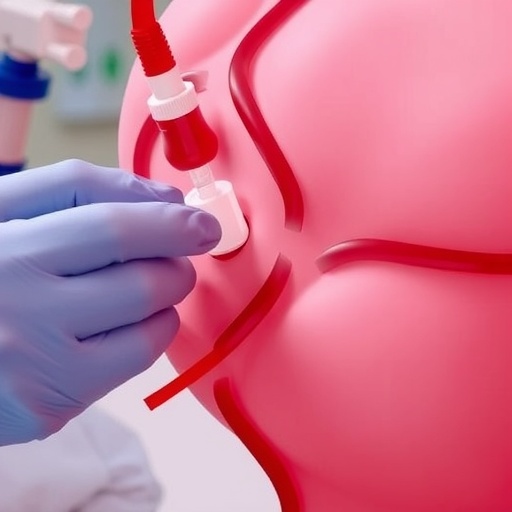
Recent advancements in medical technology have made venovenous extracorporeal membrane oxygenation (VV-ECMO) a critical intervention for patients suffering from severe respiratory and cardiac failure. As clinicians increasingly utilize this sophisticated technique, the significance of the cannulation configuration in VV-ECMO has come to the forefront of academic research. A groundbreaking study published in the Annals of Biomedical Engineering by Xi, Li, and Wang et al. explores how various cannulation configurations affect hemodynamic characteristics and the risks of hemolysis in patients undergoing this life-saving intervention.
At its core, VV-ECMO operates by temporarily diverting blood from a patient’s circulatory system, oxygenating it externally through a membrane oxygenator, and returning it to the body. This support system is typically employed in scenarios where conventional interventions, such as mechanical ventilation, prove inadequate. The focus of Xi et al.’s research delves deeply into the pivotal role that the configuration of venous cannulation plays in this process, which is essential for optimizing patient outcomes.
The researchers employed a combination of computational fluid dynamics and clinical evaluation to assess how different cannulation configurations influence blood flow dynamics. This approach allowed them to uncover intricate relationships between cannulation placements and the ensuing hemodynamic performance. These findings not only contribute to the understanding of VV-ECMO mechanics but also offer practical insights that could enhance patient management strategies.
One of the key revelations of the study is the identification of specific configurations that demonstrated superior hemodynamic stability and reduced risks of complications. For instance, the placement of the arterial and venous cannulas at strategic anatomical sites has been shown to minimize turbulence and shear stress, which are often precursors to hemolysis. The implications of these findings are profound, as hemolysis—divided red blood cell destruction—can lead to serious consequences, including anemia and organ dysfunction.
Moreover, Xi et al. observed that configurations involving dual-lumen cannulas offered distinct advantages over traditional dual-cannula setups. By effectively reducing blood stagnation and enhancing blood mixing, these advanced designs foster improved oxygen delivery and tissue perfusion, essential components in the critical care environment. As such, this research underscores the need for ongoing innovation in cannula design and placement techniques.
The study also explores the significance of patient-specific factors, such as anatomical variations and underlying conditions, that influence the optimal choice of cannulation configuration. By adopting a personalized approach, clinicians can better tailor VV-ECMO therapies to individual patient needs, potentially leading to enhanced outcomes. This focus on personalized medicine resonates with current trends in healthcare, emphasizing the importance of individualized treatment plans.
In addition to the direct clinical implications, the research presents a compelling case for further exploration into the optimization of VV-ECMO practices. As the prevalence of conditions requiring ECMO support continues to rise globally, understanding the nuances of cannulation techniques will become increasingly vital. This knowledge will ultimately pave the way for evolving guidelines and best practices for healthcare providers.
The paper’s discussions also extend to the educational implications for healthcare professionals involved in ECMO management. By disseminating knowledge about the various factors influencing cannulation strategies, the research aims to foster a more informed community of practitioners. Enhanced understanding can lead to improved training programs and better-equipped medical teams capable of managing complex ECMO scenarios.
In conclusion, the findings by Xi et al. highlight the essential nature of accurately configuring venous cannulation in VV-ECMO procedures. Their research has sparked meaningful conversations about improving patient outcomes in critical care settings through innovative strategies and technologies. As the field of ECMO continues to evolve, the insights gained from this study will undoubtedly influence future research and clinical practices, ensuring that patient safety and efficacy remain at the forefront of care in respiratory and cardiac support.
The exploration of cannulation configuration in VV-ECMO by Xi and colleagues not only redefines existing paradigms but also encourages a robust dialogue among clinicians, engineers, and researchers. Their contributions serve as a steppingstone toward enhanced methodologies that will ensure better healthcare delivery for patients relying on this life-saving intervention.
As further studies and clinical trials validate these findings, the healthcare community is encouraged to embrace these insights, leading to continuous improvement in the techniques employed in ECMO therapy. Collectively, these steps promise to redefine patient care standards in the high-stakes world of critical medicine.
With research like Xi et al.’s paving the way for future innovations, the potential to enhance outcomes and reduce complications during ECMO interventions is brighter than ever. As the field looks ahead, there is hope that such advancements will usher in a new era of precision medicine, ultimately saving countless lives and improving the quality of care for patients with severe cardiac and respiratory issues.
Xi, Y., Li, Y., Wang, H. et al. The Impact of Venovenous Extracorporeal Membrane Oxygenation Cannulation Configuration on Hemodynamic Characteristics and Risks of Hemolysis.
Ann Biomed Eng (2025). https://doi.org/10.1007/s10439-025-03862-4
Cite Scienmag News
Audrey Campbell. (October 11, 2025). How ECMO Cannulation Shapes Hemodynamics and Hemolysis Risks. Scienmag. https://scienmag.com/how-ecmo-cannulation-shapes-hemodynamics-and-hemolysis-risks/
Audrey Campbell. "How ECMO Cannulation Shapes Hemodynamics and Hemolysis Risks." Scienmag, 11 October 2025, https://scienmag.com/how-ecmo-cannulation-shapes-hemodynamics-and-hemolysis-risks/. Accessed 4 September 2026.
Audrey Campbell. "How ECMO Cannulation Shapes Hemodynamics and Hemolysis Risks." Scienmag. October 11, 2025. https://scienmag.com/how-ecmo-cannulation-shapes-hemodynamics-and-hemolysis-risks/


