
Sunday, March 22, 2026
Science
No Result
View All Result
  • Login
  • HOME
  • SCIENCE NEWS
  • CONTACT US
  • HOME
  • SCIENCE NEWS
  • CONTACT US
No Result
View All Result
Scienmag
No Result
View All Result
Home Science News Chemistry

How does superglue work, and what the heck is electroadhesion? (video)

July 15, 2024
in Chemistry
Reading Time: 2 mins read
0
How does superglue work, and what the heck is electroadhesion? (video)
65
SHARES
595
VIEWS
Share on FacebookShare on Twitter
ADVERTISEMENT

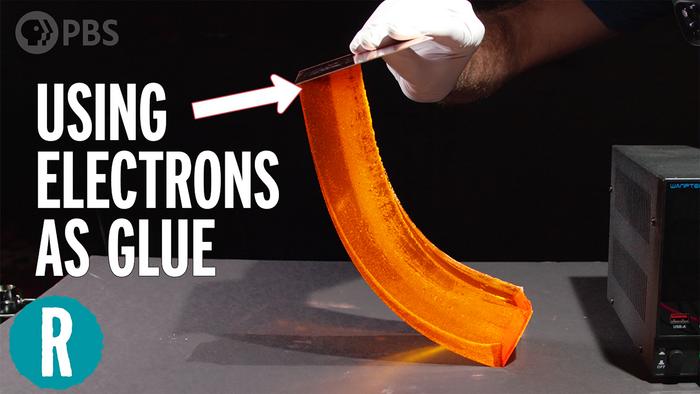
WASHINGTON, July 15, 2024 — How would you stick a slice of banana to a sheet of copper? Until a few months ago, you couldn’t. But a new discovery called “hard-soft electroadhesion” enables chemists to stick almost any hydrogel to almost any metal, using nothing but an electric current. And you can unstick the materials simply by reversing the current. Recently reported in ACS Central Science, this astonishingly general phenomenon works with a wide variety of gels (including fruits, vegetables, meat and fish) and conductors (including metals and graphite). Join our host George as he attempts to replicate electroadhesion in his basement and tries to discover what — if anything — this remarkable phenomenon shares with superglue.

How does superglue work, and what the heck is electroadhesion? (video)

Credit: The American Chemical Society.

WASHINGTON, July 15, 2024 — How would you stick a slice of banana to a sheet of copper? Until a few months ago, you couldn’t. But a new discovery called “hard-soft electroadhesion” enables chemists to stick almost any hydrogel to almost any metal, using nothing but an electric current. And you can unstick the materials simply by reversing the current. Recently reported in ACS Central Science, this astonishingly general phenomenon works with a wide variety of gels (including fruits, vegetables, meat and fish) and conductors (including metals and graphite). Join our host George as he attempts to replicate electroadhesion in his basement and tries to discover what — if anything — this remarkable phenomenon shares with superglue.

Reactions is a video series produced by the American Chemical Society and PBS Digital Studios. Subscribe to Reactions at and follow us on X, formerly Twitter @ACSReactions.

The American Chemical Society (ACS) is a nonprofit organization chartered by the U.S. Congress. ACS’ mission is to advance the broader chemistry enterprise and its practitioners for the benefit of Earth and all its people. The Society is a global leader in promoting excellence in science education and providing access to chemistry-related information and research through its multiple research solutions, peer-reviewed journals, scientific conferences, eBooks and weekly news periodical Chemical & Engineering News. ACS journals are among the most cited, most trusted and most read within the scientific literature; however, ACS itself does not conduct chemical research. As a leader in scientific information solutions, its CAS division partners with global innovators to accelerate breakthroughs by curating, connecting and analyzing the world’s scientific knowledge. ACS’ main offices are in Washington, D.C., and Columbus, Ohio.

To automatically receive news releases from the American Chemical Society, contact newsroom@acs.org.

Follow us: Twitter | Facebook | Instagram



Share26Tweet16
Previous Post

When certain boys feel their masculinity is threatened, aggression ensues

Next Post

Wyss Institute research collaboration awarded ARPA-H agreement to develop disease-agnostic immunotherapeutic RNA platform

Related Posts

blank
Chemistry

Physicists Identify Electronic Drivers Behind Flat Band Quantum Materials

March 20, 2026
blank
Chemistry

Würzburg Chemistry Professor Claudia Höbartner Receives Prestigious Honor

March 20, 2026
blank
Chemistry

Scientists Reveal How Magnets Control Metamaterial Behavior

March 20, 2026
blank
Chemistry

Gallium-Based Liquid Metals: Pioneering Cybernetic Bridges for Human-Machine Integration

March 20, 2026
blank
Chemistry

Terahertz Imaging Advances Propel Real-Time, Non-Invasive Diagnostic Breakthrough

March 20, 2026
blank
Chemistry

Amino Acid Composition Controls Peptide Synthesis Aggregation

March 20, 2026
Next Post
The Wyss Institute's ARPA-H team

Wyss Institute research collaboration awarded ARPA-H agreement to develop disease-agnostic immunotherapeutic RNA platform

  • Mothers who receive childcare support from maternal grandparents show more parental warmth, finds NTU Singapore study

    Mothers who receive childcare support from maternal grandparents show more parental warmth, finds NTU Singapore study

    27627 shares
    Share 11047 Tweet 6905
  • University of Seville Breaks 120-Year-Old Mystery, Revises a Key Einstein Concept

    1029 shares
    Share 412 Tweet 257
  • Bee body mass, pathogens and local climate influence heat tolerance

    671 shares
    Share 268 Tweet 168
  • Researchers record first-ever images and data of a shark experiencing a boat strike

    535 shares
    Share 214 Tweet 134
  • Groundbreaking Clinical Trial Reveals Lubiprostone Enhances Kidney Function

    520 shares
    Share 208 Tweet 130
Science

Embark on a thrilling journey of discovery with Scienmag.com—your ultimate source for cutting-edge breakthroughs. Immerse yourself in a world where curiosity knows no limits and tomorrow’s possibilities become today’s reality!

RECENT NEWS

  • UK Study Reveals No Additional Advantage of Surfactant Therapy in Severe Bronchiolitis Cases in Infants
  • Social Isolation Lessons from Nursing Home COVID-19 Relatives
  • Pseudoexfoliation Syndrome in Northwest Ethiopia Cataract Patients
  • Bridging Generations: Talking Advance Care Planning Together

Categories

  • Agriculture
  • Anthropology
  • Archaeology
  • Athmospheric
  • Biology
  • Biotechnology
  • Blog
  • Bussines
  • Cancer
  • Chemistry
  • Climate
  • Earth Science
  • Editorial Policy
  • Marine
  • Mathematics
  • Medicine
  • Pediatry
  • Policy
  • Psychology & Psychiatry
  • Science Education
  • Social Science
  • Space
  • Technology and Engineering

Subscribe to Blog via Email

Enter your email address to subscribe to this blog and receive notifications of new posts by email.

Join 5,191 other subscribers

© 2025 Scienmag - Science Magazine

Welcome Back!

Login to your account below

Forgotten Password?

Retrieve your password

Please enter your username or email address to reset your password.

Log In
No Result
View All Result
  • HOME
  • SCIENCE NEWS
  • CONTACT US

© 2025 Scienmag - Science Magazine

Discover more from Science

Subscribe now to keep reading and get access to the full archive.

Continue reading