


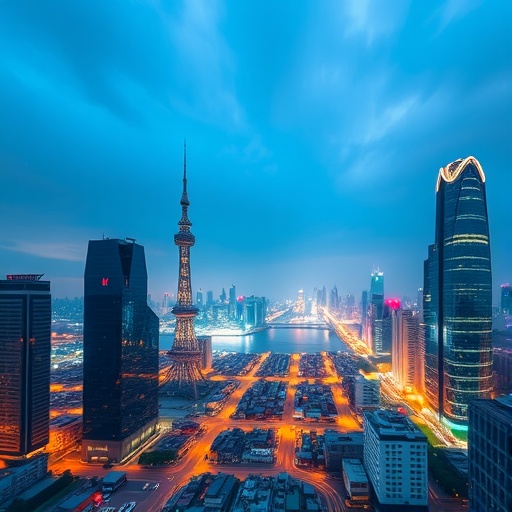
China’s biggest urban clusters are becoming the frontline of a global environmental experiment: how can densely populated regions remain resilient to shocks while producing economic value with fewer carbon emissions? A new study by Feng, Lin, Li and colleagues examines that question across China’s major urban agglomerations, focusing on the relationship between urban resilience and carbon emission efficiency. Published in Humanities and Social Sciences Communications, the research explores whether cities that are better able to withstand disruption are also more capable of managing energy, infrastructure and economic activity without generating excessive greenhouse-gas emissions.
The question is increasingly urgent because urban agglomerations concentrate almost everything that drives modern development. They bring together factories, offices, transport networks, energy systems, housing and millions of residents within connected metropolitan regions. This concentration can create powerful economies of scale, but it can also intensify pollution, congestion, resource demand and vulnerability to cascading failures. A disruption in one city can affect supply chains, electricity use, employment and transportation across an entire cluster. At the same time, policies designed to cut carbon emissions may influence industrial competitiveness, public services and the ability of cities to respond to crises.
The study’s central concept, urban resilience, refers to the capacity of a city or metropolitan system to absorb disturbances, maintain essential functions, recover after shocks and adapt to changing conditions. Resilience is broader than emergency response. It can include the reliability of infrastructure, the diversity of the economy, the quality of public services, the strength of innovation systems and the ability of institutions to coordinate action. A resilient urban agglomeration is not simply one that returns to normal after a flood, pandemic or energy shortage; it is one that can learn from disruption and reorganize itself to perform better in the future.
Carbon emission efficiency, the second major concept in the research, measures how effectively an economy generates output while limiting carbon dioxide emissions. In technical terms, it considers the relationship between economic production and carbon inputs, often while accounting for energy consumption and undesirable environmental outputs. Two cities may produce similar economic value but emit very different quantities of carbon because of differences in industrial structure, technology, energy sources, transportation systems and environmental regulation. Higher carbon emission efficiency generally indicates that a region is obtaining more economic and social value from each unit of energy and carbon released.
The researchers examine how these two dimensions interact through the idea of coupling coordination. In this context, “coupling” describes the degree to which separate systems influence one another, while “coordination” indicates whether they are developing in a balanced and mutually supportive way. A city could be highly resilient but carbon-intensive, relying on energy-heavy infrastructure and polluting industries to maintain stability. Another could achieve relatively low emissions while remaining fragile because of weak public services, limited economic diversity or inadequate transport and energy networks. Coupling coordination analysis is designed to distinguish between these situations and to reveal whether resilience and low-carbon development are advancing together.
This perspective matters because climate policy is often discussed as if emissions reduction and urban stability were competing goals. The study instead places them within the same analytical framework. Cleaner energy, efficient buildings, modern public transport and circular manufacturing can reduce emissions while strengthening the reliability and adaptability of urban systems. However, the transition can also create short-term risks if carbon-intensive industries close abruptly, workers lack alternative employment or communities face higher energy costs. Understanding the relationship between resilience and carbon efficiency therefore requires more than counting emissions; it requires examining how environmental, economic and social systems interact over space and time.
China’s major urban agglomerations provide an especially revealing setting for this analysis. These regions differ sharply in economic development, industrial specialization, geography, population density and energy structure. Coastal clusters are deeply integrated into international trade and advanced manufacturing, while inland regions may contain major resource industries, rapidly expanding cities and large infrastructure networks. Some metropolitan areas have access to strong research institutions and investment in clean technology; others face greater pressure from heavy industry, energy demand or uneven public services. Such contrasts allow researchers to investigate why similar national policies may produce different outcomes from one urban cluster to another.
The “driving mechanisms” highlighted by the research refer to the forces that may explain these differences. Potential drivers include technological innovation, industrial upgrading, energy efficiency, government investment, environmental regulation, digital infrastructure, population mobility and regional cooperation. Innovation can improve production processes and support renewable energy, while industrial restructuring can shift economies away from high-emission activities. Transport integration may reduce duplicated infrastructure and encourage public transit, but rapid expansion can also increase construction-related emissions. Regional governance is equally important because air pollution, electricity systems, water supplies and commuting patterns do not stop at administrative borders.
By placing urban resilience and carbon emission efficiency side by side, the study offers a framework for identifying metropolitan regions that are advancing on both fronts, as well as those where progress is unbalanced. That distinction could be valuable for policymakers. Regions with strong resilience but weak carbon efficiency may need cleaner industrial technologies and stricter energy management. Regions with relatively efficient emissions performance but limited resilience may require investment in hospitals, transport connections, digital networks, disaster preparedness and social protection. Areas with weaknesses in both dimensions may benefit from coordinated long-term planning rather than isolated projects that solve one problem while worsening another.
The broader message is that the low-carbon city of the future cannot be designed as a collection of separate targets. Emissions, economic security, infrastructure reliability and social well-being form a connected urban system. If cities are treated only as sources of carbon pollution, policies may overlook the social and economic conditions needed for a stable transition. If resilience is pursued without environmental limits, urban systems may become more robust in the short term while deepening the climate pressures that threaten them in the long term. The research by Feng, Lin, Li and colleagues brings these challenges into a single conversation, offering a way to assess whether China’s urban agglomerations are not merely growing, but becoming cleaner, more adaptive and better prepared for an uncertain future.
Cite Scienmag News
Sloane Callahan. (August 13, 2026). How China’s Major Urban Agglomerations Link Urban Resilience and Carbon Efficiency. Scienmag. https://scienmag.com/how-chinas-major-urban-agglomerations-link-urban-resilience-and-carbon-efficiency/
Sloane Callahan. "How China’s Major Urban Agglomerations Link Urban Resilience and Carbon Efficiency." Scienmag, 13 August 2026, https://scienmag.com/how-chinas-major-urban-agglomerations-link-urban-resilience-and-carbon-efficiency/. Accessed 3 September 2026.
Sloane Callahan. "How China’s Major Urban Agglomerations Link Urban Resilience and Carbon Efficiency." Scienmag. August 13, 2026. https://scienmag.com/how-chinas-major-urban-agglomerations-link-urban-resilience-and-carbon-efficiency/


