

The function of non-coding RNA in the cell has long been a mystery to researchers. Unlike coding RNA, non-coding RNA does not produce proteins – yet it exists in large quantities. A research team from the University of Göttingen has now discovered an important function of antisense RNA (asRNA): the researchers found that asRNA acts as a “superhighway” in cell transport and thus accelerates gene expression. The results were published in Nature.

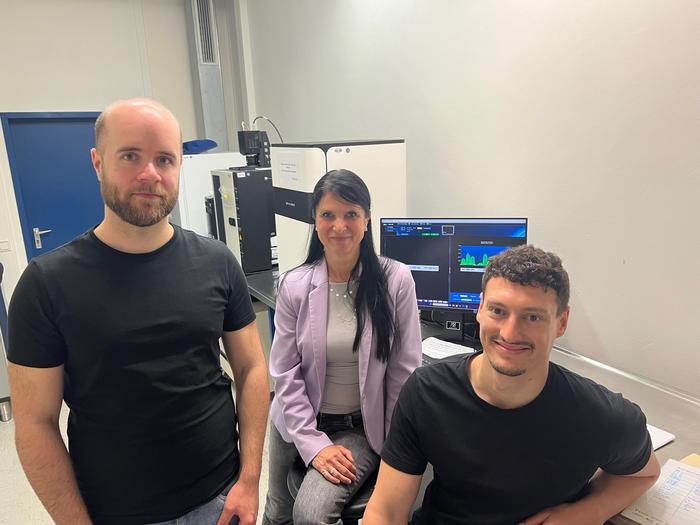
Credit: H Krebber
The function of non-coding RNA in the cell has long been a mystery to researchers. Unlike coding RNA, non-coding RNA does not produce proteins – yet it exists in large quantities. A research team from the University of Göttingen has now discovered an important function of antisense RNA (asRNA): the researchers found that asRNA acts as a “superhighway” in cell transport and thus accelerates gene expression. The results were published in Nature.
RNA (ribonucleic acid) plays a central role in the translation of DNA information into proteins. There are different types of RNA, one of which is known as messenger RNA (mRNA). Messenger RNA is a type of coding RNA and its job is to transmit the building instructions for proteins from the DNA in the cell nucleus out into the cytoplasm, where other cell components translate them into proteins. In addition to coding RNA, there are large quantities of non-coding RNA. Much of the non-coding RNA is produced as the complementary strand to mRNA and is therefore referred to as antisense RNA (asRNA). Their function has been unclear for a long time. “It seemed unbelievable to me that a cell would produce RNAs without a purpose,” says Professor Heike Krebber from Göttingen University’s Institute of Microbiology and Genetics. “This is contrary to nature.”
Krebber’s team discovered that asRNA combines with mRNA, which is then preferentially transported from the cell nucleus into the cytoplasm. This means that the cell translates the information from the mRNA into proteins faster than would be the case without asRNA. Therefore, asRNA serves as a “booster” for gene expression. This is necessary for the cell in many situations, for example when confronted with harmful environmental conditions or stress. This work is the next step from the team’s earlier basic research, also published in Nature, which showed that mRNAs activated under stress are no longer subject to quality control.
The new research findings about asRNAs solve the long-standing question of why the cell sometimes produces large quantities of asRNA. “In biology, this is particularly striking because the cell expends a lot of energy on asRNA production,” explains Krebber. The mechanism that has now been discovered explains how cells can react abruptly to external influences to produce the necessary proteins immediately and in large quantities in order to adapt to environmental conditions or, for example, to enter a certain stage of development. “This new understanding brings asRNAs into the focus of the question of how diseases develop and how they can be combated,” says Krebber.
Original publication: Coban, I. et al. dsRNA formation leads to preferential nuclear export and gene expression. Nature 2024. Doi: 10.1038/s41586-024-07576-w
Contact:
Professor Heike Krebber
University of Göttingen
Göttingen Center for Molecular Biosciences GZMB, and
Institute of Microbiology and Genetics – Department of Molecular Genetics
Grisebachstraße 8, 37077 Göttingen
Telephone: (0551) 39-23801
Email: heike.krebber@biologie.uni-goettingen.de
www.img.bio.uni-goettingen.de/Krebber-lab_homepage.html
The function of non-coding RNA in the cell has long been a mystery to researchers. Unlike coding RNA, non-coding RNA does not produce proteins – yet it exists in large quantities. A research team from the University of Göttingen has now discovered an important function of antisense RNA (asRNA): the researchers found that asRNA acts as a “superhighway” in cell transport and thus accelerates gene expression. The results were published in Nature.
RNA (ribonucleic acid) plays a central role in the translation of DNA information into proteins. There are different types of RNA, one of which is known as messenger RNA (mRNA). Messenger RNA is a type of coding RNA and its job is to transmit the building instructions for proteins from the DNA in the cell nucleus out into the cytoplasm, where other cell components translate them into proteins. In addition to coding RNA, there are large quantities of non-coding RNA. Much of the non-coding RNA is produced as the complementary strand to mRNA and is therefore referred to as antisense RNA (asRNA). Their function has been unclear for a long time. “It seemed unbelievable to me that a cell would produce RNAs without a purpose,” says Professor Heike Krebber from Göttingen University’s Institute of Microbiology and Genetics. “This is contrary to nature.”
Krebber’s team discovered that asRNA combines with mRNA, which is then preferentially transported from the cell nucleus into the cytoplasm. This means that the cell translates the information from the mRNA into proteins faster than would be the case without asRNA. Therefore, asRNA serves as a “booster” for gene expression. This is necessary for the cell in many situations, for example when confronted with harmful environmental conditions or stress. This work is the next step from the team’s earlier basic research, also published in Nature, which showed that mRNAs activated under stress are no longer subject to quality control.
The new research findings about asRNAs solve the long-standing question of why the cell sometimes produces large quantities of asRNA. “In biology, this is particularly striking because the cell expends a lot of energy on asRNA production,” explains Krebber. The mechanism that has now been discovered explains how cells can react abruptly to external influences to produce the necessary proteins immediately and in large quantities in order to adapt to environmental conditions or, for example, to enter a certain stage of development. “This new understanding brings asRNAs into the focus of the question of how diseases develop and how they can be combated,” says Krebber.
Original publication: Coban, I. et al. dsRNA formation leads to preferential nuclear export and gene expression. Nature 2024. Doi: 10.1038/s41586-024-07576-w
Contact:
Professor Heike Krebber
University of Göttingen
Göttingen Center for Molecular Biosciences GZMB, and
Institute of Microbiology and Genetics – Department of Molecular Genetics
Grisebachstraße 8, 37077 Göttingen
Telephone: (0551) 39-23801
Email: heike.krebber@biologie.uni-goettingen.de
www.img.bio.uni-goettingen.de/Krebber-lab_homepage.html
Journal
Nature
Method of Research
Experimental study
Subject of Research
Not applicable
Article Title
dsRNA formation leads to preferential nuclear export and gene expression
Article Publication Date
19-Jun-2024

