


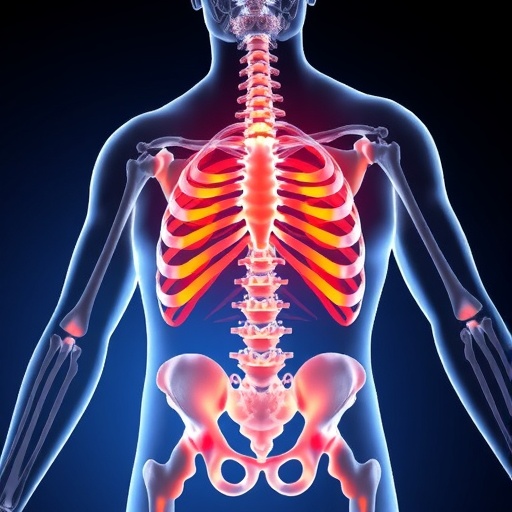
In a groundbreaking study set to shift paradigms in bone biology and metabolic research, scientists have uncovered a novel mechanism underlying obesity-related bone loss, implicating bone marrow adipocytes as active drivers of immune suppression and osteoclastogenesis. Contrary to the longstanding belief that increased body weight fortifies the skeleton through mechanical loading, this new evidence elucidates how obesity-induced expansion of fat within the bone marrow microenvironment orchestrates immune signaling pathways that culminate in accelerated bone resorption.
Central to this discovery is the identification of the MCP-1 chemokine as a pivotal signaling molecule secreted by expanded bone marrow adipocytes in obese mice. Elevated MCP-1 levels recruit and modulate the phenotype of myeloid immune cells, steering them toward an immunosuppressive state characterized by the expression of programmed death-ligand 1 (PD-L1). These PD-L1-positive myeloid cells create a bone marrow niche that suppresses T-cell activity, thereby disrupting the delicate immune equilibrium and fostering a microenvironment conducive to pathological bone remodeling.
The researchers provide compelling evidence that these immunosuppressive myeloid cells interact with osteoclast precursors via the PD-1 receptor, a critical immune checkpoint molecule traditionally studied in the context of T-cell regulation. This PD-L1/PD-1 interaction uniquely promotes the differentiation and activation of osteoclasts, the specialized bone-resorbing cells responsible for degrading mineralized bone matrix. As a result, bone architecture deteriorates with notable reductions in both trabecular and cortical bone density, revealing a direct link between immune checkpoint signaling and skeletal fragility in obesity.
Remarkably, pharmacological blockade of the PD-1/PD-L1 signaling axis during early osteoclast precursor development mitigated osteoclast formation and resorptive activity, underscoring the therapeutic potential of targeting this pathway to preserve bone integrity. This facet of the study elegantly ties together immunomodulation and skeletal health, suggesting that immune checkpoint inhibitors, currently employed in oncology, might be repurposed to combat metabolic bone diseases associated with obesity.
To substantiate these findings, the team utilized genetically engineered mouse models deficient in bone marrow adipocytes. These models exhibited significantly reduced MCP-1 expression, diminished populations of PD-L1-expressing myeloid cells, and a concomitant decrease in osteoclast precursors. Importantly, despite the presence of obesity, these mice maintained superior bone microarchitecture and suppressed pathological bone resorption, firmly establishing bone marrow adipose tissue as a central regulator of immune-mediated skeletal degradation.
The study’s insights extend beyond mechanistic novelty; they illuminate the broader implications of obesity-driven bone marrow remodeling on systemic immune competence. The immunosuppressive milieu fostered by expanded bone marrow fat could partly explain the compromised vaccine responses and heightened infection susceptibility documented in obese populations. Thus, the interplay between marrow adiposity, immune regulation, and skeletal homeostasis emerges as a critical axis influencing overall health outcomes.
These findings resonate profoundly within translational medicine realms, inviting interdisciplinary exploration between immunologists, endocrinologists, and bone biologists. The demonstrated crosstalk between metabolic status and immune checkpoint pathways redefines bone marrow adipocytes not as passive fat stores but as dynamic cellular entities modulating both immunity and bone metabolism. This reconceptualization holds promise for novel interventions targeting marrow adiposity or immune checkpoints to ameliorate or prevent obesity-associated skeletal disorders.
The study, led by Dr. Clifford J. Rosen and Dr. Sergey Ryzhov at the MaineHealth Institute for Research, epitomizes cutting-edge research leveraging diet-induced obese mouse models in conjunction with sophisticated cellular and genetic tools. Their meticulous approach delineates a comprehensive causative chain linking metabolic perturbations to cellular immunodynamics and structural bone loss, published in the March 2026 issue of Bone Research.
Notably, the coupling of PD-L1-expressing myeloid cells with osteoclastogenesis marks an unprecedented discovery that bridges two traditionally distinct biological domains: immune checkpoint biology and bone remodeling. This nexus paves the way for reimagined therapeutic strategies incorporating immune modulation to protect skeletal health in metabolic disease contexts.
Experts anticipate that this paradigm shift will catalyze further research into the molecular signals emanating from bone marrow adipocytes and their systemic effects. Understanding the full spectrum of adipocyte-derived factors and their immunological targets could reveal additional nodes for intervention, optimizing therapeutic efficacy for patients burdened by obesity-related bone fragility.
The implications of this work ripple into public health strategies, emphasizing the necessity to recognize bone marrow fat as an active participant in disease pathology rather than a mere biomarker. Targeting the bone marrow microenvironment may represent a frontier in combating the dual epidemics of obesity and osteoporosis, with the potential to improve resilience against skeletal degeneration and immune dysfunction in a growing patient population.
In sum, this landmark study not only enhances our comprehension of obesity’s detrimental impact on the skeleton but also heralds a new era of integrated metabolic-immuno-skeletal research. By elucidating how marrow adipocytes modify immune checkpoints to accelerate osteoclastogenesis, it lays the scientific groundwork for therapeutic innovations that could redefine clinical management of bone health in obesity and beyond.
News Publication Date: 20-Mar-2026
Web References: DOI link
Cite Scienmag News
Daisy Hatcher. (April 24, 2026). How Bone Marrow Fat Fuels Immune Suppression and Bone Loss in Obesity. Scienmag. https://scienmag.com/how-bone-marrow-fat-fuels-immune-suppression-and-bone-loss-in-obesity/
Daisy Hatcher. "How Bone Marrow Fat Fuels Immune Suppression and Bone Loss in Obesity." Scienmag, 24 April 2026, https://scienmag.com/how-bone-marrow-fat-fuels-immune-suppression-and-bone-loss-in-obesity/. Accessed 3 September 2026.
Daisy Hatcher. "How Bone Marrow Fat Fuels Immune Suppression and Bone Loss in Obesity." Scienmag. April 24, 2026. https://scienmag.com/how-bone-marrow-fat-fuels-immune-suppression-and-bone-loss-in-obesity/


