

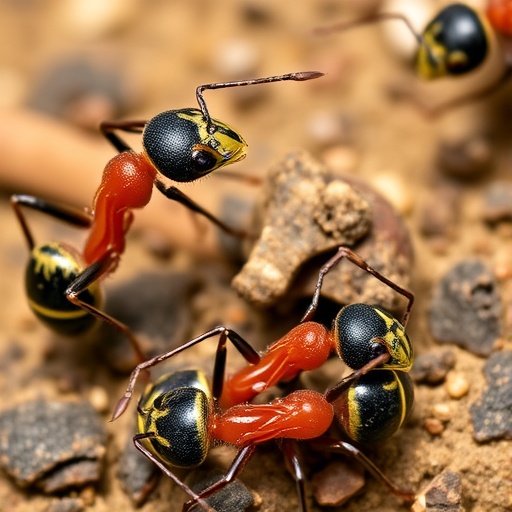
In the intricate world of ants, the ability to immediately recognize nestmates from intruders is a vital survival trait that underpins the complex social structures of their colonies. Recent groundbreaking research has revealed that ants’ nestmate recognition systems are far more pliable and adaptive than previously understood, involving a dynamic interplay of innate recognition and lifelong learning. This study, spearheaded by Daniel Kronauer and his team at Rockefeller University, provides profound insights into how ants maintain colony integrity while adapting to changing social and environmental cues, shedding light on broader principles of social behavior and evolution.
Ant colonies epitomize the extraordinary evolutionary transition from solitary existence to superorganismal cooperation. Thousands of individuals coordinate seamlessly, akin to cells within a body or immune cells defending an organism. Central to their success is the capacity to distinguish self from non-self—a principle as critical for ants defending their homes as it is for immune systems combating pathogens. This complex social recognition is mediated by subtle chemical signatures, primarily waxy compounds coating ants’ exoskeletons. Even though the basic array of chemicals is conserved across colonies, their specific ratios create unique odor profiles that ants learn to associate with their own colony.
However, these chemical cues are not static. Variations can emerge due to shifts in genetic makeup, environmental factors, or changes in neighboring colonies’ identities. Consequently, ants must possess a mechanism for continuously updating their internal recognition templates to remain adept at identifying friend from foe. This hypothesis inspired Kronauer’s laboratory, particularly postdoctoral researcher Tiphaine Bailly, to explore the flexibility of ant social recognition and the extent to which ants learn and adapt throughout their life spans.
The team utilized the clonal raider ant, Ooceraea biroi, a species notable for its asexual reproduction, which generates genetically identical individuals. This unique biology provided an experimental advantage by enabling researchers to construct colonies with ants of distinct genotypes in controlled mixtures, facilitating the observation of recognition learning and behavioral adaptation in real-time. Chemical profiling revealed that although these colonies shared the same set of chemical compounds, the precise mixture ratios varied, endowing each colony with a distinct olfactory signature.
Behavioral experiments reinforced these chemical findings. When single ants from foreign genotypes were introduced into established colonies, the resident ants consistently displayed aggression manifesting as biting, underscoring robust baseline rejection of outsiders. Yet, the researchers found the recognition system was malleable. Remarkably, young ants transplanted into foreign colonies could, over prolonged exposure, acquire their foster colony’s chemical profile and, correspondingly, their acceptance by foster nestmates. This enduring modification, reaching parity with ants born within the colony, illuminated an impressive capacity for chemical and social identity reshaping over time.
Nonetheless, this plasticity was bounded by intrinsic limitations. Ants separated from their original kin at the egg stage, despite developing new colony odors, still recognized their genetically identical siblings, indicating that experience modulates but does not erase innate genotype recognition. This dual mechanism—combining intrinsic identity recognition with experience-dependent learning—ensures colonies maintain a genetically anchored core identity while allowing flexibility to adapt to social changes.
Further probing revealed the persistence of learned tolerance required ongoing social contact. Removal from the foster colony for approximately one week resulted in the erosion of tolerance, resumption of aggressive behavior, and regression of chemical profiles toward their originals. Yet, this reversal was not immediate; tolerance persisted for several days after separation, implying the involvement of long-term olfactory memory rather than transient sensory habituation, which typically dissipates in shorter timescales ranging from minutes to hours.
Intriguingly, this social flexibility in ants draws a conceptual parallel to immune tolerance mechanisms observed in humans, wherein controlled, repeated low-level exposure to an allergen leads to diminished immune responses—a process exploited in allergy immunotherapies. While molecular pathways differ fundamentally, the analogy emphasizes convergent evolutionary themes where organisms develop ways to balance defensive barriers with necessary tolerance to complex and changing environments.
From an evolutionary perspective, these findings resonate with profound transitions from unicellularity to multicellularity. Ant colonies, functioning as superorganisms, mirror the need for cells within an organism to distinguish self from non-self to maintain cooperation and prevent parasitism. The discovery that ants continuously refine recognition throughout adulthood implies a dynamic, flexible neural system equipped to manage social complexity, rather than a rigid, genetically hardwired template alone.
This research lays essential groundwork for subsequent neurobiological studies aimed at parsing the neural circuits and molecular underpinnings that facilitate such social learning and recognition plasticity. The capacity to visualize neural activity in ants responding to nestmates versus non-nestmates opens exciting avenues for understanding how brains process social odors and mediate complex behavioral decisions underpinning colony integrity.
Ultimately, this study challenges entrenched notions of fixed social recognition templates in eusocial insects and paints a vibrant picture of learning and memory sculpting colony cohesion. The demonstrated flexibility in recognition systems enhances our understanding of cooperation’s evolutionary stability and illuminates mechanisms by which social animals reconcile genetic identity with environmental and social flux, a balance critical from ants to humans.
As ants refine who belongs within their community through both inherited and acquired cues, they model a sophisticated interplay of genetics, chemistry, experience, and neural processing. In doing so, they reaffirm that the evolution of cooperation is not merely a tale of genes but also a story of lifelong learning, adaptation, and the subtle chemistry of recognition—a story that continues to captivate and inform scientists across disciplines.
Subject of Research: Social recognition and learning mechanisms in clonal raider ants (Ooceraea biroi)
Article Title: Tolerance toward foreigners in ants requires chronic exposure for establishment but only sporadic exposure for maintenance
News Publication Date: 20-Mar-2026
Web References: 10.1016/j.cub.2026.02.041
Image Credits: Daniel Kronauer
Keywords: Ants, Nestmate recognition, Social learning, Chemical communication, Eusocial insects, Clonal raider ants, Olfactory memory, Behavioral adaptation, Superorganism, Evolution of cooperation


