

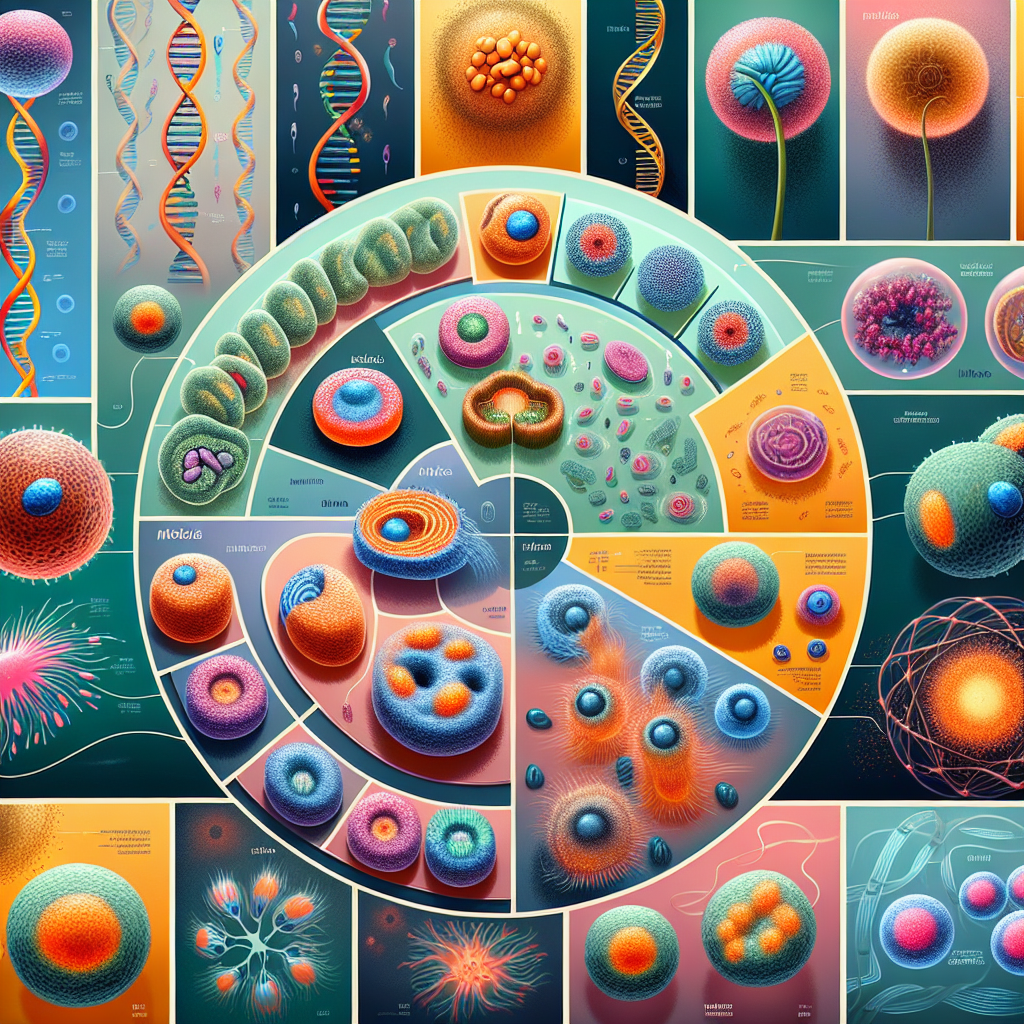
Cell division is fundamental to life, enabling growth, reproduction, and survival across all organisms, from single-celled bacteria to complex multicellular animals. While animals and fungi share a common eukaryotic ancestry, their mechanisms of cell division, particularly mitosis, have diverged significantly, raising intriguing evolutionary questions.
Cell division is fundamental to life, enabling growth, reproduction, and survival across all organisms, from single-celled bacteria to complex multicellular animals. While animals and fungi share a common eukaryotic ancestry, their mechanisms of cell division, particularly mitosis, have diverged significantly, raising intriguing evolutionary questions.
Animals typically undergo open mitosis, where the nuclear envelope disassembles during cell division, while fungi exhibit closed mitosis, maintaining an intact nuclear envelope. The evolutionary reasons behind these divergent strategies remain largely unexplored, making it a compelling area of research for scientists seeking to understand the underlying biological principles.
In a new study, Omaya Dudin’s group at EPFL, Gautam Dey and Yannick Schwab’s team at EMBL Heidelberg investigated this phenomenon in the Ichthyosporea, a group of marine protists that are closely related to both animals and fungi (a protist is a eukaryotic organism that is not an animal, land plant, or fungus). Dudin is an expert in Ichthyosporean life cycles, while Dey’s research focuses on the evolutionary origins of nuclear organization and cell division
The scientists focused on two species of Ichthyosporea: Sphaeroforma arctica and Chromosphaera perkinsii. The research combined comparative genomics and advanced imaging techniques, such as Expansion Microscopy and Volume Electron Microscopy, to examine how these species’ life cycles influenced their modes of cell division. S. arctica was observed to undergo closed mitosis, similar to fungi, while C. perkinsii performed open mitosis, akin to animal cells.
“By studying diversity across organisms and reconstructing how things evolved, we can begin to ask if there are universal rules that underlie how such fundamental biological processes work,” says Dey.
The study found a clear link between the life cycle stages of Ichthyosporea and their mitotic strategies. Species with multinucleate stages, where cells contain multiple nuclei, tended to undergo closed mitosis. Conversely, species with predominantly mononucleate stages – single nuclei per cell – used open mitosis. This correlation suggests that the evolutionary path of cell division in animals and fungi may have been shaped by their respective life cycle needs.
“Ichthyosporean development displays remarkable diversity,” says Dudin. “On one hand, several species exhibit developmental patterns similar to those of early insect embryos, featuring multinucleated stages and synchronized cellularization. On the other hand, C. perkinsii undergoes cleavage division, symmetry breaking, and forms multicellular colonies with distinct cell types, similar to the ‘canonical view’ of early animal embryos. This diversity not only helps in understanding the path to animals but also offers a fascinating opportunity for comparative embryology outside of animals, which is, in itself, very exciting.”
The findings suggest that the way animal cells divide might have evolved long before the emergence of animals themselves. Meanwhile, the mode of mitosis appears to be intricately connected to the organism’s life cycle, which opens up new perspectives on the evolution of cell division mechanisms in eukaryotes.
Other contributors
- EMBL Electron Microscopy Core Facility
- Ruđer Bošković Institute (RBI)
- University of Groningen
Reference
Hiral Shah, Marine Olivetta, Chandni Bhickta, Paolo Ronchi, Monika Trupinić, Eelco C. Tromer, Iva M. Tolić, Yannick Schwab, Omaya Dudin, Gautam Dey. Life-cycle-coupled evolution of mitosis in close relatives of animals. Nature 22 May 2024. DOI: 10.1038/s41586-024-07430-z
Journal
Nature
Article Title
Life-cycle-coupled evolution of mitosis in close relatives of animals
Article Publication Date
22-May-2024


