


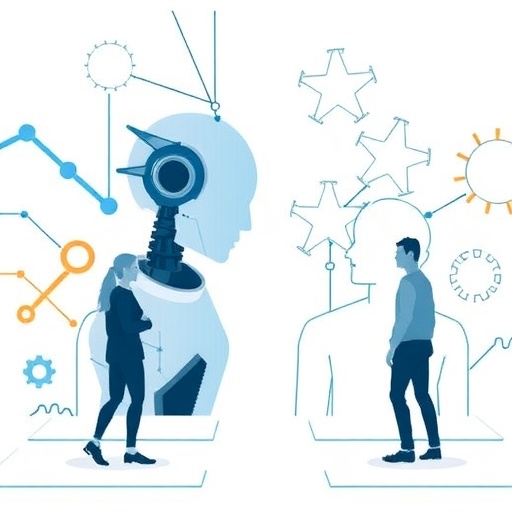
In a groundbreaking study published in the Journal of Knowledge Management, researchers at the University of East London have unveiled compelling evidence that artificial intelligence (AI) does not merely serve as a replacement for human cognition but rather functions as a powerful augmentation of it. This perspective challenges the widespread narrative that AI’s ultimate role is to supplant human intellect and decision-making. Instead, the research highlights how AI systems can amplify human thinking by accelerating data processing and pattern recognition, while leaving critical interpretative and ethical judgments firmly within the human domain.
The study takes a comprehensive approach, synthesizing insights from ninety research papers spanning the last decade. This extensive systematic review underscores the emergent consensus within the scientific community: the fusion of AI’s analytical prowess with human creativity and experiential knowledge produces superior outcomes compared to either working independently. In fields as varied as healthcare, education, organizational management, and scientific research, this symbiotic relationship enhances problem-solving capabilities and fosters innovation.
Central to the paper’s thesis is the conceptualization of AI as a dynamic partner in knowledge ecosystems. Unlike traditional computational tools that merely automate routine tasks, advanced AI leverages machine learning algorithms to identify intricate patterns within vast datasets. This capability enables rapid generation of insights that would be impractical for unaided human analysts to discern. Nevertheless, the nuanced interpretation of these insights—considering cultural, social, and ethical contexts—remains an inherently human responsibility, demanding critical thinking and moral sensitivity.
The researchers particularly emphasize the importance of maintaining human oversight in AI deployment, especially in environments where decisions carry significant consequences. High-stakes domains such as clinical diagnostics, legal judgments, and policy formation require mechanisms that ensure AI outputs are transparent, unbiased, and subject to rigorous human scrutiny. Without such safeguards, there is a risk of perpetuating systemic biases or making ethically questionable choices based on incomplete or misinterpreted data.
Dr. Susan Akinwalere, a co-author of the study, articulates this perspective succinctly: “The real promise of AI is not that it replaces human intelligence, but that it helps people work through complexity faster while leaving judgment, meaning and responsibility in human hands.” Her observation encapsulates the ethical imperative underpinning the partnership paradigm, advocating for AI design philosophies that prioritize augmenting human capabilities and respecting human agency.
Moreover, the paper advocates for institutional frameworks that foster the development of “knowledge ecosystems,” where AI technologies and human actors co-evolve symbiotically. This approach calls for integrating AI tools into organizational processes in a manner that promotes continuous learning, collaboration, and adaptive decision-making. By viewing AI as a collaborator rather than a competitor, institutions can harness its full potential without forsaking essential human qualities like empathy, intuition, and ethical judgment.
Co-author Professor Kirk Chang elaborates on this human-centric approach, emphasizing the critical role of interpretive frameworks in rendering AI-generated knowledge meaningful: “AI can help us process information at a scale that was not possible before, but knowledge only becomes meaningful when people interpret it, question it and apply it responsibly.” This statement underscores that data and analytics alone do not constitute knowledge; instead, knowledge emerges through human engagement with information.
The study’s systematic review methodology lends robust empirical support to these assertions. By meticulously analyzing diverse studies covering AI applications across multiple disciplines, the authors provide a nuanced understanding of how AI-human collaboration manifests in practice. This breadth of evidence highlights consistent benefits where AI handles data-intensive tasks while humans provide strategic oversight, creativity, and ethical considerations.
Importantly, the research also cautions against uncritical reliance on AI systems. The delegation of decision-making to opaque algorithms without sufficient human supervision can reduce accountability and obscure the rationale behind critical choices. Therefore, the authors recommend implementing rigorous governance protocols that ensure AI transparency, fairness, and ethical compliance. Such protocols might include human-in-the-loop models, ethical audits, and continual monitoring to detect and correct biases.
This balanced view of AI’s role in knowledge production and management signals a shift in how society perceives intelligent machines. Rather than viewing AI as an autonomous agent capable of supplanting human intellect, the study reframes AI as an indispensable tool that complements and extends human cognitive capacities. This reframing aligns with emerging trends in AI ethics and human-centered design, advocating for technologies that empower rather than replace people.
Beyond theoretical implications, the findings carry practical significance for decision-makers across sectors. For healthcare providers, integrating AI-enhanced diagnostics with physician expertise can improve patient outcomes. In education, AI-driven analytics can assist teachers in tailoring instruction while maintaining human mentorship. For businesses, AI can optimize operations while leaders shape strategy and ethical standards. Across all domains, the marriage of AI and human intelligence fosters resilience and adaptability in complex, rapidly changing environments.
Ultimately, this comprehensive study signals a paradigm where the future of knowledge ecosystems depends on cultivating symbiotic relationships between human intelligence and AI. By embracing this partnership, society can leverage technological advances to navigate complexity, drive innovation, and safeguard ethical principles, ensuring that technological progress enhances rather than diminishes human dignity and agency.
News Publication Date: 25-Mar-2026
Web References: Journal of Knowledge Management article
References: Akinwalere, Susan, and Kirk Chang, “The symbiotic roles of artificial intelligence and human intelligence in advancing knowledge ecosystem,” Journal of Knowledge Management. DOI: 10.1108/JKM-03-2025-0362.
Cite Scienmag News
Blake Davidson. (April 21, 2026). How AI Excels When Collaborating with Humans—Not Replacing Them. Scienmag. https://scienmag.com/how-ai-excels-when-collaborating-with-humans-not-replacing-them/
Blake Davidson. "How AI Excels When Collaborating with Humans—Not Replacing Them." Scienmag, 21 April 2026, https://scienmag.com/how-ai-excels-when-collaborating-with-humans-not-replacing-them/. Accessed 4 September 2026.
Blake Davidson. "How AI Excels When Collaborating with Humans—Not Replacing Them." Scienmag. April 21, 2026. https://scienmag.com/how-ai-excels-when-collaborating-with-humans-not-replacing-them/


