


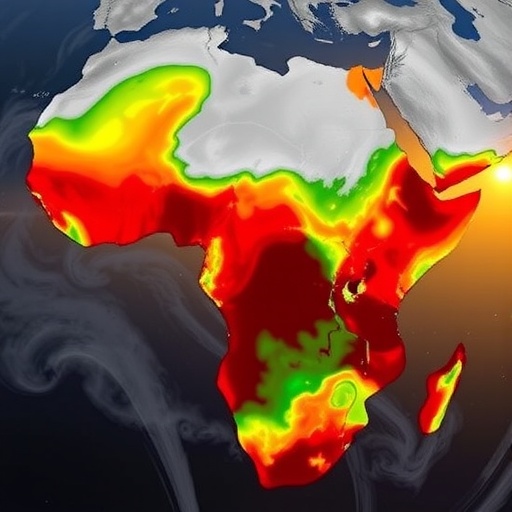
Ethiopia’s summer rains may be governed by two vast, invisible rivers of air moving high above the ground, according to a new study that links the country’s crucial Kiremt monsoon to the strength and position of the African easterly jet and the tropical easterly jet. The finding offers a sharper explanation for why rainfall can surge across broad regions of Ethiopia in some years, fail dramatically in others, and linger later into the season than expected. It also points to a practical target for improving forecasts: weather and climate models may need to represent not only how fast these atmospheric jets blow, but also precisely where their cores are located.
The Kiremt season, which runs from June through September, supplies much of Ethiopia’s annual rainfall. Its timing and intensity influence crop planting and harvests, reservoir levels, hydropower generation, pasture conditions, and the risk of floods and drought. Yet seasonal rainfall is notoriously difficult to predict because it depends on an intricate interaction between surface heating, moisture transport, rising air, and circulation systems spanning thousands of kilometres. The new analysis, published in Theoretical and Applied Climatology, identifies the African easterly jet, or AEJ, and the tropical easterly jet, or TEJ, as central pieces of that system.
Jets in the atmosphere are narrow corridors of unusually rapid wind. They do not behave like rigid tubes; instead, they shift in latitude, strengthen and weaken, and interact with clouds, moisture, and vertical motion. The TEJ examined in the study is an upper-tropospheric current near the 200-hectopascal pressure level, roughly 12 to 13 kilometres above Earth’s surface. The AEJ is a mid-tropospheric current near 600 hectopascals, approximately four kilometres above the ground. Both flow from east to west, but their different heights mean that they influence rainfall through different physical pathways.
The researchers combined high-resolution rainfall observations from Ethiopia’s Enhancing National Climate Services, or ENACTS, dataset with wind and specific-humidity fields from the ERA5 global atmospheric reanalysis. They then used K-means clustering, a statistical technique that groups observations with similar patterns, to divide Ethiopia into rainfall regimes and examine wet and dry conditions within them. This regional approach matters because the country’s complex topography, including highlands, rift valleys, and western lowlands, produces substantial local differences in rainfall. A circulation pattern that brings moisture to one region may not have the same effect elsewhere.
The strongest rainfall signal came from the tropical easterly jet. The TEJ reaches its greatest intensity in July, when winds exceed 25 metres per second, and its core moves to its northernmost position, around 12.5 to 13 degrees north. Periods with a stronger TEJ were associated with increased rainfall across all the study’s rainfall regimes. The reported correlations between upper-level easterly wind intensity and rainfall ranged from about −0.4 to −0.6. The negative sign does not mean that stronger easterly flow suppresses rain. Rather, it reflects the way the study defined the wind variable: as the easterly wind becomes stronger, its zonal wind value becomes more negative, while rainfall increases.
The physical explanation lies in what happens above developing storms. A vigorous TEJ can help establish upper-level divergence, meaning air spreads outward near the top of the troposphere. When air diverges aloft, air from below can rise to replace it. Rising air cools as it expands, allowing water vapour to condense into cloud droplets and ice particles. That condensation releases latent heat, which can further energize convection and deepen storm systems. In the study’s composite analyses, wet periods were characterized by upper-level divergence and ascent in the middle troposphere, a configuration that supports persistent cloud formation and rainfall. The influence of the TEJ was especially apparent in August and appeared to delay the seasonal retreat of rainfall into September.
The mid-level African easterly jet produced a more complicated signal. In general, the AEJ becomes strongest during August and September, and stronger winds were associated with rainfall suppression, with positive correlations of approximately +0.4 to +0.6 between AEJ intensity and reduced rainfall. The researchers interpret this relationship as a sign that an intense mid-level jet can limit the inland transport of moist air and accelerate the withdrawal of the monsoon circulation. In dry periods, the atmosphere showed patterns of subsidence—air sinking from above—and moisture divergence, in which water vapour was carried away from the region rather than concentrated within it. Sinking air warms as it compresses, reducing relative humidity and making cloud growth more difficult.
But the AEJ’s location proved just as important as its speed. During some wet months, the jet shifted unusually far north, reaching approximately 14 to 16 degrees north. Instead of drying Ethiopia, this displacement was associated with widespread positive rainfall anomalies and correlations near +0.4. A northward-shifted AEJ can alter the direction and strength of mid-level moisture transport, drawing humid air farther inland. It can also increase vertical wind shear, the change in wind speed or direction with height. Wind shear is often treated as a threat to ordinary thunderstorms because it can separate updrafts from downdrafts, but in organized tropical convection it can also help storms persist, rotate, and efficiently convert atmospheric moisture into rainfall.
The study’s moisture diagnostics reinforce that interpretation. Wet months featured convergent southwesterly moisture fluxes, meaning humid air moved toward Ethiopia and accumulated in the region. Dry months instead showed moisture divergence. These patterns were not simply a matter of how much water vapour existed in the atmosphere; they depended on the winds transporting it and on vertical motions that determined whether moisture was lifted into clouds or pushed downward and away. The researchers also found circulation differences among three broad rainfall regimes: the northeastern and central rift valleys, the northwestern and western areas, and the southwestern parts of the country. Such distinctions could be valuable for local early-warning systems, because a national rainfall forecast may conceal sharply different risks between regions.
The results do not mean that the AEJ and TEJ are the only controls on Ethiopian rainfall. Ocean temperatures, El Niño–Southern Oscillation, the Indian Ocean Dipole, land heating, African monsoon circulation, and local topography can all influence the moisture supply and atmospheric stability. The study instead identifies the two jets as dynamic mechanisms that help translate large-scale climate conditions into regional rainfall. Its use of reanalysis data also comes with the usual caveats: ERA5 is a sophisticated reconstruction based on observations and a numerical weather model, but the observational network over parts of Africa remains relatively sparse. The authors made their generated and analyzed datasets available from the corresponding author upon reasonable request, while ERA5 and ENACTS rainfall data are publicly accessible through their respective providers.
The broader implication is a challenge to the next generation of forecasting systems. A model can reproduce the average position of a jet while still missing the northward or southward displacement that determines whether moisture reaches Ethiopia. It can also simulate a wind corridor with the wrong intensity, vertical structure, or seasonal timing. Those errors can cascade through the atmosphere, altering upper-level divergence, mid-level ascent, cloud organization, and rainfall totals. The authors argue that numerical weather prediction and artificial-intelligence weather and climate models should explicitly resolve and assimilate the AEJ and TEJ, including their changing latitudes and strengths. If that can be achieved, forecasters may gain a more reliable view of whether Ethiopia’s Kiremt rains will arrive forcefully, persist into September, or fade into a season of heightened drought risk.
Cite Scienmag News
Violet Maxwell. (August 26, 2026). How African and Tropical Easterly Jets Shape Ethiopia’s Summer Rainfall. Scienmag. https://scienmag.com/how-african-and-tropical-easterly-jets-shape-ethiopias-summer-rainfall/
Violet Maxwell. "How African and Tropical Easterly Jets Shape Ethiopia’s Summer Rainfall." Scienmag, 26 August 2026, https://scienmag.com/how-african-and-tropical-easterly-jets-shape-ethiopias-summer-rainfall/. Accessed 3 September 2026.
Violet Maxwell. "How African and Tropical Easterly Jets Shape Ethiopia’s Summer Rainfall." Scienmag. August 26, 2026. https://scienmag.com/how-african-and-tropical-easterly-jets-shape-ethiopias-summer-rainfall/


