


In February 2020, a seemingly routine technical decision inside one of the world’s most influential weather and climate modeling systems set off a chain reaction that quietly distorted seasonal forecasts for years. Scientists at the National Centers for Environmental Prediction had been producing the Climate Forecast System Reanalysis, or CFSR, a continuous reconstruction of past atmospheric and oceanic conditions that serves as the starting point for many operational forecasts. As part of that system, the top layer of the ocean model is strongly nudged, or relaxed, toward an external sea surface temperature analysis, a common practice in ocean reanalysis designed to keep the simulated ocean surface anchored to observations. For years, the anchor was NOAA’s Optimum Interpolation Sea Surface Temperature version 2, a widely trusted satellite-based product. Then, without much fanfare outside the modeling community, the system switched to NCEP’s own Near-Surface Sea Temperature analysis, known as NSST.
A new study published in Climate Dynamics by Caihong Wen, Wanqiu Wang, Arun Kumar, and Michelle L’Heureux of NOAA’s Climate Prediction Center examines what happened next, and the results are a striking cautionary tale about how a change in input data can propagate through an entire forecast enterprise. The researchers found that the switch from OISSTv2 to NSST coincided with a sharp discontinuity in the sea surface temperatures recorded in CFSR. Before 2020, the reanalysis SST tracked the OISSTv2.1 reference dataset almost perfectly, with negligible differences. After the switch, a large cold bias appeared across much of the global ocean, as if the ocean’s skin had suddenly been cooled by an invisible hand.
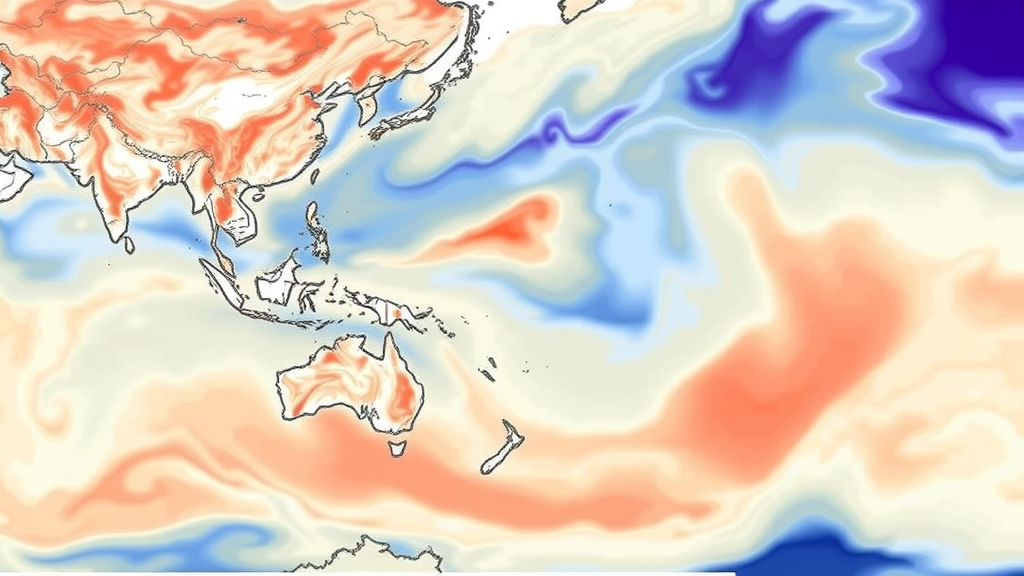
The geography of the bias is telling. The largest discrepancies, exceeding minus one degree Celsius, emerged along the energetic western boundary currents such as the Gulf Stream and Kuroshio extensions, and along the Antarctic Circumpolar Current, regions where the ocean is dynamically active and where different SST products can diverge substantially. In the tropical upwelling zones, where winds drive cold water to the surface, the differences were more moderate but still significant, ranging from about minus 0.2 to minus 0.5 degrees Celsius. These are precisely the regions that matter most for the El Niño-Southern Oscillation, the planet’s dominant source of seasonal climate variability, which swings between warm El Niño and cold La Niña states and reshuffles weather patterns from California to Kenya.
What makes the finding particularly consequential is how these biases behaved once forecasts were launched from the reanalysis. The researchers examined two seasonal forecast systems that rely on CFSR for their ocean initial conditions: NCEP’s Climate Forecast System version 2, known as CFSv2, and the Community Climate System Model version 4, or CCSM4, which contributes to the North American Multi-Model Ensemble. Both models ingested the cold anomalies at initialization almost undamped. At zero-month lead time, meaning at the very start of the forecast, both systems exhibited cold anomalies in the eastern tropical Pacific. Rather than fading away as the coupled atmosphere-ocean system evolved, these anomalies intensified and spread westward toward the dateline within four months, contaminating the forecast trajectory itself.
The consequences for ENSO prediction were systematic and measurable. By constructing composites of forecast behavior around historical El Niño and La Niña events, the team showed that forecasts initialized after 2020 carried a persistent cold bias during boreal fall and winter, the seasons when ENSO events typically reach peak strength and when forecast skill is usually highest. In practical terms, the models were systematically underestimating ocean temperatures in the tropical Pacific during the most important window of the ENSO cycle, affecting the predicted amplitude of both El Niño warm events and La Niña cold events. A forecast that starts with a cold ocean and then cools it further will inevitably lean too far toward La Niña-like outcomes.
The 2024 La Niña episode provided a vivid real-world demonstration. Even during seasons when ENSO forecasts historically perform well, the post-2020 forecast systems produced overly cold La Niña predictions, exaggerating the intensity of the event. For forecasters, agricultural planners, disaster managers, and governments that depend on seasonal outlooks for drought, flood, and temperature guidance, such a bias is not an academic curiosity. It shifts probability distributions that inform billions of dollars in decisions, from crop planting to water reservoir management to famine early warning systems across the tropics.
There is also a deeper historical irony embedded in the findings. The CFSR has long been known to carry a warm bias in tropical Pacific SST forecasts, a discontinuity that emerged around 1999 and was documented in earlier studies of the system’s nonstationary errors. The 2020 switch in nudging datasets effectively reversed that sign, replacing a warm bias with a cold one. The result is a forecast system whose errors are nonstationary in time, meaning that bias corrections calibrated on one era of the reanalysis become invalid in another. Statistical post-processing, machine learning corrections, and forecaster intuition all implicitly assume that a model’s errors are reasonably stable; a sudden sign flip violates that assumption and degrades every downstream correction built on it.
The technical root of the problem lies in the subtle difference between what the two SST products actually measure. The OISST analysis targets a foundation SST, broadly representative of the temperature near the ocean surface free of diurnal variability, while the NSST scheme represents the temperature at the very top of the ocean model, including near-surface gradients that can differ from bulk or foundation temperatures. When a reanalysis nudges its top ocean layer toward a product defined differently from what the model layer represents, systematic offsets can be introduced. Because the nudging is strong, the ocean model has little freedom to correct those offsets through its own physics, and because the coupled forecast models are initialized from the reanalysis, the offsets ride along into every prediction. The study’s authors emphasize that although different SST analyses are routinely adopted in operational ocean reanalysis systems around the world, the impacts of switching between them have rarely been examined with this level of rigor.
The broader lesson extends well beyond NCEP. Ocean reanalysis systems operated by centers in Europe, Japan, and the United States all face similar choices about which SST product to assimilate, and operational systems inevitably evolve as datasets are updated or replaced. The Wen and colleagues analysis demonstrates that such transitions deserve the same scrutiny as changes to model physics or observation networks, because a change in the anchoring dataset is, in effect, a change to the climate the reanalysis describes. The researchers suggest that monitoring reanalysis products against independent references, quantifying discontinuities at transition points, and assessing how initialization biases propagate through coupled forecasts should become standard practice whenever operational data streams change. Otherwise, the quiet swap of one temperature dataset for another can silently recalibrate the world’s seasonal forecasts, turning a well-understood prediction system into one that is systematically, and invisibly, off balance.
Subject of Research: Impact of switching the sea surface temperature nudging dataset in the CFSR ocean reanalysis on seasonal ENSO forecast biases.
Article Title: Impact of SST nudging on CFSR analysis and seasonal ENSO forecasts
Article References: Wen, C., Wang, W., Kumar, A., & L’Heureux, M. (2026). Impact of SST nudging on CFSR analysis and seasonal ENSO forecasts. Climate Dynamics, 64(10), Article 418. https://doi.org/10.1007/s00382-026-08375-x
Image Credits: AI Generated
DOI: 10.1007/s00382-026-08375-x
Keywords: ENSO prediction, ocean reanalysis, CFSR, sea surface temperature, SST nudging, seasonal forecasting, CFSv2, CCSM4, NMME, La Niña, forecast bias, Climate Dynamics
Cite Scienmag News
Sloane Callahan. (September 13, 2026). How a Quiet Switch in Sea Temperature Data Bent ENSO Forecasts Cold. Scienmag. https://scienmag.com/how-a-quiet-switch-in-sea-temperature-data-bent-enso-forecasts-cold/
Sloane Callahan. "How a Quiet Switch in Sea Temperature Data Bent ENSO Forecasts Cold." Scienmag, 13 September 2026, https://scienmag.com/how-a-quiet-switch-in-sea-temperature-data-bent-enso-forecasts-cold/. Accessed 4 October 2026.
Sloane Callahan. "How a Quiet Switch in Sea Temperature Data Bent ENSO Forecasts Cold." Scienmag. September 13, 2026. https://scienmag.com/how-a-quiet-switch-in-sea-temperature-data-bent-enso-forecasts-cold/


