


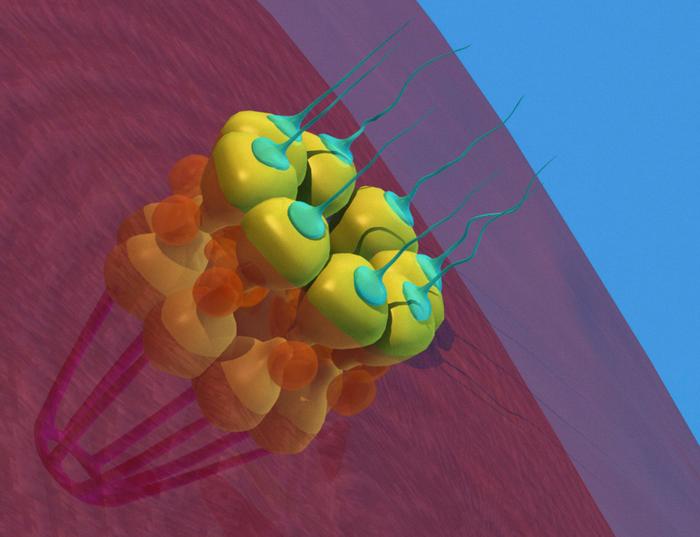
Nuclear pore complexes (NPCs) are channels composed of multiple proteins that ferry molecules in and out of the nucleus, regulating many critical cellular functions, such as gene expression, chromatin organization and RNA processes that influence cell survival, proliferation, and differentiation.

Credit: M. Towler and J. Aitken, Wellcome Collection
Nuclear pore complexes (NPCs) are channels composed of multiple proteins that ferry molecules in and out of the nucleus, regulating many critical cellular functions, such as gene expression, chromatin organization and RNA processes that influence cell survival, proliferation, and differentiation.
In recent years, new studies, including work by Maximiliano D’Angelo, Ph.D., associate professor in the Cancer Metabolism and Microenvironment Program at Sanford Burnham Prebys, have noted that NPCs in cancer cells are different, but how these alterations contribute to malignancy and tumor development—or even how NPCs function in normal cells—is poorly understood.
In a new paper, published June 5, 2024 in Science Advances, D’Angelo with first author Valeria Guglielmi, Ph.D., and co-author Davina Lam, uncover Nup358, one of roughly 30 proteins that form the NPCs, as an early player in the development of myeloid cells, blood cells that if not formed or working properly leads to myeloid disorders such as leukemias.
The researchers found that when they eliminated Nup358 in a mouse model, the animals experienced a severe loss of mature myeloid cells, a group of critical immune cells responsible for fighting pathogens that are also responsible for several human diseases including cancer. Notably, Nup358 deficient mice showed an abnormal accumulation of early progenitors of myeloid cells referred as myeloid-primed multipotent progenitors (MPPs).
“MPPs are one of the earliest precursors of blood cells,” said D’Angelo. “They are produced in the bone marrow from hematopoietic stem cells, and they differentiate to generate the different types of blood cells.
“There are different populations of MPPs that are responsible for producing specific blood cells and we found that in the absence of Nup358, the MPPs that generate myeloid cells, which include red blood cells and key components of the immune system, get stuck in the differentiation process.”
Fundamentally, said Gugliemi, Nup358 has a critical function in the early stages of myelopoiesis (the production of myeloid cells). “This is a very important finding because it provides insights into how blood cells develop, and can help to establish how alterations in Nup358 contribute to blood malignancies.”
The findings fit into D’Angelo’s ongoing research to elucidate the critical responsibilities of NPCs in healthy cells and how alterations to them contribute to immune dysfunction and the development and progression of cancer.
“Our long-term goal is to develop novel therapies targeting transport machinery like NPCs,” said D’Angelo, who recently received a two-year, $300,000 Discovery Grant from the American Cancer Society to advance his work.
This research was supported in part by a Research Scholar Grant from the American Cancer Society (RSG-17-148-01), the Department of Defense (grant W81XWH-20-1-0212) and the National Institutes of Health (AI148668).
The study’s DOI is 10.1126/sciadv.adn8963.
Journal
Science Advances
Method of Research
Experimental study
Subject of Research
Cells
Article Title
Nucleoporin Nup358 drives the differentiation 1 of myeloid-biased multipotent 2 progenitors by modulating HDAC3 nuclear translocation
Article Publication Date
5-Jun-2024
COI Statement
Authors declare that they have no competing interests.
Cite Scienmag News
Nathaniel Bowman. (June 5, 2024). How a protein component of nuclear pore complexes regulates development of blood cells and may contribute to myeloid disorders. Scienmag. https://scienmag.com/how-a-protein-component-of-nuclear-pore-complexes-regulates-development-of-blood-cells-and-may-contribute-to-myeloid-disorders/
Nathaniel Bowman. "How a protein component of nuclear pore complexes regulates development of blood cells and may contribute to myeloid disorders." Scienmag, 5 June 2024, https://scienmag.com/how-a-protein-component-of-nuclear-pore-complexes-regulates-development-of-blood-cells-and-may-contribute-to-myeloid-disorders/. Accessed 6 September 2026.
Nathaniel Bowman. "How a protein component of nuclear pore complexes regulates development of blood cells and may contribute to myeloid disorders." Scienmag. June 5, 2024. https://scienmag.com/how-a-protein-component-of-nuclear-pore-complexes-regulates-development-of-blood-cells-and-may-contribute-to-myeloid-disorders/

