


Plants are known to respond to seasonal changes by budding, leafing, and flowering. As climate change stands to shift these so-called phenological stages in the life cycle of plants, access to data about phenological changes – from many different locations and in different plants – can be used to draw conclusions about the actual effects of climate change. However, conducting such analyses require a large amount of data and data collection of this scale would be unthinkable without the help of citizen scientists. “The problem is that the quality of the data suffers when fewer people engage as citizen scientists and stop collecting data,” says first author Karin Mora, research fellow at Leipzig University and iDiv.

Credit: Flora Incognita
Plants are known to respond to seasonal changes by budding, leafing, and flowering. As climate change stands to shift these so-called phenological stages in the life cycle of plants, access to data about phenological changes – from many different locations and in different plants – can be used to draw conclusions about the actual effects of climate change. However, conducting such analyses require a large amount of data and data collection of this scale would be unthinkable without the help of citizen scientists. “The problem is that the quality of the data suffers when fewer people engage as citizen scientists and stop collecting data,” says first author Karin Mora, research fellow at Leipzig University and iDiv.
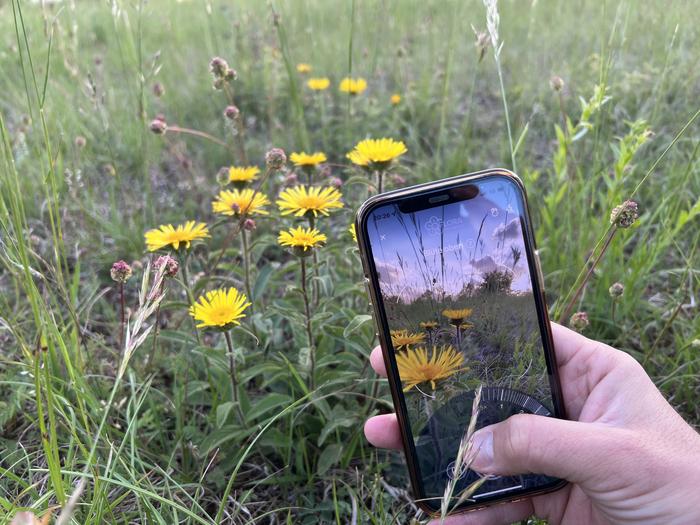
Mobile apps like Flora Incognita could help solve this issue. The app allows users to identify unknown wild plants within a matter of seconds. “When I take a picture of a plant with the app, the observation is recorded with the (exact) location as well as a time stamp,” explains co-author Jana Wäldchen from the Max Planck Institute for Biogeochemistry (MPI-BGC), who developed the app with colleagues from TU Ilmenau. “Millions of time-stamped plant observations from different regions have been collected by now.” Although satellite data also records the phenology of entire ecosystems from above, they do not provide information about the processes taking place on the ground.
Plants show synchronised response
The researchers developed an algorithm that draws on almost 10 million observations of nearly 3,000 plants species identified between 2018 and 2021 in Germany by users of Flora Incognita. The data show that each individual plant has its own cycle as to when it begins a flowering or growth phase. Furthermore, the scientists were able to show that group behaviour arises from the behaviour of individuals. From this, they were able to derive ecological patterns and investigate how these change with the seasons. For example, ecosystems by rivers differ from those in the mountains, where phenological events start later.
The algorithm also accounts for the observational tendencies of Flora Incognita users, whose data collection is far from systematic. For example, users record more observations on the weekend and in densely populated areas. “Our method can automatically isolate these effects from the ecological patterns,” Karin Mora explains. “Fewer observations don’t necessarily mean that we can’t record the synchronisation. Of course, there are very few observations in the middle of winter, but there are also very few plants that can be observed during that time.”
It is known that climate change is causing seasonal shifts – for example, spring is arriving earlier and earlier. How this affects the relationship between plants and pollinating insects and therefore potentially also food security is still being subject to further research. The new algorithm can now be used to better analyse the effects of these changes on the plant world.
This study was funded by the Deutsche Forschungsgemeinschaft (DFG; FZT-118) and the iDiv Flexpool.
Journal
Methods in Ecology and Evolution
Method of Research
Data/statistical analysis
Subject of Research
Not applicable
Article Title
Macrophenological dynamics from citizen science plant occurrence data
Article Publication Date
9-Jul-2024
Cite Scienmag News
Sloane Callahan. (July 9, 2024). How a plant app helps identify the consequences of climate change. Scienmag. https://scienmag.com/how-a-plant-app-helps-identify-the-consequences-of-climate-change/
Sloane Callahan. "How a plant app helps identify the consequences of climate change." Scienmag, 9 July 2024, https://scienmag.com/how-a-plant-app-helps-identify-the-consequences-of-climate-change/. Accessed 3 September 2026.
Sloane Callahan. "How a plant app helps identify the consequences of climate change." Scienmag. July 9, 2024. https://scienmag.com/how-a-plant-app-helps-identify-the-consequences-of-climate-change/

