


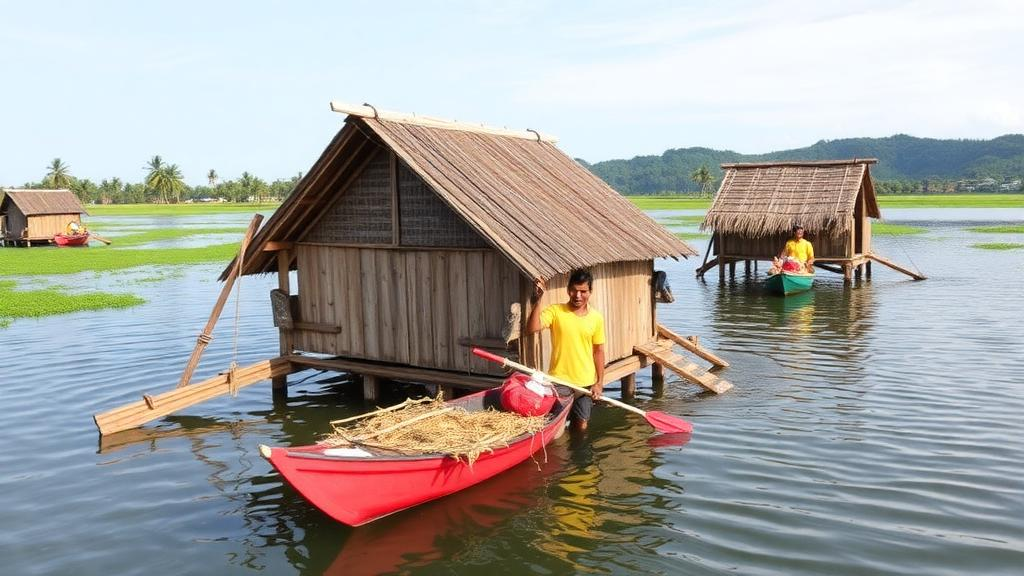
On the waters of Danau Sentani in Papua, Indonesia, roughly ninety percent of the buildings in Kampung Yoboi stand above the lake itself. Wooden bridges connect painted floating houses, boats replace roads, and sago forests fringe the shoreline. What might look like a picturesque curiosity is, according to new research, something far more analytically interesting: a living case study in how Indigenous knowledge becomes tourism value, and why that transformation does not automatically deliver fair, inclusive development. A team led by Ferdinand Risamasu of Cenderawasih University spent June and July 2025 in the village, interviewing twenty-four informants and observing daily life to trace the pathway from local knowledge to social innovation to inclusion.
The study, published in Discover Global Society, rests on a deliberately conditional argument. Local knowledge, the authors contend, does not inherently become tourism value; a tourism activity is not inherently a social innovation; and social innovation does not necessarily produce inclusive development. Each step requires something extra. Knowledge must be translated with community authorization, translation must reorganize relationships and capabilities to count as innovation, and innovation must be institutionalized under community control before its benefits can be called inclusive. In Kampung Yoboi, the researchers found strong evidence for the first two steps and only partial evidence for the third.
The raw material is distinctive. Sago, the starchy staple of Papuan communities, functions simultaneously as food, livelihood, ecological system, cultural identity, and intergenerational knowledge. In Kampung Yoboi it has been reinterpreted as a tourism experience through guided sago-forest tracking, traditional food preparation, storytelling, and the sago grub festival. A tourism manager told the researchers that sago is not merely food but the community’s identity, a medium through which visitors can learn about the culture, environment, and way of life around Lake Sentani. The floating settlement itself, with its colorful docks and painted houses, has been reframed as the destination rather than a backdrop to separately constructed attractions.
Methodologically, the study is an interpretive qualitative case study. The team used purposive, criterion-based sampling to assemble informants across seven categories: one community leader, four members of the Tourism Awareness Group known as Pokdarwis, one tourism manager, five residents involved in tourism, four local knowledge holders, five visitors, and four village-level institutional actors. Semi-structured interviews lasting forty-five to sixty minutes were audio-recorded with consent, transcribed, and analyzed thematically in NVivo 12, combining deductive codes drawn from social innovation theory with inductive codes that surfaced unanticipated issues such as dependence on individuals and damaged facilities. Triangulation across participant groups, field observations, and documentary sources strengthened the analysis, and an audit trail preserved interpretive decisions.
The findings show that tourism value in Kampung Yoboi is co-created rather than manufactured. A community leader explained that the village becomes attractive because what visitors see comes from local life itself, from the lake, the houses on water, and the way people live with sago and nature. Ordinary infrastructure doubles as tourism infrastructure: bridges are both daily pathways and visitor routes, and household practices such as craft production and food preparation become small-scale income opportunities. This supports value co-creation theory, in which tourism value emerges from interactions among residents, knowledge holders, visitors, and the material environment rather than from managers alone.
Yet the translation process remains fragile. Much of the community’s knowledge about sago, customs, and lake life is transmitted orally and resides with individual elders. One local knowledge holder noted that many stories still need to be written down and introduced more clearly to visitors and younger generations. Without community-controlled documentation, the researchers warn, tourism development could fragment or erode the very knowledge it celebrates. The study treats documentation not as a technical fix but as a political question: who decides what is recorded, who is authorized to share it, and how customary authority is preserved when cultural content circulates to outsiders.
The social innovation dimension emerges through what the authors call relational recombination. Elders contribute cultural interpretation; households supply food, crafts, and hospitality; Pokdarwis members and the tourism manager coordinate activities; visitors provide feedback and recognition; and village institutions shape legitimacy and resources. Training sessions and community forums allow residents to discuss visitor suggestions and improve management skills. A Pokdarwis member described how villagers support tourism in different ways, some making crafts, some preparing food, and others beautifying the village. Innovation here is not technological novelty but the reorganization of roles, relationships, and collective capabilities in response to locally defined needs.
However, the researchers draw a sharp line between emergent and institutionalized innovation. Kampung Yoboi’s creativity is relationally rich but institutionally weak. Roles and responsibilities have not been fully formalized, tourism is not consistently integrated into village planning and budgeting, and activities depend on a small group of motivated individuals. A tourism manager observed that the ideas already exist but must be managed collectively so tourism does not depend on a few people and instead becomes a shared responsibility of the whole village. Youth involvement in digital promotion and oral history documentation is promising but remains peripheral to formal decision-making.
Inclusion, the study’s most demanding criterion, is emerging but incomplete. Recognitional inclusion is the strongest dimension: tourism visibly affirms sago culture, floating settlement identity, and lake-based livelihoods, and the village’s national recognition, including a place among the top fifty villages in the 2021 Anugerah Desa Wisata Indonesia and finalist status in the 2025 Wonderful Indonesia Award, has reinforced community pride. Economic opportunities exist through food, crafts, and hospitality, but they remain small-scale and unevenly accessible. Procedural and distributive inclusion lag behind, because evidence on who controls priorities, who receives the largest benefits, and how women, youth, and less-connected households participate is limited. Visibility of Indigenous culture, the authors stress, is not the same as inclusion when communities lack authority over representation and development priorities.
Material constraints compound the governance gap. Limited village funding restricts the maintenance of bridges, toilets, sanitation systems, and public spaces, and poor sanitation threatens both visitor comfort and the environmental quality of Lake Sentani. Human resource limitations affect guiding, interpretation, digital promotion, and safety management, while existing training is too occasional to build a continuous capacity system. These constraints reinforce one another: weak institutional recognition limits funding, inadequate facilities reduce visitor satisfaction, limited skills weaken service quality, and reliance on a few individuals threatens continuity. The central problem, the researchers conclude, is not a shortage of creativity but the absence of stable governance, financing, maintenance, and capacity-building arrangements.
The study’s theoretical contribution is a conditional pathway with clear policy implications. Local knowledge contributes to inclusive community-based tourism through community-authorized translation, relational recombination, and community-controlled institutionalization. The authors recommend integrating tourism into village planning and accountable budgeting, treating bridges, sanitation, and public facilities as shared community and visitor infrastructure, establishing representative coordination among village governments, customary leaders, Pokdarwis, knowledge holders, households, women, and youth, and making benefit distribution transparent. Institutionalization, they caution, should not mean imposing external bureaucratic models that displace Indigenous institutions, but rather formalizing rules and roles while the community retains cultural authority.
The limitations are acknowledged candidly. A single-case, interpretive design with twenty-four informants cannot establish statistical representativeness or causal effects, demographic data were too incomplete for subgroup analysis, and the absence of longitudinal data prevents assessment of whether current initiatives endure. Visitor statistics are also patchy; available records indicate roughly 1,852 visitors during 2021 to 2022, but comprehensive seasonal series do not exist. Future research, the team suggests, should compare Indigenous lake-based tourism cases, track governance and benefit distribution over time, and test whether the proposed pathway holds under different customary, ecological, and institutional conditions.
For a village of floating houses on a Papuan lake, the stakes extend well beyond tourism. Kampung Yoboi demonstrates that communities can convert inherited ecological knowledge into experiences that visitors genuinely value, and that this conversion can strengthen identity, pride, and learning. But the research also delivers a caution to policymakers and destination marketers everywhere: participation is not empowerment, visibility is not inclusion, and creativity without institutional foundations risks evaporating when its few champions step away. The pathway from knowledge to inclusive development, the study shows, must be built deliberately, governed locally, and maintained continuously, one bridge, one budget, and one documented story at a time.
Subject of Research: Local knowledge and social innovation in inclusive community-based tourism in an Indigenous lake settlement in Papua, Indonesia
Article Title: Local knowledge and social innovation for inclusive community based tourism in Kampung Yoboi, Papua, Indonesia
Article References: Risamasu, F., Srem, A. I. A., Wabe, T. G., Manaqib, I. W., Amandaria, R., Azkar, R., Darma, R., & Ardiansyah, M. F. P. (2026). Local knowledge and social innovation for inclusive community based tourism in Kampung Yoboi, Papua, Indonesia. Discover Global Society, 4(1), Article 265. https://doi.org/10.1007/s44282-026-00627-9
Image Credits: AI Generated
DOI: 10.1007/s44282-026-00627-9
Keywords: community-based tourism, Indigenous tourism, social innovation, local knowledge, sago, Lake Sentani, Papua, inclusive development, value co-creation, participatory governance, cultural sustainability, Indonesia
Cite Scienmag News
Courtney Benton. (October 6, 2026). How a Floating Papuan Village Turned Sago and Lake Life Into Inclusive Tourism. Scienmag. https://scienmag.com/how-a-floating-papuan-village-turned-sago-and-lake-life-into-inclusive-tourism/
Courtney Benton. "How a Floating Papuan Village Turned Sago and Lake Life Into Inclusive Tourism." Scienmag, 6 October 2026, https://scienmag.com/how-a-floating-papuan-village-turned-sago-and-lake-life-into-inclusive-tourism/. Accessed 6 October 2026.
Courtney Benton. "How a Floating Papuan Village Turned Sago and Lake Life Into Inclusive Tourism." Scienmag. October 6, 2026. https://scienmag.com/how-a-floating-papuan-village-turned-sago-and-lake-life-into-inclusive-tourism/


