


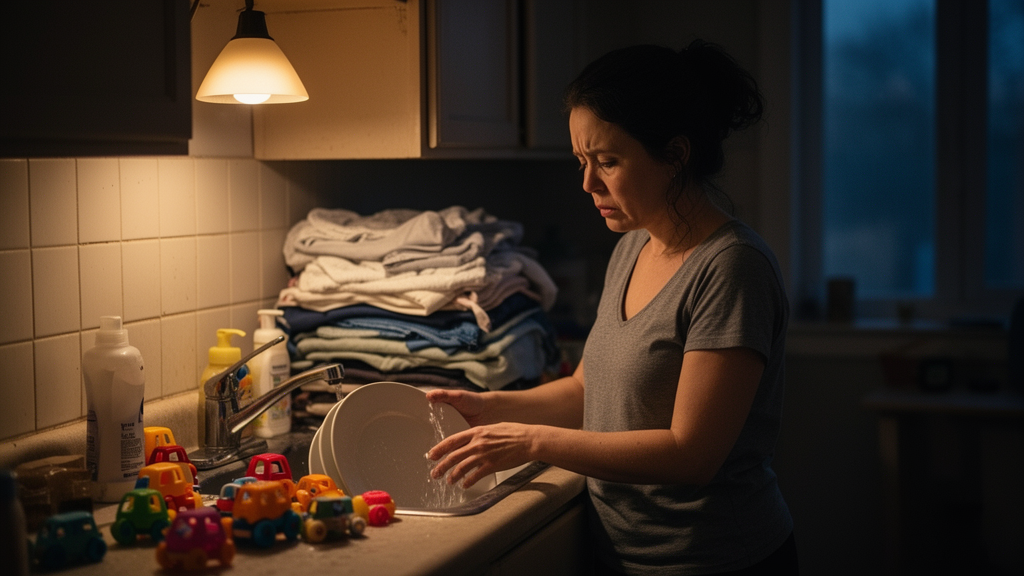
Single parents live a double shift. They must earn a living while simultaneously absorbing every task that a two-adult household would normally divide: feeding children, washing clothes, cleaning floors, scheduling medical appointments, and providing emotional support, all without a partner to share the load. A new study from South Korea now offers one of the clearest quantitative portraits yet of how that invisible workload translates into mental health outcomes, and its central finding is strikingly gendered. Among single mothers, every additional hour spent on housework is associated with measurably worse depressive symptoms, while among single fathers, no such relationship emerges.
The research, published in BMC Public Health by Seong-Uk Baek of Yonsei University College of Medicine and Jin-Ha Yoon of Yonsei University’s Department of Preventive Medicine, draws on the 2021 Single-Parent Family Survey, a nationally representative dataset collected by the Korean Women’s Development Institute. The analytic sample comprised 1,095 single fathers and 2,205 single mothers, a total of 3,300 parents raising children alone in one of the world’s most rapidly aging and rapidly changing societies. By using nationwide data rather than small convenience samples, the authors aimed to move beyond anecdote and establish whether the time single parents devote to unpaid domestic labor is independently associated with psychological distress.
The methodological design was straightforward but carefully specified. Participants self-reported the average number of hours they spent each day on two distinct categories of unpaid labor: childcare, meaning direct caregiving of their children, and housework, meaning routine domestic tasks such as cooking, cleaning, and laundry. Depressive symptoms were measured with the Patient Health Questionnaire-9, or PHQ-9, a nine-item screening instrument widely validated across clinical and population settings. The PHQ-9 asks respondents how often, over the preceding two weeks, they have experienced problems such as depressed mood, anhedonia, sleep disturbance, fatigue, appetite changes, feelings of worthlessness, concentration difficulties, psychomotor slowing, and thoughts of self-harm. Scores range from zero to twenty-seven, with higher totals indicating more severe symptoms. The researchers then fitted linear regression models to estimate the association between daily hours of each unpaid labor category and PHQ-9 scores, allowing them to quantify the relationship separately for fathers and mothers.
The descriptive statistics alone reveal a meaningful asymmetry in how single parents spend their non-working hours. Single fathers reported an average of 2.2 hours per day on caregiving and 2.3 hours per day on housework. Single mothers reported 2.8 hours of caregiving and 2.9 hours of housework daily. The gaps, roughly half an hour in each category, may appear modest at first glance, but they compound dramatically over time: a single mother performing 0.6 more hours of unpaid work per day than a single father accumulates nearly 220 additional hours of domestic labor each year, the equivalent of more than five additional full working weeks. This pattern echoes decades of time-use research showing that even when women are the sole adults in a household, the gendered distribution of domestic tasks does not simply disappear; it reasserts itself in the division of what gets done and how much of it falls on the mother.
The regression results sharpen the picture considerably. Among single mothers, time spent on housework showed a positive and statistically robust association with depressive symptoms, with a regression coefficient of 0.515, a standard error of 0.098, a t-statistic of 5.256, and a p-value below 0.001. In practical terms, each additional daily hour of housework was associated with an increase of roughly half a point on the PHQ-9 scale, holding other model covariates constant. By contrast, caregiving hours among mothers were not significantly associated with depressive symptoms; the coefficient was a negligible 0.054 with a standard error of 0.059 and a p-value of 0.355. Among single fathers, neither caregiving hours nor housework hours displayed a clear association with depressive symptoms at all.
This dissociation between the two forms of unpaid labor is arguably the study’s most intellectually interesting result, and it invites careful interpretation. Childcare, despite its demands, is a socially engaged, relational activity: it involves interaction, affection, and a sense of purpose that many parents find meaningful even when it is exhausting. Housework, by contrast, is repetitive, invisible, and structurally tedious, a treadmill of tasks that regenerate as soon as they are completed. Psychological research on labor and well-being has long distinguished between effort that carries intrinsic reward and effort that does not, and the Korean findings are consistent with that framework. For single mothers, whose domestic burden is both heavier and less socially recognized, the drudgery of housework may represent a chronic, unrewarded strain that erodes mood over time, whereas the hours spent with children, however tiring, do not carry the same depressive signal.
The absence of any association among single fathers is equally noteworthy and admits several non-exclusive explanations. One possibility is statistical: fathers in the sample spent less time on unpaid labor overall, and a narrower range of exposure can make genuine dose-response relationships harder to detect. Another possibility is normative. In South Korea, as in most societies, domestic labor remains strongly coded as women’s work, and men who perform it may experience it differently, perhaps as a chosen activity rather than an obligatory one, or perhaps with less of the accumulated resentment and role overload that women carry. A third possibility concerns the broader context of single fathers’ lives, including differences in income, employment patterns, social support networks, and the age composition of their children, any of which could buffer the psychological impact of domestic tasks. The study’s cross-sectional design cannot adjudicate among these explanations, and the authors are appropriately measured in their interpretation.
That design limitation deserves emphasis. Because the data capture a single point in time, the analysis establishes association rather than causation. It is possible that depressive symptoms lead parents to spend more time on housework, for instance if low mood reduces motivation to outsource tasks or to adopt efficiency strategies, or if depression narrows the energy available for paid work and forces greater reliance on home production. Reverse causation of this kind cannot be ruled out without longitudinal data or natural experiments. Self-reported time use also carries well-documented measurement limitations, since respondents may round, estimate, or report in ways shaped by social expectations. Nevertheless, the strength and specificity of the housework-depression association among mothers, and its absence among fathers, would be difficult to produce through measurement artifact alone, lending credibility to the core finding.
The policy implications are concrete. South Korea has one of the highest rates of relative poverty among single-parent households in the OECD, and its welfare architecture for single parents has historically lagged behind that of peer nations. The authors argue that policies are required to support single parents in balancing paid work and domestic responsibilities, and the study’s gendered results suggest what such support might look like. Expanding access to affordable childcare would relieve the caregiving hours that dominate single parents’ schedules, but the findings imply that housework relief matters at least as much for maternal mental health. Subsidized domestic services, after-school programs that absorb meal preparation and supervision, flexible working arrangements that reduce the compression of unpaid labor into evening hours, and cash transfers that allow single mothers to purchase domestic help could all plausibly interrupt the pathway from housework hours to depressive symptoms. More fundamentally, the results challenge the assumption that single parents, and single mothers in particular, can simply self-optimize their way out of a structural time deficit.
For a society watching its fertility rate collapse to the lowest level ever recorded anywhere, the mental health of the parents who are raising children alone is not a marginal concern. Depression among single mothers carries intergenerational consequences, affecting children’s emotional development, educational outcomes, and future health. The Yonsei study does not claim to have identified the full architecture of single-parent distress, but it has isolated one modifiable exposure, the hours of unrewarded domestic drudgery that fall disproportionately on women, and shown that it leaves a measurable imprint on mood. In a field where interventions are often diffuse and expensive, that is a genuinely actionable clue: reducing the housework burden of single mothers may be one of the most direct levers available for protecting their mental health, and by extension, the wellbeing of the children who depend on them.
Subject of Research: The association between unpaid domestic labor time and depressive symptoms among single mothers and single fathers in South Korea
Article Title: Association of time spent on unpaid labor with depressive symptoms among single parents in Korea: focus on gender differences
Article References: Baek, S.-U., & Yoon, J.-H. (2026). Association of time spent on unpaid labor with depressive symptoms among single parents in Korea: focus on gender differences. BMC Public Health. https://doi.org/10.1186/s12889-026-29608-y
Image Credits: AI Generated
DOI: 10.1186/s12889-026-29608-y
Keywords: unpaid labor, housework, single mothers, single fathers, depressive symptoms, PHQ-9, South Korea, mental health, childcare, gender differences, BMC Public Health, time pressure
Cite Scienmag News
Glenn Wilkins. (October 8, 2026). Housework Hours Linked to Depression in Single Mothers, Korean Study Finds. Scienmag. https://scienmag.com/housework-hours-linked-to-depression-in-single-mothers-korean-study-finds/
Glenn Wilkins. "Housework Hours Linked to Depression in Single Mothers, Korean Study Finds." Scienmag, 8 October 2026, https://scienmag.com/housework-hours-linked-to-depression-in-single-mothers-korean-study-finds/. Accessed 8 October 2026.
Glenn Wilkins. "Housework Hours Linked to Depression in Single Mothers, Korean Study Finds." Scienmag. October 8, 2026. https://scienmag.com/housework-hours-linked-to-depression-in-single-mothers-korean-study-finds/


