


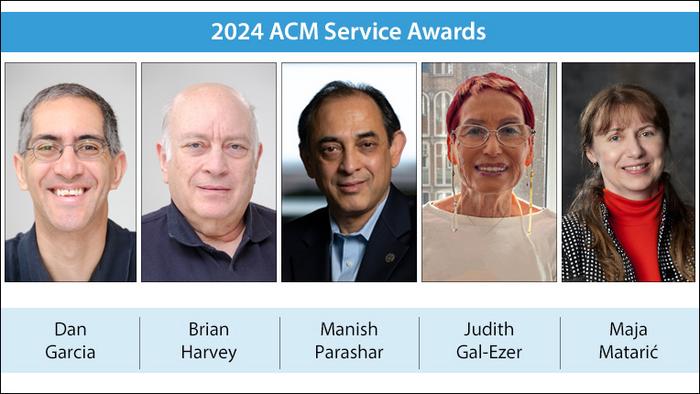
In a landmark celebration of innovation and dedication, the Association for Computing Machinery (ACM) has announced the recipients of its coveted 2024 Service Awards, honoring five luminaries whose work spans the breadth of computer science education, cyberinfrastructure, and human-centered robotics. These individuals have not only propelled their respective fields forward but have also catalyzed broader societal benefits, exemplifying the transformative power of computing. Their formal recognition will take place at ACM’s prestigious annual awards banquet scheduled for June 14, 2025, in San Francisco, gathering the computing community to salute these extraordinary contributions.
Among the awardees, Professors Dan Garcia and Brian Harvey, both affiliated with the University of California, Berkeley, have been distinguished with the Karl V. Karlstrom Outstanding Educator Award. This honor reflects their profound impact on computer science pedagogy and curriculum development, particularly their advocacy for inclusivity and representation in the computing classroom. Garcia and Harvey are recognized for spearheading the "Beauty and Joy of Computing" (BJC) curriculum, a pioneering approach designed to make computing accessible and engaging especially for students from historically underrepresented backgrounds. Their efforts have been instrumental in demonstrating that computer science can be invigorating and approachable to diverse populations.
The BJC curriculum, an integral component of the nationwide CSforALL initiative, employs innovative techniques such as the Snap! programming environment—a visually intuitive, blocks-based language co-developed by Harvey in collaboration with Jens Mönig. This non-traditional programming model enables learners to grasp complex computational concepts through interactive, user-friendly interfaces, thereby lowering entry barriers often posed by textual programming languages. Through intensive teacher training programs and the adaptation of BJC content into Spanish, as well as the development of a middle school version called BJC Sparks, Garcia and his colleagues have broadened the curriculum’s accessibility and global reach.
Intriguingly, the BJC course offerings at Berkeley have achieved unprecedented gender diversity, consistently enrolling over 50% female students and peaking above 70% in certain semesters—statistics that starkly contrast the traditional demographics of STEM fields. This underscores the curriculum’s success in cultivating an inclusive environment where the intrinsic allure of computing resonates with a wider audience, challenging prevailing stereotypes and fostering equitable participation.
Taking a contrasting yet complementary path, Professor Manish Parashar of the University of Utah has been awarded the ACM Distinguished Service Award for his visionary contributions to cyberinfrastructure and computational science. Parashar’s leadership has been pivotal at multiple high-profile national scientific bodies, including the National Science Foundation (NSF) and the White House Office of Science and Technology Policy (OSTP). His strategic formulation of the Future Advancement Computing Ecosystem (FACE) underscores a forward-looking vision for a national cyberinfrastructure poised to accelerate scientific discovery through high-performance computing, data management, and resource integration.
At ACM, Parashar’s stewardship as editor-in-chief of the Transactions on Autonomous and Adaptive Systems (TAAS) placed him at the forefront of disseminating cutting-edge research on adaptive computing frameworks. His service extends beyond editorial roles as he has chaired numerous steering and programming committees, helping shape the direction of conferences that define contemporary computer science discourse. This breadth of involvement exemplifies the holistic nature of service to the discipline, blending policy, administration, and scholarly mentorship.
From a global perspective, Professor Emerita Judith Gal-Ezer of the Open University of Israel has been recognized with the Outstanding Contribution to ACM Award, honoring her sustained leadership in computer science education research and policy, as well as her instrumental role on the ACM Europe Council. Gal-Ezer’s contributions to informatics education extend beyond academia into advocacy, where she champions the advancement of high-quality science curricula at the European level. Her engagement with Informatics for All (I4All) demonstrates a strategic coalition-building effort involving ACM Europe, Informatics Europe, CEPIS, and IFIP to embed informatics education across primary and secondary schooling in Europe.
This coalition’s persistence was a crucial factor in influencing the European Commission’s decision to integrate informatics as a fundamental component of educational standards, reflective of a shift recognizing computational literacy as central to 21st-century skillsets. Gal-Ezer’s combination of research excellence and community leadership amplifies ACM’s mission to foster educational innovation and global inclusivity.
Bridging the gap between technology and human welfare, Professor Maja Matarić of the University of Southern California has been awarded the ACM Eugene L. Lawler Award for Humanitarian Contributions within Computer Science and Informatics. Matarić is widely regarded as a pioneer in socially assistive robotics (SAR), a multidisciplinary field that melds robotics, human-computer interaction, and behavioral sciences to design robotic systems tailored to augment human capabilities and well-being.
Matarić’s research emphasis on co-design and active user involvement sets SAR apart from traditional robotics by ensuring empathetic, personalized assistance. Her work addresses the rehabilitation and cognitive support of populations with special needs, encompassing applications such as post-stroke motor recovery, therapeutic interventions for children on the autism spectrum, and cognitive-social skills enhancement for Alzheimer’s patients. The deployment of SAR technologies in clinical and educational settings exemplifies how sophisticated computational systems can be harnessed to provide nuanced support, ultimately improving quality of life.
Taken together, the 2024 ACM Service Award recipients paint a vivid portrait of the dynamism and scope inherent in modern computing. Their endeavors highlight the critical interplay between education, infrastructure, policy, and practical innovation—a tapestry that continues to shape how society leverages technology for human advancement. The ACM’s acknowledgement of these figures not only recognizes individual excellence but also signals the directions in which computing as a discipline is moving: toward greater inclusivity, sustainability, and humanitarian impact.
The awards, each backed by significant institutional and financial support—from the $10,000 prize accompanying the Karlstrom Educator Award sponsored by Pearson Education, to the biennial $5,000 honorarium for the Lawler Award—reflect the ACM’s commitment to fostering talent that transcends disciplinary boundaries. Moreover, these recognitions underscore a shared ethos of service, emphasizing that advancing computing entails both technological breakthrough and the cultivation of vibrant, diverse communities.
As the computing landscape faces mounting complexity—from ethical considerations in AI deployment to the integration of cyberinfrastructure at massive scales—the contributions of these service awardees offer vital exemplars. They reinforce the notion that sustained engagement, whether through pedagogy, policy-making, or humanitarian application, is foundational to the discipline’s ongoing evolution. The upcoming banquet in San Francisco will undoubtedly be a moment to celebrate these achievements and to inspire future generations to continue this enriching tradition of service driven by vision and compassion.
In sum, ACM’s 2024 service awards spotlight not merely individual accomplishment but the continuum of efforts propelling computer science forward. By elevating figures devoted to education reform, infrastructure strategy, international collaboration, and robotics innovation, ACM is affirming the multifaceted and profoundly impactful nature of computing service—a narrative that resonates deeply within and beyond the academy.
News Publication Date: June 14, 2025
Web References:
- https://www.acm.org/
- https://bjc.berkeley.edu/
- https://awards.acm.org/karlstrom
- https://awards.acm.org/distinguished-service
- https://awards.acm.org/outstanding-contribution
- http://awards.acm.org/lawler/
Cite Scienmag News
Courtney Benton. (May 28, 2025). Honoring the Architects of a Thriving Technical Community. Scienmag. https://scienmag.com/honoring-the-architects-of-a-thriving-technical-community/
Courtney Benton. "Honoring the Architects of a Thriving Technical Community." Scienmag, 28 May 2025, https://scienmag.com/honoring-the-architects-of-a-thriving-technical-community/. Accessed 3 September 2026.
Courtney Benton. "Honoring the Architects of a Thriving Technical Community." Scienmag. May 28, 2025. https://scienmag.com/honoring-the-architects-of-a-thriving-technical-community/


