


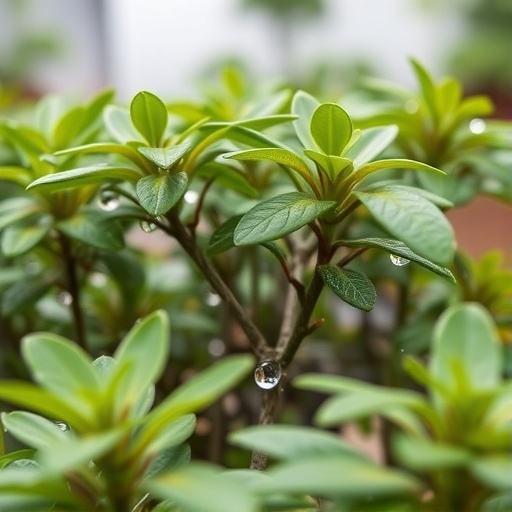
Fine particulate air pollution is quietly disrupting one of nature’s most important climate-regulating systems, according to a new global study led by researchers at the University of Hong Kong. The research shows that PM2.5 pollution—particles smaller than 2.5 micrometres in diameter—significantly reduces the efficiency with which plants use water while absorbing carbon dioxide. By weakening photosynthesis, the pollution may limit vegetation’s ability to remove carbon from the atmosphere, suggesting that cleaner air could be an important and overlooked form of climate action.
Plants constantly balance two competing exchanges with the atmosphere. Through tiny pores called stomata, they take in carbon dioxide for photosynthesis while releasing water vapour through transpiration. Plant water-use efficiency, commonly abbreviated as WUE, describes how much carbon a plant gains for the amount of water it loses. A higher WUE generally means that vegetation is capturing more carbon while using less water. Rising atmospheric carbon dioxide and several consequences of climate change have increased WUE in many parts of the world in recent decades, but the new findings indicate that air pollution is eroding some of those gains.
The study, led by Professor Yuyu Zhou of the Department of Geography and the Institute for Climate and Carbon Neutrality at HKU, examined the relationship between PM2.5 and plant function across multiple spatial and temporal scales. The researchers combined evidence from tree-ring isotope records, eddy-covariance flux measurements and satellite observations of vegetation. Tree rings can preserve chemical signatures associated with past photosynthesis and water use, while eddy-covariance towers measure exchanges of carbon dioxide and water vapour between ecosystems and the atmosphere. Satellite-based vegetation metrics provide a broader view of how plant activity changes across landscapes and over time.
Across these independent sources of evidence, PM2.5 displayed a predominantly negative relationship with plant water-use efficiency. The effect was particularly important because it weakened the increase in WUE associated with rising carbon dioxide concentrations since the 2000s. Carbon dioxide can stimulate photosynthesis and cause plants to partially close their stomata, potentially allowing them to gain carbon while losing less water. However, the researchers found that particulate pollution interferes with this apparent benefit. The strength of the effect differed geographically, reflecting the interaction of pollution intensity with vegetation characteristics and local climate.
The central mechanism was not a major change in the amount of water lost by plants. Instead, PM2.5 primarily reduced the amount of carbon gained through photosynthesis. One pathway involves the particles’ influence on incoming sunlight. Fine aerosols scatter and absorb solar radiation, reducing the quantity of photosynthetically active radiation—the portion of sunlight that plants can use to drive photosynthesis—reaching leaves. Although aerosols can sometimes diffuse light and improve illumination within dense canopies, the global pattern identified in this study indicates that the overall effect of PM2.5 is harmful to plant carbon uptake.
The pollution also appears to affect the biochemical machinery responsible for converting carbon dioxide into organic compounds. Photosynthesis depends on the capacity of enzymes in the Calvin cycle, particularly the carbon-fixing enzyme Rubisco, to incorporate carbon dioxide. The researchers linked PM2.5 exposure to lower carboxylation capacity, meaning that leaves become less able to fix carbon even when carbon dioxide is available. Particles may contribute to this decline through reduced light availability, changes in leaf temperature and humidity, oxidative stress, or the deposition of pollutants directly onto leaf surfaces. Together, these biophysical and biogeochemical pathways suppress photosynthesis without necessarily producing a proportional reduction in evapotranspiration.
This distinction is crucial for understanding the climate consequences. If pollution reduced both photosynthesis and water loss by the same proportion, WUE might remain relatively stable. But when carbon gain falls more strongly than water loss, plants become less efficient. Vegetation may then remove less carbon from the atmosphere for every unit of water consumed. The consequences could be especially significant in polluted regions where forests, grasslands and croplands already face heat, drought and other environmental pressures. Forests and non-forest ecosystems also showed different patterns, indicating that plant structure, species composition and canopy characteristics help determine how pollution affects the carbon-water balance.
The findings expose a limitation in many current ecosystem and Earth-system models. These models are widely used to estimate future carbon storage, vegetation productivity and climate feedbacks, but they often represent plant responses to temperature, precipitation, radiation and carbon dioxide without explicitly accounting for aerosol pollution. As a result, they may attribute changes in WUE to climate drivers while missing a direct influence from particulate matter. The researchers found that models relying only on covarying climate variables could not reproduce the observed PM2.5–WUE relationship, demonstrating that aerosol processes need to be integrated into next-generation simulations.
The study points to a connection between air-quality policy and climate policy that is often treated as secondary. Cutting PM2.5 emissions would immediately reduce risks to human health, but it could also help restore plant photosynthetic performance and strengthen the ability of terrestrial ecosystems to absorb carbon. The researchers argue that future assessments should consider aerosol composition, particle size, atmospheric transport and deposition onto vegetation, rather than treating pollution as a simple reduction in sunlight. As cities and nations plan climate adaptation strategies, overlooking these interactions could produce inaccurate estimates of ecosystem resilience and lead to maladaptive decisions. By showing that microscopic particles can weaken the biological machinery linking water and carbon, the HKU-led research places clean air at the centre of the planet’s climate response.
News Publication Date: 17-Aug-2026
Web References: https://doi.org/10.1038/s41558-026-02712-y
References: Zhou, Y. et al. “Particulate air pollution undermines plant water-use efficiency by inhibiting photosynthesis.” Nature Climate Change. DOI: 10.1038/s41558-026-02712-y
Cite Scienmag News
Russell Cooper. (August 21, 2026). HKU study finds PM2.5 pollution reduces plants’ water efficiency and carbon uptake. Scienmag. https://scienmag.com/hku-study-finds-pm2-5-pollution-reduces-plants-water-efficiency-and-carbon-uptake/
Russell Cooper. "HKU study finds PM2.5 pollution reduces plants’ water efficiency and carbon uptake." Scienmag, 21 August 2026, https://scienmag.com/hku-study-finds-pm2-5-pollution-reduces-plants-water-efficiency-and-carbon-uptake/. Accessed 3 September 2026.
Russell Cooper. "HKU study finds PM2.5 pollution reduces plants’ water efficiency and carbon uptake." Scienmag. August 21, 2026. https://scienmag.com/hku-study-finds-pm2-5-pollution-reduces-plants-water-efficiency-and-carbon-uptake/


