


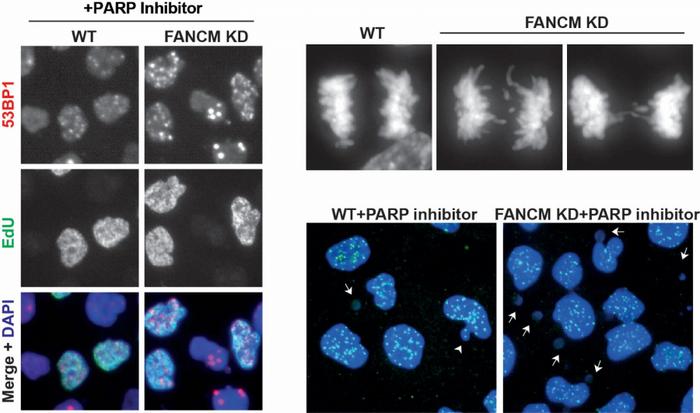
A research team led by Professor Ying Wai CHAN from the School of Biological Sciences at The University of Hong Kong (HKU) has made a significant breakthrough in understanding how cancer cells develop resistance to a class of cancer drugs known as PARP inhibitors. Their latest findings, published in Cell Reports, reveal the crucial role of a protein named FANCM in promoting resistance to these drugs.

Credit: The University of Hong Kong
A research team led by Professor Ying Wai CHAN from the School of Biological Sciences at The University of Hong Kong (HKU) has made a significant breakthrough in understanding how cancer cells develop resistance to a class of cancer drugs known as PARP inhibitors. Their latest findings, published in Cell Reports, reveal the crucial role of a protein named FANCM in promoting resistance to these drugs.
The challenge of PARP inhibitors
PARP inhibitors have shown remarkable effectiveness against certain types of cancer, especially those with mutations in genes like BRCA1 and BRCA2, which are involved in DNA repair through a mechanism called homologous recombination. Currently, four PARP inhibitors – olaparib, niraparib, rucaparib, and talazoparib – have received FDA approval, demonstrating remarkable clinical success in treating certain breast, ovarian, prostate and pancreatic cancers. Despite their effectiveness, some cancer cells eventually develop resistance to these drugs, reducing their impact.
FANCM promotes PARP inhibitor resistance
Professor Ying Wai Chan’s team discovered that FANCM, a protein involved in DNA repair, is a key player in this resistance.
Normally, PARP inhibitors cause DNA damage that leads to cancer cell death. However, FANCM repairs this damage, allowing cancer cells to survive and continue growing. The research team found that DNA damage increases in the absence of FANCM, leading to the death of cancer cells. Conversely, when FANCM is present, it prevents the formation of DNA damage by promoting the repair of collapsed DNA replication structures, helping cancer cells survive. These findings are significant as they explain why some cancers may become resistant to PARP inhibitors and continue to thrive.
By understanding the role of FANCM in drug resistance, more effective treatment strategies may be developed against cancers, particularly those that are currently resistant to PARP inhibitors.
‘Our findings provide new insights into the mechanisms of drug resistance in cancer cells,’ said Professor Chan. ‘Understanding the role of FANCM in this process could open up new avenues for improving the effectiveness of cancer treatments and potentially expanding the use of PARP inhibitors beyond BRCA-mutated cancers.’
A New Strategy to Enhance Cancer Treatment
The study suggests that inhibiting FANCM could potentially enhance the effectiveness of PARP inhibitors, providing a new strategy to overcome drug resistance. This approach could significantly broaden the application of PARP inhibitors in treating a more comprehensive range of cancers.
‘By targeting FANCM, we may be able to enhance the sensitivity of cancer cells to PARP inhibitors and reduce the risk of drug resistance,’ added Professor Chan. ‘This could have significant implications for improving cancer treatment strategies and patient outcomes.’
Learn more about the work of Professor Ying Wai Chan and his research team:
About the research paper: ‘FANCM promotes PARP inhibitor resistance by minimizing ssDNA gap formation and counteracting resection inhibition’, Zeyuan Liu, Huadong Jiang, Sze Yuen Lee, Nannan Kong, Ying Wai Chan. Cell Reports, July 9, 2024.
The journal paper can be accessed from here:
For media enquiries, please contact Ms Casey To, Assistant Manager (Communications) (Tel: 3917 4948; Email: caseyto@hku.hk / Ms Cindy Chan, Assistant Director of Communications of HKU Faculty of Science (Tel: 3917 5286; Email: cindycst@hku.hk).
Journal
Cell Reports
Method of Research
Meta-analysis
Subject of Research
Not applicable
Article Title
FANCM promotes PARP inhibitor resistance by minimizing ssDNA gap formation and counteracting resection inhibition
Article Publication Date
9-Jul-2024
Cite Scienmag News
Nathaniel Bowman. (August 8, 2024). HKU researchers shed light on overcoming cancer drug resistance unlocking potential to expand use of PARP inhibitors across cancer types. Scienmag. https://scienmag.com/hku-researchers-shed-light-on-overcoming-cancer-drug-resistance-unlocking-potential-to-expand-use-of-parp-inhibitors-across-cancer-types/
Nathaniel Bowman. "HKU researchers shed light on overcoming cancer drug resistance unlocking potential to expand use of PARP inhibitors across cancer types." Scienmag, 8 August 2024, https://scienmag.com/hku-researchers-shed-light-on-overcoming-cancer-drug-resistance-unlocking-potential-to-expand-use-of-parp-inhibitors-across-cancer-types/. Accessed 7 September 2026.
Nathaniel Bowman. "HKU researchers shed light on overcoming cancer drug resistance unlocking potential to expand use of PARP inhibitors across cancer types." Scienmag. August 8, 2024. https://scienmag.com/hku-researchers-shed-light-on-overcoming-cancer-drug-resistance-unlocking-potential-to-expand-use-of-parp-inhibitors-across-cancer-types/

