


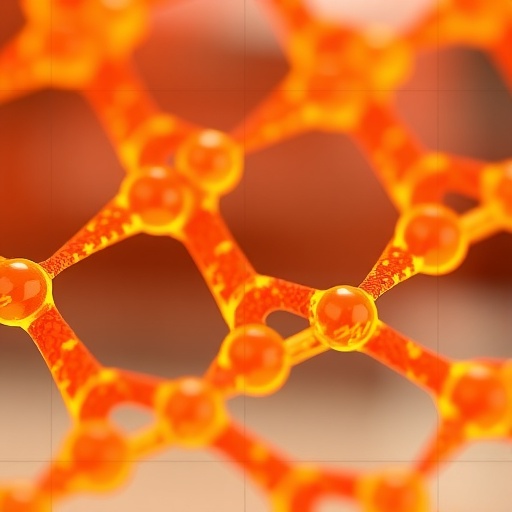
In the unseen molecular theater of modern materials, polymers perform a complex dance, their tangled chains resembling a chaotic bowl of noodles at the microscopic level. This entanglement has long stood as a formidable obstacle, resisting scientists’ efforts to decode and direct the fundamental properties of polymer-based materials. From the plastics that package our everyday goods to the flexible scaffolds in wearable electronics, these molecular knots dictate critical characteristics like strength, flexibility, and elasticity, yet their precise influence has remained elusive.
Breaking new ground in this intricate puzzle, researchers at The University of Hong Kong’s Department of Chemistry, led by Professors Yufeng Wang and Ho Yu Au-Yeung, have pioneered a transformative approach. By employing discrete molecular rings as highly controlled models of polymer knots, their study has unraveled the convoluted relationship between molecular architecture and the mechanical behavior of polymeric materials. This advancement shifts the paradigm from observing random molecular entanglements to strategically engineering materials at the nanoscale with predetermined properties.
At the core of their discovery lies the concept of “hidden length” within molecular rings—an internal slack that remains concealed until mechanical force is applied. Analogous to a seatbelt that instantly engages during a collision or a spring returning to its original shape, these molecular rings exhibit distinct mechanical responses depending on their topology. Simple macrocyclic rings harbor considerable internal slack, allowing them to unfurl under stress to absorb energy, resulting in materials exhibiting remarkable toughness and resilience.
Conversely, mechanically interlocked structures called catenanes form compact, constrained conformations with minimal hidden length. Such configurations behave like rapid-response springs, enabling materials to snap back swiftly after deformation. This intrinsic elasticity opens avenues for creating polymers that do not just endure mechanical strain but actively recover their shape, a property immensely valuable in fields requiring materials that combine flexibility with robustness.
Perhaps most striking is the researchers’ innovative use of metal ions—in this case, copper—to dynamically manipulate the internal slack within these molecular rings. The introduction of copper ions effectively “locks” the slack, transforming flexible polymer networks into more rigid constructs on demand. This metal-ion induced modulation introduces an unprecedented level of control, allowing material properties such as stiffness and elasticity to be finely tuned in real time, responsive to external stimuli.
This breakthrough heralds a new frontier for the development of “smart” materials capable of adapting their mechanical properties in situ. The ability to toggle between softness and rigidity through molecular topology adjustments offers tailored solutions for emerging technologies in soft robotics, tissue engineering, and wearable electronics. For soft robotics, these materials promise components that flex and bear loads without compromising durability. In tissue engineering, they emulate the dynamic biomechanical environment of living tissues, facilitating better integration and function of engineered constructs.
Wearable electronic devices, which demand both endurance against continuous mechanical stresses and flexible conformability to human movement, stand to immensely benefit from these innovations. By precisely orchestrating molecular knots and their hidden lengths, materials can be engineered to maintain integrity under strain while rebounding elastically, ensuring comfort and longevity in consumer electronics.
Beyond applications, this research provides profound insight into the molecular mechanics underlying polymer behavior—a topic that has confounded scientists for decades. By shifting from disordered tangles to well-defined cyclic architectures, the team decodes the language of molecular entanglements, transforming a chaotic mix into an interpretable, engineerable system. This molecular-level understanding opens expansive possibilities for the design of polymers that align with specific functional demands.
The experimental methodology employed integrates synthetic chemistry, advanced mechanical testing, and molecular topology analyses to achieve this intricate level of control. By crafting defined macrocyclic and catenane molecular structures and studying their response to mechanical forces, the researchers correlate precise structural features with measurable properties of the resulting gels and networks, bringing theory and experiment into congruent focus.
An exemplary highlight of their work is the reversible and controllable modulation of material properties upon metal ion incorporation. This metal switch mechanism operates by coordinating with specific sites on the molecular rings, enhancing rigidity by limiting internal slack without altering the chemical integrity of the polymer backbone. Such reversible control paves the way for materials that can adjust their performance parameters dynamically, responding to environmental triggers or operational demands.
The implications of this study reverberate through material science, chemistry, and engineering domains, broadening the toolkit available for designing next-generation polymers. It exemplifies how fundamental scientific inquiry into the subtleties of molecular topology can translate into practical materials with customized functionalities, that until now remained out of reach due to the intrinsic complexity of polymer entanglements.
As Professor Ho Yu Au-Yeung remarked, mastering the art of controlling molecular “knots” and tuning their hidden lengths empowers scientists to architect materials tailored to diverse needs, breaking free from the limits imposed by conventional polymer designs. Meanwhile, Professor Yufeng Wang envisions the profound impact this framework will have—from soft robotic actuators that mimic muscle movement to durable, flexible wearable tech—underscoring the broad interdisciplinary potential of these findings.
Supported by the Research Grants Council of Hong Kong and the CAS-HKU Joint Laboratory on New Materials, this pioneering work reflects a collaborative and forward-thinking research ethos. The project’s first authors, PhD candidates Tianjin Luo, Yulin Deng, and Mingda Hu, have contributed significant experimental expertise and insight, furthering our understanding of molecular topology’s role in material science.
The publication of this work in the Journal of the American Chemical Society not only cements its scientific merit but also signals a new chapter in polymer chemistry where control at the molecular level is no longer an aspirational goal but an achievable reality. The tangible ability to govern material properties via topology switching introduces a paradigm shift with the potential to redefine design principles across myriad applications, from biomedicine to advanced robotics.
In summary, this research transcends the traditional obstacles posed by polymer entanglements, unveiling a refined molecular toolkit. By precisely designing and controlling molecular rings and their hidden lengths, scientists can now engineer smart materials with tunable mechanical responses. This breakthrough opens limitless possibilities, heralding an era of polymers tailored with unprecedented precision for the demands of future technologies.
News Publication Date: 7-May-2026
Web References:
https://pubs.acs.org/doi/10.1021/jacs.6c01062
References:
Wang, Y., Au-Yeung, H.Y., Luo, T., Deng, Y., & Hu, M. (2026). Role of Molecular Topology Elucidated in Unified Gels. Journal of the American Chemical Society, DOI: 10.1021/jacs.6c01062.
Keywords
Polymer Materials, Molecular Topology, Macrocyclic Rings, Catenanes, Hidden Length, Mechanical Properties, Metal-ion Modulation, Smart Materials, Soft Robotics, Tissue Engineering, Wearable Electronics, Molecular Architecture
Cite Scienmag News
Bethany Barker. (June 12, 2026). HKU Chemists Crack the Code to Creating Ultra-Tough, Highly Responsive “Smart” Materials. Scienmag. https://scienmag.com/hku-chemists-crack-the-code-to-creating-ultra-tough-highly-responsive-smart-materials/
Bethany Barker. "HKU Chemists Crack the Code to Creating Ultra-Tough, Highly Responsive “Smart” Materials." Scienmag, 12 June 2026, https://scienmag.com/hku-chemists-crack-the-code-to-creating-ultra-tough-highly-responsive-smart-materials/. Accessed 5 September 2026.
Bethany Barker. "HKU Chemists Crack the Code to Creating Ultra-Tough, Highly Responsive “Smart” Materials." Scienmag. June 12, 2026. https://scienmag.com/hku-chemists-crack-the-code-to-creating-ultra-tough-highly-responsive-smart-materials/


