


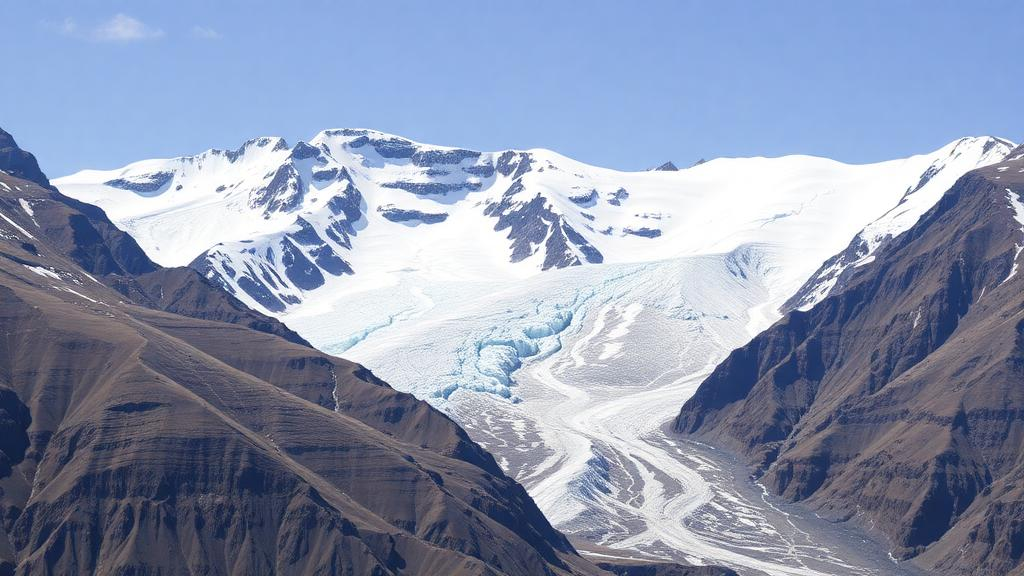
High in the Zanskar region of Ladakh, the glaciers that feed the Doda River are quietly rewriting the story of the Western Himalaya’s frozen water reserves. A new study published in Regional Environmental Change by Ajay Singh Rana, Vinit Kumar and Manish Mehta of the Wadia Institute of Himalayan Geology has assembled one of the most comprehensive pictures yet of how these ice masses have behaved over three decades, combining field observations with a battery of satellite datasets spanning 1993 to 2023. The verdict is sobering: the basin’s glaciers are shrinking, thinning and slowing down simultaneously, and the smallest of them are suffering the most.
The research team quantified five independent indicators of glacier health: total glacial area, frontal retreat, surface ice velocity, surface elevation change and geodetic mass balance. Measuring several variables across the same basin matters because any single metric can mislead. A glacier’s snout may advance while the ice behind it thins, or a debris-covered tongue may hold its position while the ice beneath stagnates. By triangulating between morphology, dynamics and mass, the authors built a picture of glacier response to both climatic and non-climatic controls that is far harder to dispute than any one measurement alone.
The headline numbers tell a clear story. The total glacierized area of the Doda sub-basin declined from roughly 356 square kilometres in 2005 to about 346 square kilometres in 2023, a loss of around three percent of the mapped ice cover in less than two decades. That figure, modest as it sounds, conceals a sharp size-dependent pattern. Glaciers smaller than five square kilometres lost 12.15 percent of their area, the highest relative loss of any size class, while glaciers larger than ten square kilometres showed comparatively modest reductions. Small ice bodies have less mass to buffer them against warming; their volume-to-surface-area ratio works against them, and once a small glacier begins to retreat, it can vanish within a generation.
Frontal retreat across the basin ranged from 9 plus or minus 2 to 13 plus or minus 3 metres per year. But the most striking contrast emerged between glaciers that end in lakes and those that terminate on land. Lake-terminating glaciers such as Durung-Drung and Mulung retreated faster than glaciers with no glacier-lake interaction. The mechanism is well understood in glaciology: when a glacier front pushes into a proglacial lake, the water attacks the ice cliff, calving accelerates retreat, and the lake itself expands, further destabilizing the terminus. In the Doda basin, this feedback loop has turned some of the region’s largest glaciers into the fastest losers.
Perhaps the most technically significant result concerns ice velocity. Using repeat satellite imagery, the team found that surface ice velocity declined by 44 percent for large glaciers and 33 percent for medium-sized glaciers between the 1999-2000 and 2022-2023 intervals. Slower ice is not healthier ice. Glacier speed reflects the driving stress that pushes ice downhill; when accumulation thins and the ice mass shrinks, the flow decelerates. A decelerating glacier is effectively a glacier that can no longer replenish its lower reaches, so the tongue stagnates, melts in place and thins from below. Velocity decline is therefore an early-warning signal of long-term decline, often preceding dramatic area loss.
To quantify how much ice the basin has actually lost, the researchers performed a geodetic mass balance analysis by differencing digital elevation models derived from the Shuttle Radar Topography Mission and ASTER satellite stereo imagery. The technique compares surface elevations at two points in time and converts the volume change into water equivalent using density assumptions. The result: a cumulative geodetic mass balance of minus 10.8 plus or minus 6.7 metres of water equivalent, or minus 0.60 plus or minus 0.44 metres per year, over the period 2000 to 2017. In plain terms, the basin’s glaciers lost the equivalent of nearly eleven metres of water spread across their entire surface in seventeen years, a rate consistent with accelerating ice loss documented across the Himalaya in recent global assessments.
The elevation-change maps revealed where the thinning concentrates. Enhanced thinning occurred near glacier termini and in zones with thin or patchy debris cover. This detail touches one of the more counterintuitive findings in Himalayan glaciology, first articulated in the classic work of Gösta Östrem in 1959: a thin layer of rock debris on ice absorbs more solar radiation than clean ice and actually accelerates melting, while only a thick debris blanket insulates the ice beneath. Patchy debris cover, therefore, creates a mosaic of enhanced ablation, and the Doda data show exactly that signature, with thin-debris zones thinning faster than either clean ice at altitude or thickly mantled tongues.
The climatic backdrop helps explain why. The team analysed a long-term climate record spanning 1901 to 2023 and found significant winter warming, with accumulation-season temperatures from November to April rising at roughly 0.01 degrees Celsius per year. Meanwhile, precipitation increased mainly during the ablation season from May to October. This combination is particularly damaging for glacier mass balance. Warmer winters mean more precipitation falls as rain rather than snow at glacier margins, reducing the snowpack that protects ice through the summer. Summer rainfall, by contrast, delivers energy that promotes melting precisely when the ice is most vulnerable, and rain falling on snow accelerates the loss of the reflective snow cover. The seasonal timing of these changes, rather than their magnitude alone, appears to have tipped the basin’s glaciers into sustained deficit.
The Doda sub-basin sits within the Zanskar Valley of Ladakh, a cold, arid, high-altitude environment where glaciers are the primary water infrastructure. Meltwater from the Durung-Drung and neighbouring glaciers sustains the Doda River, which joins the Zanskar and ultimately contributes to the Indus system on which agriculture and hydropower across the region depend. The authors highlight that the combined climatic and geomorphic factors accelerating glacier instability pose increasing risks to long-term water-resource sustainability in the Zanskar region. In a region where villages depend on glacier-fed streams for irrigation of barley and vegetable crops during the short growing season, the slow-motion loss of ice storage translates directly into future water insecurity, particularly in late summer when meltwater demand peaks.
What makes this study valuable beyond its regional findings is its methodological integration. Rather than relying on a single satellite record, the authors fused multi-source optical and radar datasets, validated them with field observations, and applied established statistical frameworks to the climate analysis. The size-dependent response they document, with small glaciers losing area fastest, lake-terminating glaciers retreating fastest and large glaciers losing velocity fastest, offers a template for predicting which ice masses in other Himalayan basins are most at risk. As the region’s glaciers continue their three-decade trajectory of shrinkage, slowdown and thinning, the Doda sub-basin stands as a detailed case study of how the Himalaya’s water towers are being drawn down, one melt season at a time.
Subject of Research: Multi-decadal glacier dynamics and mass loss in the Doda sub-basin, Western Himalaya
Article Title: Multi‑decadal assessment of glacier dynamics in the Doda sub‑Basin, Western Himalaya
Article References: Rana, A. S., Kumar, V., & Mehta, M. (2026). Multi‑decadal assessment of glacier dynamics in the Doda sub‑Basin, Western Himalaya. Regional Environmental Change, 26(4), Article 212. https://doi.org/10.1007/s10113-026-02700-0
Image Credits: AI Generated
DOI: 10.1007/s10113-026-02700-0
Keywords: glacier retreat, Doda basin, Ladakh, Western Himalaya, geodetic mass balance, surface ice velocity, debris cover, glacier lakes, climate change, Zanskar, remote sensing, water resources
Cite Scienmag News
Sloane Callahan. (October 7, 2026). Himalayan Glaciers Are Slowing Down and Shrinking, Thirty-Year Study of Ladakh’s Doda Basin Reveals. Scienmag. https://scienmag.com/himalayan-glaciers-are-slowing-down-and-shrinking-thirty-year-study-of-ladakhs-doda-basin-reveals/
Sloane Callahan. "Himalayan Glaciers Are Slowing Down and Shrinking, Thirty-Year Study of Ladakh’s Doda Basin Reveals." Scienmag, 7 October 2026, https://scienmag.com/himalayan-glaciers-are-slowing-down-and-shrinking-thirty-year-study-of-ladakhs-doda-basin-reveals/. Accessed 7 October 2026.
Sloane Callahan. "Himalayan Glaciers Are Slowing Down and Shrinking, Thirty-Year Study of Ladakh’s Doda Basin Reveals." Scienmag. October 7, 2026. https://scienmag.com/himalayan-glaciers-are-slowing-down-and-shrinking-thirty-year-study-of-ladakhs-doda-basin-reveals/


