


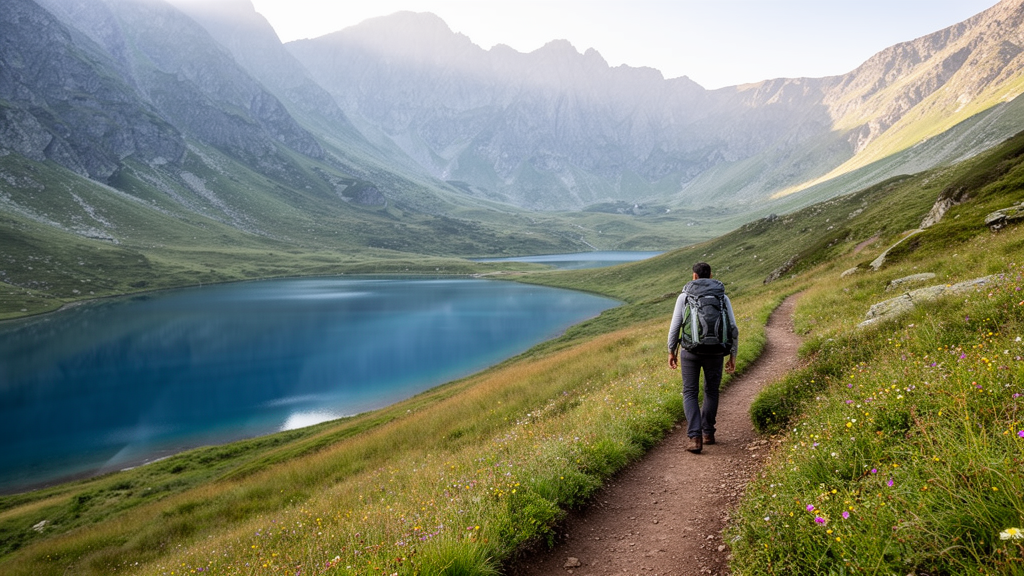
High in Bulgaria’s Rila Mountains, a chain of glacier-carved lakes has become one of the Balkans’ most beloved hiking destinations—and, according to growing public concern, a victim of its own popularity. The Seven Rila Lakes, a stepped cascade of alpine pools sitting between roughly 2,095 and 2,673 meters above sea level, draw tens of thousands of visitors each summer, many ferried close to the shorelines by a chairlift opened in 2009. For years, scientists and media alike have blamed this tourist influx for accelerating the eutrophication of the lakes, a process in which nutrient enrichment drives algal growth and degrades water quality. Now, a new study published in One Ecosystem offers the first targeted test of that assumption, and its findings are more nuanced than the popular narrative suggests.
The research, led by a team examining the relationship between the lakes’ ecological condition and the trail network threading through their catchments, set out to answer a deceptively simple question: does the degradation of hiking trails—widening, deepening, and the proliferation of informal paths—actually influence the trophic status of the water? The answer, based on Spearman’s rank correlation analysis, is that natural abiotic factors remain the primary drivers of the lakes’ eutrophication, while recreational pressure exerts a secondary, but detectable, influence. The distinction matters enormously for how the site is managed in the years ahead.
The study’s conceptual backbone is the DPSIR model—Driving Forces, Pressure, State, Impact, Responses—developed by the European Environment Agency. This framework allowed the researchers to systematically separate natural processes from anthropogenic pressures, hypothesising that while eutrophication in the lakes occurs naturally as part of their glacial-lake evolution, it is markedly intensified by recreational activities that degrade soil and vegetation in the watersheds. The team grounded its approach in recreational ecology, a field that examines how outdoor leisure activities affect vegetation, soil, wildlife, and water. Direct impacts on water bodies include increased turbidity, higher nutrient influx, and the introduction of exotic species, while indirect effects manifest as shifts in species composition and increased algal growth.
Five of the seven lakes—Bubreka, Bliznaka, Trilistnika, Ribno, and Dolno—were included in the analysis, representing 71.4% of the total population. Salzata and Okoto were excluded due to gaps in available ecological status data. The researchers compiled morphometric and hydro-climatic characteristics from decades of Bulgarian hydrological records, ecological status assessments based on Biological Quality Elements including phytoplankton, macrophytes, macrozoobenthos, and zooplankton communities, and trail characteristics from a 2020 field survey measuring width, maximum depth, and a derived cross-sectional area indicator of degradation at 17 points within the lakes’ catchments. Trail density and dispersion were derived from a GIS-based inventory of the entire trail network in the Seven Rila Lakes Cirque.
The statistical picture is complicated by the small sample size of just five lakes, which limits the study’s statistical power and the generalisability of its conclusions. Most correlations did not reach conventional levels of statistical significance, and confidence intervals computed using Fisher’s transformation were frequently broad. Nevertheless, the patterns that emerged are instructive. Abiotic factors—altitude, catchment area, lake depth, water volume, and warm-season temperatures—showed strong relationships with macrophyte assessments (rho = 0.9 with mean air temperature), macrozoobenthos evaluations (rho = 0.9 with lake surface area), and zooplankton community structure indices such as Pielou’s evenness (rho = 1.0 with altitude, p = 0.02—the sole statistically significant result in the study).
When the researchers turned to trail characteristics, a different set of relationships surfaced. Phytoplankton biomass correlated strongly with average trail dispersion (rho = 0.825), zooplankton abundance showed a very strong correlation with trail density (rho = 0.8), and zooplankton biomass correlated strongly with average maximum trail depth (rho = 0.8). The Shannon-Weaver biodiversity index for zooplankton correlated particularly strongly with average trail dispersion (rho = 0.975, p = 0.1, with a narrow confidence interval entirely within the positive range). Meanwhile, macrophyte assessments—often cited in prior literature as the primary indicator of recreation-induced eutrophication in oligotrophic mountain lakes—correlated poorly with trail indicators, challenging earlier conclusions about their relevance.
The mechanism the researchers propose is one of dispersed visitor pressure. Rather than concentrating foot traffic on formal trails, the unregulated visitor flow in the Seven Rila Lakes Cirque has generated nearly 35 kilometres of informal trail networks across approximately 4.5 square kilometres, roughly half of which show moderate to extreme degradation. These informal paths are more susceptible to erosion than maintained trails, leading to vegetation destruction and soil exposure. Runoff from these degraded surfaces carries eroded materials, mineral salts, and nutrients into the lakes, subtly altering water alkalinity and physicochemical parameters. Even minor changes in these parameters can affect phytoplankton and zooplankton communities, which are highly sensitive to water chemistry, ultimately influencing the trophic status of the lakes.
This interpretation aligns with previous research on the Seven Rila Lakes. Earlier studies demonstrated that nutrient concentrations depend on soil cover in the drainage basins, and that increasing nutrient influx over recent decades has contributed to a shift from oligotrophic toward mesotrophic conditions in some lakes. Sediment records reveal the cumulative effects of atmospheric pollution and reduced snow cover over the past 150 years, while diatom and zooplankton communities have been shown to respond to even small changes in water chemistry and temperature. The new study’s findings also echo broader recreational ecology research showing that informal trails degrade faster than formal ones, causing disproportionate vegetation loss and soil erosion.
From a management perspective, the study underscores the need for regular monitoring of both the ecological status of the lakes and the condition of the trails in their catchments, ideally at least once every five years. The researchers recommend daily monitoring of visitor numbers and behaviour, reduction of the trail network to a minimum, technical measures to minimise erosion in sections with intensive incision, and measures to limit the diffusion of visitor flow and regulate visitor numbers where necessary. Pre-visit information outlining rules of conduct and potential negative impacts, alongside the development of an ecotourism product highlighting the lakes’ natural heritage values, could further reduce pressure while fostering human-nature synergies.
The study represents the first targeted attempt to explain the mechanism by which recreation negatively impacts the water ecosystems of the Seven Rila Lakes. While it lacks definitive conclusiveness due to its small sample size and the absence of comparable methodological studies in the scientific literature, it corroborates long-standing concerns about eutrophication processes induced by recreational activities. Natural factors play the leading role, but the uncontrolled diffusion of visitor flow—generating informal paths and increasing spatial tourism pressure on the catchment areas—leads to adverse changes in phytoplankton and zooplankton communities. The researchers call for expanded datasets and broader-scale research to refine these findings, alongside visitor management measures to preserve the natural heritage of this iconic Bulgarian destination for generations to come.
Subject of Research: Environmental Science
Article Title: Hiking trail impacts on eutrophication of the Seven Rila Lakes, Rila National Park, Bulgaria
Article References: Mitova, R. (2025). Hiking trail impacts on eutrophication of the Seven Rila Lakes, Rila National Park, Bulgaria. One Ecosystem, 10, Article e139690. https://doi.org/10.3897/oneeco.10.e139690
Image Credits: AI Generated
DOI: 10.3897/oneeco.10.e139690
Keywords: eutrophication, Seven Rila Lakes, hiking trails, recreational ecology, Rila National Park, alpine lakes, zooplankton, phytoplankton, trail erosion, Bulgaria, Hiking, trail
Cite Scienmag News
Gavin Prescott. (October 18, 2026). Hiking Trails Leave a Subtle but Measurable Mark on Bulgaria’s Famous Seven Rila Lakes. Scienmag. https://scienmag.com/hiking-trails-leave-a-subtle-but-measurable-mark-on-bulgarias-famous-seven-rila-lakes/
Gavin Prescott. "Hiking Trails Leave a Subtle but Measurable Mark on Bulgaria’s Famous Seven Rila Lakes." Scienmag, 18 October 2026, https://scienmag.com/hiking-trails-leave-a-subtle-but-measurable-mark-on-bulgarias-famous-seven-rila-lakes/. Accessed 18 October 2026.
Gavin Prescott. "Hiking Trails Leave a Subtle but Measurable Mark on Bulgaria’s Famous Seven Rila Lakes." Scienmag. October 18, 2026. https://scienmag.com/hiking-trails-leave-a-subtle-but-measurable-mark-on-bulgarias-famous-seven-rila-lakes/


