

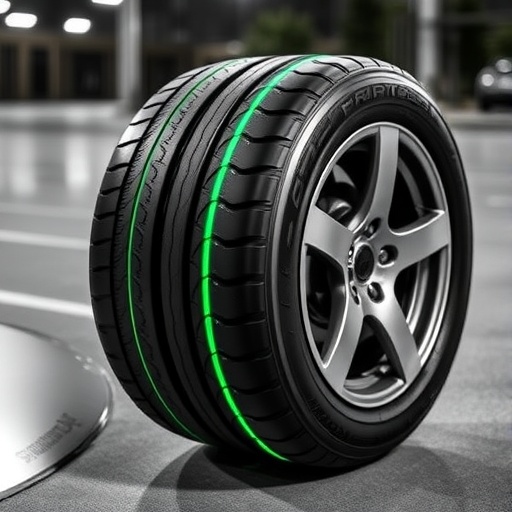
Tire cornering stiffness represents a critical aspect in the dynamics of vehicle performance, particularly when assessing how vehicles respond during high-speed maneuvers. As the automotive sector increasingly pivots toward improved performance and safety, accurate measurements of this parameter have become indispensable. A recent study conducted by researchers L. Grabbe and R. Mayer delves deep into the realm of High-Speed Sensitivity (HSS) measurements, providing an innovative approach to evaluate tire cornering stiffness under high-speed conditions.
Understanding tire cornering stiffness is essential for various aspects of vehicle dynamics, including steering response, traction, and overall stability. Theoretical models suggest that as speed increases, tires behave differently due to factors such as thermal effects and dynamic changes in contact patches. Traditional measurement techniques often fall short when it comes to providing an accurate representation of tire behavior at elevated speeds. The current research therefore shines a spotlight on a hitherto underexplored aspect—a standardized test procedure that integrates both high-speed sensitivity measurements and cornering stiffness assessments.
One of the main challenges in high-speed tire testing is the complexity of accurately capturing the tire’s response to lateral forces. At low speeds, tires exhibit predictable behaviors, and conventional testing techniques yield reliable data. However, the dynamics shift significantly as the speed increases, influenced by various factors including centrifugal forces and material properties of the tire itself. Grabbe and Mayer’s study specifically addresses these challenges by implementing a methodical approach that brings newfound precision to the measurement of cornering stiffness.
The methodology employed in this study introduces sophisticated instrumentation capable of capturing tire behavior with high temporal resolution. This approach integrates advanced sensors, data acquisition systems, and real-time processing to analyze tire responses to lateral forces. By utilizing a controlled environment that simulates real-world high-speed conditions, the researchers were able to derive empirical data that offers insights into the physical phenomena occurring at the contact patch between the tire and the road.
During high-speed cornering, the contact patch—the area of the tire that engages with the road—undergoes rapid changes. These changes include alterations in shape, size, and pressure distribution, all of which can significantly affect cornering stiffness. Grabbe and Mayer’s findings reveal that traditional models fail to account for these dynamic changes, particularly under conditions of extreme lateral acceleration. The research underscores the importance of recalibrating existing models to incorporate these high-speed effects.
The significance of this study extends beyond mere academic interest; it has practical implications for the automotive industry. Improved tire cornering stiffness measurements can lead to better vehicle designs, enhance safety features, and optimize performance metrics. For manufacturers, understanding the nuanced behavior of tires at speed can guide the development of new tire compounds and structures that enhance grip and handling without compromising durability.
Moreover, the study opens avenues for future research into the relationship between tire performance and vehicle dynamics under high-speed conditions. The implications for autonomous driving, where vehicles rely heavily on precise feedback from tire behavior, are profound. Enhanced accuracy in cornering stiffness measurements can facilitate better decision-making algorithms, ultimately leading to safer and more responsive self-driving technologies.
As the automotive landscape evolves with the advent of electric and autonomous vehicles, the relevance of tire dynamics cannot be overstated. Research like that conducted by Grabbe and Mayer becomes foundational for engineers and designers aiming to push the boundaries of vehicle performance. By recalibrating our understanding of tire cornering stiffness and its dependencies at high speeds, the study represents a significant leap toward integrating advanced metrics into vehicle dynamics.
In a world where every fraction of a second can determine the outcome of a maneuver, the precision offered by this new testing procedure cannot be underestimated. It allows for more reliable simulations of vehicle behavior, which in turn leads to enhancement in driver experience and safety. Thorough investigations of tire characteristics at varying speeds will undoubtedly drive innovation across the automotive spectrum.
Additionally, this research could catalyze new regulatory standards for tire testing, ensuring that safety benchmarks account for high-speed performance capabilities. Enhanced testing protocols will not only fortify safety measures but also empower manufacturers to develop superior tire systems that meet the evolving demands of modern vehicles. Thus, the study serves both academic and industrial communities, paving the way for innovative solutions and improved safety protocols.
In conclusion, Grabbe and Mayer’s exploration of HSS measurements presents a transformative approach to understanding tire dynamics. With its potential to redefine cornering stiffness measurement in high-speed contexts, this research is set to influence future studies and applications within automotive engineering. The synthesis of advanced measurement techniques and theoretical models marks a new chapter in tire performance evaluation, ensuring that the industry can aim for higher standards in safety and performance metrics.
As the automotive industry continues to advance, staying ahead of the curve with nuanced and precise measurement approaches will play a vital role in driving the future of automotive engineering. The significance of research like that of Grabbe and Mayer resonates across the industry, producing ripples that are likely to enhance the safety and performance of vehicles for years to come.
Ultimately, the evolution of tire cornering stiffness measurement is a testament to the relentless pursuit of innovation within the automotive realm. Engaging with new methodologies and embracing high-speed testing will undoubtedly lead to a new era in vehicle dynamics, and industry professionals must adapt to these changes to remain competitive and enhance vehicle performance and safety standards.
Subject of Research: Tire Cornering Stiffness at High Speeds
Article Title: HSS-measurements, high-speed sensitivity measurements, HSS-measurements: a test procedure of tire cornering stiffness measurements at high speeds.
Article References:
Grabbe, L., Mayer, R. HSS-measurements, high-speed sensitivity measurements, HSS-measurements: a test procedure of tire cornering stiffness measurements at high speeds.
Automot. Engine Technol. 8, 43–53 (2023). https://doi.org/10.1007/s41104-022-00125-5
Image Credits: AI Generated
DOI: https://doi.org/10.1007/s41104-022-00125-5
Keywords: Tire Cornering Stiffness, High-Speed Sensitivity, Vehicle Dynamics, Automotive Engineering, Tire Testing, Performance Measurement, Safety Standards.


