


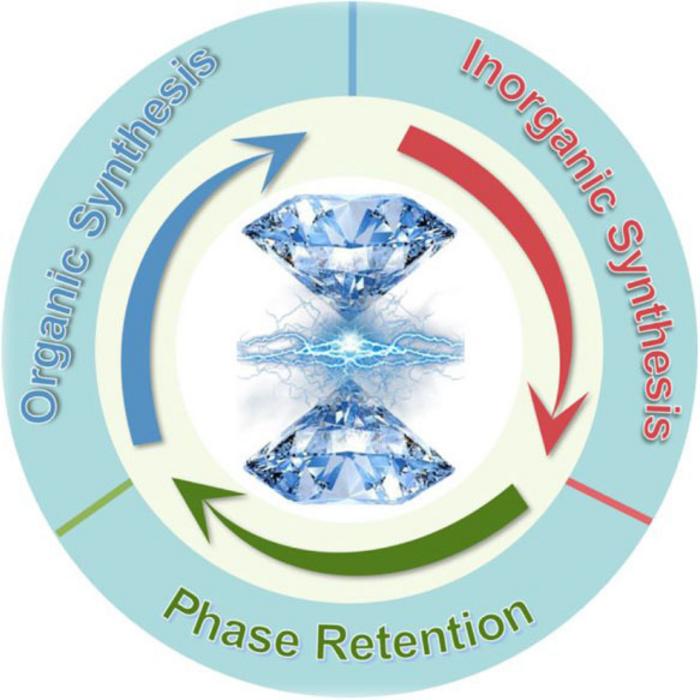
In the realm of chemical synthesis, a transformative frontier is rapidly unfolding: the application of high pressure to drive the formation of novel materials with extraordinary properties. A recent comprehensive review published in CCS Chemistry by Professor Guanjun Xiao and Professor Bo Zou of Jilin University, alongside esteemed colleagues from Beijing High Pressure Science Research Center and Hainan University, encapsulates the remarkable advances and promising future directions of high-pressure-driven chemical synthesis. This paradigm not only broadens the horizons of material science but also redefines how we approach the molecular design of next-generation functional materials.
Traditional chemical synthesis approaches, both organic and inorganic, have reached a crossroads where incremental improvements no longer suffice to meet the demands of modern technologies and societal needs. Functional materials underpin innovations in national defense, healthcare, energy, and electronics, yet their performance boundaries are increasingly constrained by conventional synthetic methods. Thus, leveraging external parameters such as extreme pressure emerges as a powerful alternative, enabling new reaction pathways and novel structural configurations that are unattainable under ambient conditions.
The principle behind high-pressure chemical synthesis is deceptively straightforward yet profoundly impactful. By applying external pressure, typically through large-volume presses or diamond anvil cells, interatomic distances within chemical species are drastically reduced, fundamentally altering electronic interactions and bonding patterns. Such compression can induce phase transitions, promote otherwise inaccessible reaction intermediates, and stabilize metastable phases that possess unique physical and chemical properties. Unlike internal chemical pressure, which often entails changes in chemical composition, external pressure exerts a uniform force that preserves the material’s stoichiometry while reshaping its structural landscape.
The review meticulously dissects the progress achieved in synthesizing a wide array of organic and inorganic compounds under high pressure. For organic materials, pressure-induced polymerization and cross-linking reactions have yielded polymers with enhanced mechanical strength and novel optoelectronic characteristics. In the inorganic domain, researchers have synthesized superhard materials exhibiting remarkable hardness and thermal stability, superconductors with unprecedented critical temperatures, and thermoelectric compounds with improved energy conversion efficiency. Each class of materials underscores the versatility of high-pressure synthesis, showcasing its ability to tailor properties through controlled structural transformation.
One of the most compelling aspects highlighted is the concept of high-pressure phase trapping. Typically, phases formed under extreme pressure revert to their original forms once the pressure is released, limiting practical applications. However, the review outlines innovative strategies to kinetically stabilize such high-pressure phases at ambient conditions, thus unlocking their potential for widespread use. Approaches like harnessing nanoscale effects, spatial steric hindrance, and synergistic hydrogen bonding create kinetic barriers that prevent reversion, enabling the retention of these valuable metastable phases outside the high-pressure environment.
Nanoscale dimensions, for instance, provide confinement effects that can effectively “lock-in” high-pressure phases. When materials are reduced to nanometric scales, their surface energy landscape changes dramatically, inhibiting phase transitions back to lower-pressure states. Additionally, spatial steric hindrance involves designing molecular or crystalline architectures that physically obstruct structural relaxation, while hydrogen bond synergy enhances phase stability by reinforcing intermolecular interactions under decompression.
Despite the impressive achievements, the review candidly acknowledges persistent challenges in the field. Precise atomic-scale characterization of products synthesized under extreme conditions remains difficult, often necessitating complex in-situ techniques such as synchrotron X-ray diffraction or Raman spectroscopy integrated within high-pressure apparatus. Moreover, the extraordinary costs and operational complexity associated with maintaining and manipulating high-pressure reactors limit broader experimental accessibility. The lack of sensitive, real-time microscopic diagnostics further constrains efforts to fully elucidate reaction mechanisms and phase dynamics under pressure.
Looking ahead, the authors advocate for strategic advancements aimed at overcoming these hurdles. Simplification and miniaturization of high-pressure equipment promise to democratize access and increase experimental throughput. Breaking through existing pressure-volume trade-offs will enable larger sample synthesis without sacrificing the achievable pressure range. Equally important is the development of innovative in-situ characterization tools capable of providing atomic-resolution insight into trapped amorphous high-pressure phases—a critical step for tailoring materials with desired functionalities.
The implications of high-pressure-driven chemical synthesis extend well beyond academic interest. Controlled preparation of superhard materials caters to cutting-edge industrial applications such as abrasion-resistant coatings and tools. Superconducting and thermoelectric materials synthesized under pressure portend energy-efficient electronic devices and novel sensor technologies. Additionally, optoelectronic materials generated through such means push the boundaries of photonics and quantum computing. This confluence of scientific discovery and application underscores the strategic importance of high-pressure chemistry in modern material innovation.
Professor Bo Zou’s team, notable for pioneering trapping strategies of metastable phases, plays a pivotal role in translating high-pressure chemistry concepts into scalable technologies. Their insights into nanoscale confinement and molecular design principles exemplify the interdisciplinary approach needed for progress. The capability to stably “trap” high-performance phases at ambient conditions unlocks the door to mass production using large-volume pressure methods, a critical transition from laboratory curiosity to commercial viability.
Beyond the confines of chemistry, high-pressure synthesis offers an invaluable proxy for understanding geophysical processes deep within Earth’s mantle, where conditions mirror those generated artificially. Simulating extreme environments sheds light on mineral phase behaviors, providing clues about Earth’s interior composition and dynamics. This cross-disciplinary relevance enhances the appeal of high-pressure techniques, positioning them as a core tool across physical sciences.
Nevertheless, the journey is far from complete. Future research must continue unraveling the atomic-level transformations and kinetic principles governing phase trapping. Bridging the gap between experimental realizations and theoretical predictions will accelerate discovery. Concurrently, cost-effective and user-friendly instrumentation will enable wider participation from global scientific communities, fostering synergistic advances across materials science, physics, and engineering.
In essence, the reviewed work published in CCS Chemistry not only heralds a new era for chemical synthesis but also epitomizes the profound impact of pressure as a variable in material design. By pushing materials into realms of structural and functional complexity unattainable at ambient conditions, high-pressure-driven synthesis enriches the palette for innovators, unlocking new properties and applications. As researchers refine methodologies and tackle remaining challenges, high-pressure chemistry stands poised to shape the next generation of materials science and technology with unprecedented precision and scope.
—
Cite Scienmag News
Bethany Barker. (May 21, 2025). High-Pressure Techniques Propel Advances in Chemical Synthesis. Scienmag. https://scienmag.com/high-pressure-techniques-propel-advances-in-chemical-synthesis/
Bethany Barker. "High-Pressure Techniques Propel Advances in Chemical Synthesis." Scienmag, 21 May 2025, https://scienmag.com/high-pressure-techniques-propel-advances-in-chemical-synthesis/. Accessed 4 September 2026.
Bethany Barker. "High-Pressure Techniques Propel Advances in Chemical Synthesis." Scienmag. May 21, 2025. https://scienmag.com/high-pressure-techniques-propel-advances-in-chemical-synthesis/


