


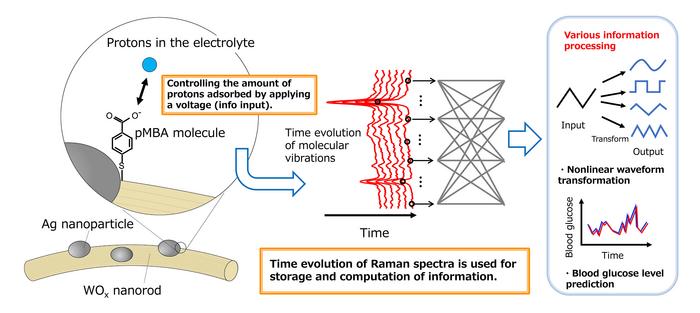
1. A collaborative research team from NIMS and Tokyo University of Science has successfully developed a cutting-edge artificial intelligence (AI) device that executes brain-like information processing through few-molecule reservoir computing. This innovation utilizes the molecular vibrations of a select number of organic molecules. By applying this device for the blood glucose level prediction in patients with diabetes, it has significantly outperformed existing AI devices in terms of prediction accuracy.

Credit: Takashi Tsuchiya
National Institute for Materials Science
1. A collaborative research team from NIMS and Tokyo University of Science has successfully developed a cutting-edge artificial intelligence (AI) device that executes brain-like information processing through few-molecule reservoir computing. This innovation utilizes the molecular vibrations of a select number of organic molecules. By applying this device for the blood glucose level prediction in patients with diabetes, it has significantly outperformed existing AI devices in terms of prediction accuracy.
2. With the expansion of machine learning applications in various industries, there’s an escalating demand for AI devices that are not only highly computational but also feature low-power consumption and miniaturization. Research has shifted towards physical reservoir computing, leveraging physical phenomena presented by materials and devices for neural information processing. One challenge that remains is the relatively large size of the existing materials and devices.
3. Our research has pioneered the world’s first implementation of physical reservoir computing that operates on the principle of surface-enhanced Raman scattering, harnessing the molecular vibrations of merely a few organic molecules. The information is inputted through ion-gating, which modulates the adsorption of hydrogen ions onto organic molecules (p-mercaptobenzoic acid, pMBA) by applying voltage. The changes in molecular vibrations of the pMBA molecules, which vary with hydrogen ion adsorption, serve the function of memory and nonlinear waveform transformation for calculation. This process, using a sparse assembly of pMBA molecules, has learned approximately 20 hours of a diabetic patient’s blood glucose level changes and managed to predict subsequent fluctuations over the next 5 minutes with an error reduction of about 50% compared to the highest accuracy achieved by similar devices to date.
4. The outcome of this study indicates that a minimal quantity of organic molecules can effectively perform computations comparable to a computer. This technological breakthrough of conducting sophisticated information processing with minimal materials and in tiny spaces presents substantial practical benefits. It paves the way for the creation of low-power AI terminal devices that can be integrated with a variety of sensors, opening avenues for broad industrial use.
***
5. The research initiative was spearheaded by Daiki Nishioka, serving as a Trainee in Ionic Devices Group at NIMS, Research Center for Materials Nanoarchitectonics (MANA), who is also a Japan Society for the Promotion of Science (JSPS) Research Fellow at Tokyo University of Science, and Takashi Tsuchiya, Principal Researcher, and Kazuya Terabe, Group Leader, both part of Ionic Devices Group at MANA, NIMS. This project is a segment of the “Nano Materials for New Principle Devices,” supervised by Yoshihiro Iwasa, and is focused on the “Creation of Ultrafast Iontronics” under the auspices of JST PRESTO (JPMJPR23H4).
6. The findings of this research was published online in the Science Advances journal at 4 a.m. Japan time on February 29, 2024.
Journal
Science Advances
Method of Research
Experimental study
Subject of Research
Not applicable
Article Title
Few- and single-molecule reservoir computing experimentally demonstrated with surface-enhanced Raman scattering and ion gating
Article Publication Date
28-Feb-2024
Cite Scienmag News
Violet Maxwell. (April 25, 2024). High-precision blood glucose level prediction achieved by few-molecule reservoir computing. Scienmag. https://scienmag.com/high-precision-blood-glucose-level-prediction-achieved-by-few-molecule-reservoir-computing/
Violet Maxwell. "High-precision blood glucose level prediction achieved by few-molecule reservoir computing." Scienmag, 25 April 2024, https://scienmag.com/high-precision-blood-glucose-level-prediction-achieved-by-few-molecule-reservoir-computing/. Accessed 5 September 2026.
Violet Maxwell. "High-precision blood glucose level prediction achieved by few-molecule reservoir computing." Scienmag. April 25, 2024. https://scienmag.com/high-precision-blood-glucose-level-prediction-achieved-by-few-molecule-reservoir-computing/

