


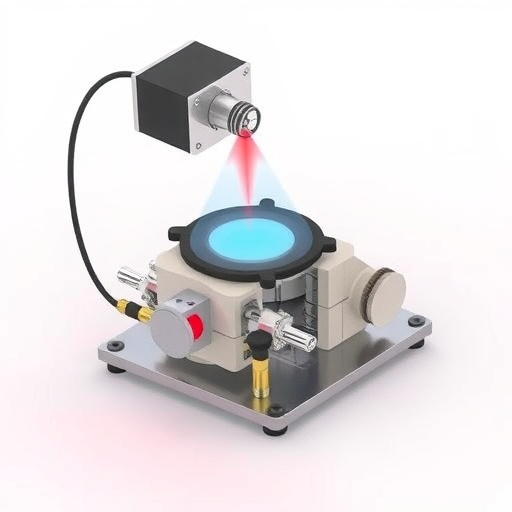
In recent years, the quest for precision and quality in additive manufacturing has driven researchers to explore innovative monitoring techniques for laser powder bed fusion (LPBF), a dominant 3D printing method for metals. A breakthrough study by Penny, Kutschke, and Hart published in npj Advanced Manufacturing introduces a high-fidelity optical monitoring system leveraging aperture division multiplexing, promising transformative advances in real-time process control. This novel approach offers unparalleled spatial and temporal resolution, critical to optimizing LPBF and ensuring the production of defect-free metal components.
Laser powder bed fusion involves selectively melting layers of metal powder with a high-power laser, building parts layer by layer with complex geometries. Despite its widespread adoption in aerospace, automotive, and medical device fabrication, LPBF still faces challenges related to porosity, residual stress, and geometric inaccuracies. These flaws largely arise due to the stochastic nature of melt pool dynamics and variations in process parameters, which are difficult to monitor in real time. Traditional sensors often lack the resolution or speed required to capture transient phenomena inherent to the LPBF process.
The research team addresses these limitations by developing an optical monitoring system using aperture division multiplexing, a technique that subdivides the optical measurement aperture into multiple channels, allowing simultaneous high-speed acquisition of spatially distinct signals. Unlike conventional single-aperture cameras or photodetectors that trade off spatial or temporal resolution, this multiplexing strategy enables concurrent high-fidelity capture across separate sections of the melt pool and powder bed. The approach dramatically enhances the capability to detect subtle process fluctuations.
Central to the design is a custom optical setup where the incoming thermal and visible light emitted by the melt pool is split through an array of pinhole apertures, each directing light to dedicated photodetector elements synchronized for synchronized acquisition. This architecture allows multiplexing signals from multiple spatial locations without compromising frame rate or sensitivity. By carefully calibrating the system, the team extracts high-resolution images and thermal maps depicting melt pool behavior with microsecond temporal granularity.
The data produced through aperture division multiplexing reveals precise spatiotemporal molten metal dynamics, for the first time allowing researchers to observe rapid fluctuations in melt pool morphology, temperature gradients, and solidification fronts during the LPBF process. These insights are crucial for understanding defect formation mechanisms, such as keyhole instability and lack-of-fusion pores, which occur on timescales too fast for previous monitoring solutions to capture reliably.
Operating the system on an industrial LPBF platform, Penny and colleagues demonstrate its ability to detect anomalies indicative of process deviations or incipient defects in situ. By implementing algorithms processing the multiplexed optical data streams, the system identifies process drifts, recoil pressure instabilities, and powder spatter events in real time. This capability opens avenues for closed-loop control strategies where the laser power or scan speed can be adjusted instantly to mitigate emerging defects, significantly improving build quality.
The implications of this optical monitoring advancement extend beyond defect detection. By capturing melt pool thermal maps with exquisite detail, the technology enables a deeper understanding of thermal gradients and their impact on microstructural evolution and residual stress development. This knowledge is vital for tailoring post-processing treatments and optimizing process parameters for specific alloy systems, ultimately enhancing the mechanical performance of printed parts.
A significant aspect of the system is its modular and scalable design, allowing integration with existing LPBF machines without extensive hardware modifications. The aperture division multiplexing module is compact and compatible with standard optical paths, facilitating rapid adoption in industrial settings. Additionally, the data acquisition hardware supports customization, enabling manufacturers to tune spatial resolution and frame rates according to their production requirements.
The study also benchmarks the performance of the aperture division multiplexing system against conventional monitoring techniques such as coaxial photodetectors and infrared cameras. The results confirm superior sensitivity to transient melt pool phenomena and better discrimination of subtle thermal fluctuations that precede defect formation. This performance leap validates the proposed approach as a new standard for in situ LPBF process monitoring.
Looking forward, the integration of this high-fidelity optical system with machine learning algorithms holds promise for automated feature extraction and predictive defect detection. Real-time pattern recognition applied to the multiplexed data streams could empower smart manufacturing platforms, enabling self-optimizing additive fabrication environments. This synergy between advanced sensing and artificial intelligence could revolutionize how metal parts are produced, ensuring consistent quality with minimal human intervention.
Moreover, the principles of aperture division multiplexing may be adapted to other manufacturing processes requiring high-resolution thermal or optical monitoring. Its successful application in LPBF sets a precedent for deploying multiplexed sensing in welding, laser machining, or even biomedical procedures where rapid, spatially distributed data collection is paramount. Thus, this technique could become a versatile tool in precision manufacturing and process diagnostics.
The robust optical signals captured by the system also facilitate advanced computational modeling of LPBF melt pools. By providing empirical data with unprecedented detail, researchers can validate and refine multiphysics simulations that incorporate thermal-fluid dynamics, phase change, and metallurgical phenomena. This iterative experimental-computational approach accelerates the development of predictive models essential for next-generation additive manufacturing.
In summary, the work of Penny, Kutschke, and Hart represents a significant milestone in additive manufacturing research, demonstrating how innovative optical engineering combined with multiplexing concepts can overcome longstanding monitoring challenges in laser powder bed fusion. Their high-fidelity optical monitoring system offers comprehensive spatial and temporal insight into melt pool behavior, enabling real-time defect detection and process control that were previously unattainable.
As industries increasingly demand reliable, high-performance metal parts produced additively, such breakthroughs in process monitoring are crucial. The ability to intervene during printing, guided by precise optical measurements, not only reduces scrap and rework but also paves the way to certify additive parts for safety-critical applications. This technology, therefore, holds profound implications for the future of manufacturing across sectors.
The study’s publication in the reputable npj Advanced Manufacturing underscores the interest and urgency in the field to push forward sensing capabilities in additive processes. It highlights an inspiring example of interdisciplinary innovation, combining optics, materials science, and manufacturing engineering to tackle complex real-world challenges. Further research and development inspired by these findings will likely continue to refine and expand high-fidelity monitoring solutions.
In conclusion, aperture division multiplexing emerges as a powerful framework for next-generation process monitoring, offering manufacturers unprecedented insight to realize the full potential of laser powder bed fusion. By enabling a clearer window into the laser-metal interaction zone, this technology promises to elevate additive manufacturing from artisanal trial-and-error into a precise, automated industrial process—poised to transform how we build the future.
Penny, R.W., Kutschke, Z. & Hart, A.J. High-fidelity optical monitoring of laser powder bed fusion via aperture division multiplexing.
npj Adv. Manuf. 2, 28 (2025). https://doi.org/10.1038/s44334-025-00039-8
Cite Scienmag News
Denise Maddox. (July 2, 2025). High-Fidelity Optical Monitoring of Laser Fusion. Scienmag. https://scienmag.com/high-fidelity-optical-monitoring-of-laser-fusion/
Denise Maddox. "High-Fidelity Optical Monitoring of Laser Fusion." Scienmag, 2 July 2025, https://scienmag.com/high-fidelity-optical-monitoring-of-laser-fusion/. Accessed 4 September 2026.
Denise Maddox. "High-Fidelity Optical Monitoring of Laser Fusion." Scienmag. July 2, 2025. https://scienmag.com/high-fidelity-optical-monitoring-of-laser-fusion/


