


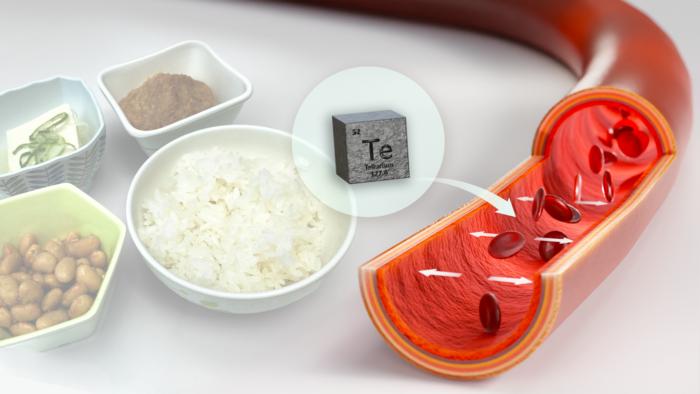
The likelihood of developing high blood pressure (hypertension) increases with higher levels of tellurium, a contaminant transferred from mining and manufacturing activities to foods. Improved monitoring of tellurium levels in specific foods could help decrease high blood pressure in the general population. The results of a study examining the relationship between tellurium exposure and hypertension were published in the journal Environment International.

Credit: Reiko Matsushita
The likelihood of developing high blood pressure (hypertension) increases with higher levels of tellurium, a contaminant transferred from mining and manufacturing activities to foods. Improved monitoring of tellurium levels in specific foods could help decrease high blood pressure in the general population. The results of a study examining the relationship between tellurium exposure and hypertension were published in the journal Environment International.
The study was led by Nagoya University in Japan. According to Takumi Kagawa, one of the researchers involved in the study, the findings are significant as they indicate that tellurium exposure may contribute to elevated blood pressure, a significant public health concern. “The results indicate diet was the most significant contributor to increased urinary tellurium levels, compared to other lifestyle factors, such as smoking and working status, and physiological factors, such as age and sex. Dietary intake, an important aspect of our lifestyle, plays a significant role in increased urinary tellurium concentrations.”
In Japan, cereals and legumes, represented by rice and natto (fermented soybeans), are popular dietary choices. These foods are packed with essential nutrients, such as high-quality carbohydrates, vitamins, and minerals, that support a person’s health.
However, tellurium, a rare metalloid, can also be present in these foods. Mining and manufacturing activities release dust, ash, and slag, which are responsible for the presence of tellurium in the soil. In certain cases, it can be transferred from the soil to crop plants, such as cereals, carrots, and garlic. Consequently, people are exposed to tellurium through food.
The study conducted by Professor Masashi Kato, Takumi Kagawa, and their colleagues involved 2,592 Japanese adults. It revealed that higher levels of tellurium in urine were associated with higher blood pressure and a greater occurrence of hypertension. The results were the same in both mice and humans.
“We administered tellurium to mice in amounts equivalent to what humans might encounter daily and observed an increase in blood pressure,” Tomoko Misawa, the lead author of the study, explained. “When we stopped the exposure, both the blood pressure and the tellurium levels in their urine decreased. These results provide a direct link between tellurium exposure and increased blood pressure, confirming findings in humans.”
Professor Kato and his team also studied foods that raise the levels of tellurium in urine. They discovered that the consumption of cereals and legumes caused high levels of tellurium, but further testing did not establish a direct link to high blood pressure rates.
“We found that despite raising tellurium levels in the urine, cereal/legume intake did not directly increase the risk of hypertension,” said Takumi Kagawa. “Cereals/legumes may contain many diverse nutrients that can mitigate the risk of hypertension despite high levels of tellurium. However, considering that increased tellurium exposure is a latent risk factor for hypertension and foods contribute to this association, careful and continuous monitoring of tellurium levels in individual foods may be crucial.”
“The urinary level of tellurium in this study was comparable with the levels in general populations in other countries,” Professor Kato said, “Our results indicate an increased potential risk of hypertension by tellurium exposure may be applicable to general populations all around the world.”
Journal
Environment International
Cite Scienmag News
Ophelia Keating. (August 1, 2024). High blood pressure associated with environmental contamination by tellurium. Scienmag. https://scienmag.com/high-blood-pressure-associated-with-environmental-contamination-by-tellurium/
Ophelia Keating. "High blood pressure associated with environmental contamination by tellurium." Scienmag, 1 August 2024, https://scienmag.com/high-blood-pressure-associated-with-environmental-contamination-by-tellurium/. Accessed 5 September 2026.
Ophelia Keating. "High blood pressure associated with environmental contamination by tellurium." Scienmag. August 1, 2024. https://scienmag.com/high-blood-pressure-associated-with-environmental-contamination-by-tellurium/

