


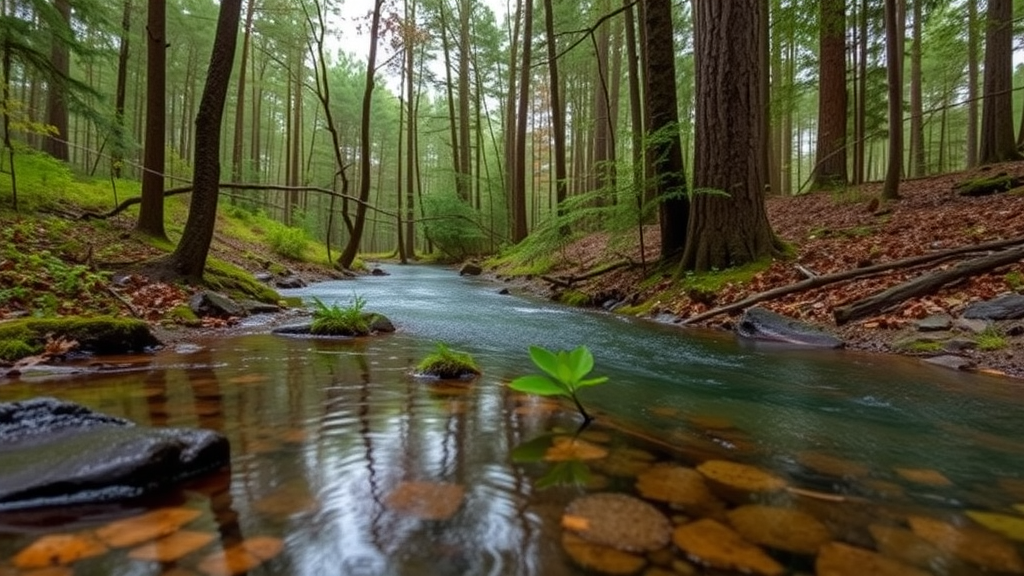
Beneath the quiet canopy of the Młodzawy forest in south-central Poland, a slow, hidden pulse beats in rhythm with the seasons. A new study published in Hydrogeology Journal has tracked that pulse in unprecedented detail, revealing how shallow groundwater across this temperate woodland rises in winter and early spring, sinks through summer and autumn, and responds in measurable ways to the twin drivers of precipitation and air temperature. By analyzing water levels recorded in 15 piezometers between 2020 and 2024, researchers led by Cong Ngoc Phan of Vinh University, working with colleagues at the University of Agriculture in Kraków, have assembled one of the most comprehensive pictures yet of how a Central European forest’s shallow aquifer behaves under contemporary climatic conditions.
Shallow groundwater is far more than a technical curiosity in forest hydrology. It acts as the connective tissue of the ecosystem, linking climatic variability to soil moisture, to the exchange of water with rivers and wetlands, and ultimately to the water available to tree roots and riparian plants. When the water table drops too far, floodplain forests suffer physiological stress; when it climbs too high, different ecological processes take over. Understanding where the water table sits, how much it fluctuates, and what climate signals it follows is therefore essential for predicting how these ecosystems will fare as Central Europe experiences more frequent droughts and hotter summers. The Młodzawy forest, located in Poland’s Świętokrzyskie Voivodeship within the Nida River valley, offers an ideal natural laboratory for such questions.
The research team drew on four years of monitoring data from a network of 15 piezometers distributed across the forest. Rather than treating each well as an isolated data point, the investigators applied a structured analytical pipeline. They began with descriptive statistics to characterize the central tendency and spread of groundwater levels at each site. They then employed k-means clustering, an exploratory machine-learning technique, grouping the wells according to two key variables: the mean water-table elevation and the coefficient of variation, a standardized measure of how much levels fluctuate relative to their average. This approach allowed the team to identify natural structure in the spatial arrangement of the shallow aquifer without imposing preconceived hydrogeological zones.
The clustering analysis revealed a clear threefold structure. The wells sorted into groups with high, intermediate, and low hydraulic position, reflecting an orderly organization of the water table across the forest landscape. Notably, the monitoring record showed a persistent northwest-to-southeast gradient in water-table elevation, meaning the shallow groundwater surface slopes systematically in one direction across the site. This spatial structure matters because it implies that different parts of the forest experience different groundwater regimes: wells in hydraulically elevated zones may respond to climate in one way, while those in low-lying positions, potentially influenced by lateral inflows and proximity to drainage channels, may behave quite differently. For ecologists and forest managers, this means that a single ‘average’ groundwater level can be misleading; the position of any given patch of forest within this gradient shapes its water availability.
Temporal patterns proved equally striking. Seasonal fluctuations were pronounced across the network, with groundwater levels consistently higher in winter and early spring and lower in summer and autumn. This rhythm reflects the classic temperate-zone water balance: recharge accumulates during the cold season, when precipitation exceeds evapotranspiration and dormant vegetation draws little water, while the growing season reverses the balance as trees transpire heavily and warm air accelerates evaporation from soils. The researchers also examined interannual variability and found an important asymmetry. Year-to-year differences in groundwater level were smallest in winter and largest in summer, indicating that the high-evapotranspiration period is also the period of strongest year-to-year variability. In practical terms, summers are when this forest’s shallow groundwater system is most volatile, and therefore most vulnerable to divergent outcomes depending on whether a given year brings drought or sustained rainfall.
The correlation analysis added quantitative teeth to these observations. Mean groundwater level showed a moderate positive association with monthly precipitation totals, meaning wetter months tended to coincide with higher water tables. The association with temperature was somewhat stronger and negative, with warmer months coinciding with lower levels. This pattern is consistent with the dominant role of evapotranspiration in temperate forest water balances: higher temperatures drive greater water demand from vegetation and soils, depleting the shallow aquifer, while rainfall replenishes it. The authors are careful, however, to frame these results as statistical associations rather than proof of specific recharge mechanisms. Because the study did not directly quantify lagged recharge processes, lateral inflows from outside the forest, or the operations of ditches and channels that regulate drainage in the Nida valley, the causal pathways linking climate to groundwater remain to be fully disentangled.
Methodologically, the study also applied nonparametric tests of trend and seasonality, robust statistical tools that make minimal assumptions about the underlying data distribution. Techniques of this kind, including rank-based approaches descended from the classic work of Mann and Kendall, are widely used in hydrology to detect whether a time series exhibits a persistent directional trend or a repeating seasonal cycle. Their use here strengthens the confidence that the seasonal signal in the Młodzawy record is genuine rather than an artifact of noise, even over a monitoring window of only four years. The k-means algorithm itself, first formalized in the late 1960s and refined in 1979 by Hartigan and Wong, remains one of the most widely used clustering methods in environmental science, prized for its simplicity and interpretability when applied to well-defined variables such as mean elevation and variability.
The broader context of the study gives its findings added urgency. Central European forests have faced repeated drought stress in recent decades, and riparian and wetland forests are among the most sensitive ecosystems to changes in groundwater regimes. The Młodzawy forest lies within the Natura 2000 site Ostoja Nidziańska, an area recognized for its valuable habitats, and it has been the focus of riparian-forest restoration efforts under the LIFE4DELTA project in the inland delta of the Nida River. Related research elsewhere in Poland, including long-term monitoring in the Białowieża Forest, has documented declining groundwater levels under climate change, raising concerns for forest composition and regeneration. Studies across the region, from Hungary’s Great Hungarian Plain to the Czech Republic, similarly show that groundwater-dependent woodlands respond sensitively to both climatic warming and hydrological management. The Młodzawy results fit squarely within this growing body of evidence while adding a carefully documented case from the Nida valley.
The authors are explicit about the limitations that should guide future work. A four-year record, while sufficient to resolve seasonal cycles and interannual contrasts, is short compared with the multi-decadal climatic reference series needed to detect long-term trends. The study relied on water-table elevation rather than groundwater depth, which can matter in areas of variable topography. And because ditch and channel operations were not directly recorded, human interventions in the local water balance remain a potential confounding factor. The researchers recommend that future investigations integrate groundwater depth measurements, longer climatic datasets, lagged hydroclimatic metrics that account for the delayed arrival of recharge, and operational information on drainage management. Such refinements would transform the present associations between climate and groundwater into a mechanistic understanding of recharge and depletion.
For now, the Młodzawy study delivers a valuable and sobering message: this temperate forest’s shallow groundwater is spatially organized but seasonally volatile, with its most precarious and unpredictable moments arriving precisely during the hot, dry summers when both ecosystems and water managers can least afford uncertainty. As Central Europe warms, the summers are expected to intensify, and the year-to-year swings documented here may widen. Monitoring networks like the one established in Młodzawy, combining simple piezometric measurements with modern exploratory statistics, offer an affordable and scientifically powerful way to keep a finger on the hidden pulse of forest groundwater, and to warn, in time, when that pulse begins to falter.
Subject of Research: Shallow groundwater level dynamics and climatic influences in a temperate forest in central Poland
Article Title: Groundwater level dynamics and climatic influences in a temperate forest of Central Europe
Article References: Phan, C. N., Strużyński, A., Kowalik, T., & Hoang, V. P. (2026). Groundwater level dynamics and climatic influences in a temperate forest of Central Europe. Hydrogeology Journal. https://doi.org/10.1007/s10040-026-03174-4
Image Credits: AI Generated
DOI: 10.1007/s10040-026-03174-4
Keywords: groundwater, temperate forest, hydrogeology, piezometers, k-means clustering, seasonality, precipitation, air temperature, evapotranspiration, Poland, drought, Nida River valley
Cite Scienmag News
Violet Maxwell. (September 12, 2026). Hidden Water Pulse: How a Polish Forest’s Groundwater Rises and Falls with the Climate. Scienmag. https://scienmag.com/hidden-water-pulse-how-a-polish-forests-groundwater-rises-and-falls-with-the-climate/
Violet Maxwell. "Hidden Water Pulse: How a Polish Forest’s Groundwater Rises and Falls with the Climate." Scienmag, 12 September 2026, https://scienmag.com/hidden-water-pulse-how-a-polish-forests-groundwater-rises-and-falls-with-the-climate/. Accessed 5 October 2026.
Violet Maxwell. "Hidden Water Pulse: How a Polish Forest’s Groundwater Rises and Falls with the Climate." Scienmag. September 12, 2026. https://scienmag.com/hidden-water-pulse-how-a-polish-forests-groundwater-rises-and-falls-with-the-climate/


