


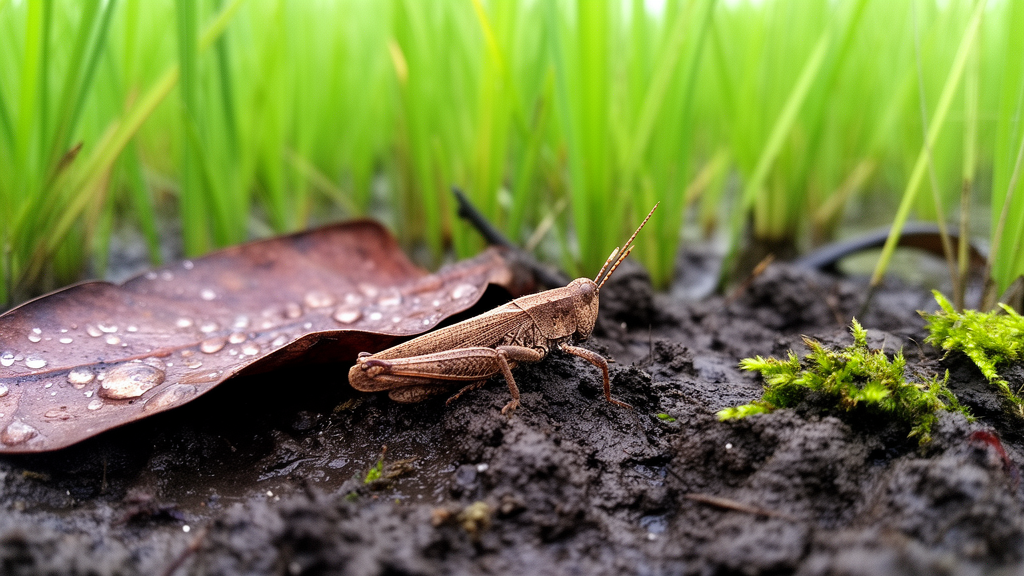
In the flooded rice paddies and marshes of the Kole wetlands of Kerala, India, a team of entomologists has spent three years crouching in the mud with sweep nets and forceps, searching for some of the smallest and most overlooked members of the grasshopper family. Their findings, published in the Journal of Orthoptera Research, document twelve morphospecies of pygmy grasshoppers across eight genera in a Ramsar-designated wetland that has long been celebrated for its birds but almost entirely ignored for its insect life. Among the haul are two genera never before recorded in the state of Kerala, a result that quietly reshapes what scientists know about the distribution of these tiny, cryptic insects in southern India.
Pygmy grasshoppers, the family Tetrigidae, are the second largest family of grasshoppers in the world, with 2,037 valid species described globally. India accounts for 165 of them, and until this survey only 22 species had been reported from Kerala. The insects are easy to overlook: most measure just a few millimeters to about a centimeter, wear drab, bark-like or leaf-like coloration, and, unlike their larger relatives, produce no perceptible sound. Their most distinctive feature is an elongated pronotum, the shield-like plate that extends backward over the abdomen, often reaching the tip of the body. Combined with the absence of an arolium, the adhesive pad between claw segments, and a distinctive tarsal formula of two segments on the first and second tarsi and three on the third, this anatomy separates them from every other grasshopper lineage.
What makes the new survey especially interesting is where it was conducted. The Kole wetlands are low-lying tracts in the Thrissur and Malappuram districts, lying roughly half a meter to a meter below mean sea level and covering 13,632 hectares. For about six months each year the entire landscape is submerged under floodwater, then drains into a mosaic of marshes, paddies, and channels. That seasonal oscillation between aquatic and terrestrial conditions creates exactly the kind of semi-aquatic habitat that pygmy grasshoppers favor. Many tetrigids are limno-terrestrial, living along riverbanks and stream margins where wet and dry phases alternate, and some species are so water-dependent that they can swim, dive, and even rest underwater. Their diet is equally unusual for a grasshopper: they graze on mosses, algae, diatoms, lichens, liverworts, and decaying detritus rather than grasses.
Between February 2021 and January 2024, researchers from the Shadpada Entomology Research Lab at Christ College, Irinjalakuda, sampled sites across both districts using sweep nets and hand collecting. The 162 specimens they gathered were pinned, examined under stereomicroscopes, photographed with high-resolution macro equipment, and compared against original species descriptions and type images held in the Orthoptera Species File. The result was twelve morphospecies in eight genera: Coptotettix, Criotettix, Eucriotettix, Thoradonta, Ergatettix, Euparatettix, Hedotettix, and Tetrix. Four species, Thoradonta spiculoba, Tetrix cf. arcunotus, Hedotettix lineifera, and Hedotettix cf. attenuatus, are new records for Kerala, and the genera Tetrix and Thoradonta had never been reported from the state at all.
The diversity tally is striking when set against comparable studies. A freshwater swamp forest in Singapore yielded nine species in seven genera; wetlands in Ramaroshan, Nepal, produced seven species; and Shivapuri Nagarjuna National Park, also in Nepal, recorded eleven species. The Kole wetlands, with twelve species, edge out all of them, underscoring the role that seasonal wetland ecosystems play in supporting pygmy grasshopper communities. Several of the genera found in Kerala, including Coptotettix, Thoradonta, Eucriotettix, Ergatettix, Euparatettix, and Hedotettix, recur in other water-associated habitats across Asia, and one of the Kole morphospecies, Coptotettix sp. 2, appears strikingly similar to a form photographed in Singapore’s Nee Soon Swamp Forest, hinting at a much broader regional distribution than current records suggest.
Not every expected species showed up, and that absence is itself informative. Euscelimena harpago, a widespread and commonly encountered Indian pygmy grasshopper that lives year-round near perennial freshwater bodies, was never found in the Kole wetlands during the survey. Previous records place it at higher elevations in Kerala, and citizen-science observations point the same way. The researchers suggest the species may be confined to a particular altitudinal band and microhabitat, a reminder that even common insects can have sharply defined ecological boundaries that only sustained fieldwork reveals.
The study also leans on an increasingly important tool for documenting invertebrate biodiversity: the citizen-science platform iNaturalist. Kerala currently has 490 pygmy grasshopper observations on the platform, representing about twenty species, though only eight carry expert confirmation, and some records are misidentified. Notably, the species Xistrella stylata, identified on iNaturalist by the taxonomist Josip Skejo, has never appeared in the published literature for Kerala, and photographic records of Thoradonta spiculoba from Thrissur, Ernakulam, and Pathanamthitta districts independently corroborate the survey’s finding that the species occurs in the state. With more than 2,100 pygmy grasshopper observations from India overall, such platforms can fill spatial gaps and flag unreported species, though the authors are careful to note that they cannot replace expert fieldwork, since coverage skews toward accessible places and eye-catching species.
Beneath the species list lies a thornier problem: tetrigid taxonomy is in disarray. Many species were described decades or even centuries ago from vague diagnoses based on pronotum length, body size, and color, characters that are notoriously unreliable in a group famous for polymorphism. The Kole specimens themselves displayed wide variation in pronotum length, body coloration, and patterning, and the genus Thoradonta includes species that occur in both short-winged brachypronotal and long-winged macropronotal forms, which can render existing identification keys useless. The researchers also suggest that Thoradonta bengalensis, described from India in 1991, may ultimately prove to be a synonym of T. spiculoba. Similar confusion clouds the genera Hedotettix, Coptotettix, Euparatettix, Ergatettix, and Tetrix, which are morphologically similar and poorly separated by the diagnostic characters in the literature.
Higher-level classification is shifting too. Recent work has excluded the tribes Thoradontini and Criotettigini from the subfamily Scelimeninae, and a new subfamily, Criotettiginae, was erected in 2025 to house them. Even more dramatically, a forthcoming analysis indicates that the type species of Eucriotettix is morphologically indistinguishable from Criotettix, implying that the two genera should be merged and that many species currently placed in Criotettix belong instead in Acantholobus. The authors of the Kole study note that Criotettix and Eucriotettix are currently inseparable in practice and flag their key accordingly. Faced with these uncertainties, the team provisionally grouped hard-to-identify specimens into morphospecies and provided a generic-level identification key for the wetlands, explicitly calling for taxonomic revision and molecular studies to settle species boundaries.
The survey, the first systematic look at pygmy grasshoppers in the Kole wetlands, found the insects most active during the monsoon and post-monsoon seasons, when the landscape offers the semi-terrestrial, moss-rich conditions they need. But the researchers also recorded human pressures during their fieldwork, including herbicide use and other disturbances, in a wetland already classified as threatened and squeezed by rapid development and intensive land and water use. Because pygmy grasshoppers are tightly linked to moisture, mosses, and detritus, they may serve as sensitive indicators of wetland health, though their ecology in Kerala remains almost entirely unstudied. The twelve species now documented represent a baseline, and the authors hope it will anchor future ecological and molecular research on a group that, despite numbering more than two thousand species worldwide, remains one of the least understood branches of the grasshopper tree.
Subject of Research: Diversity and taxonomy of pygmy grasshoppers (Tetrigidae) in the Kole wetlands, a Ramsar site in Kerala, India
Article Title: Pygmy grasshoppers ( Orthoptera , Tetrigidae ) of Kole wetlands, a Ramsar site in Kerala, India
Article References: Thasnim, E. S., Bijoy, C., & Bhaskar, D. (2026). Pygmy grasshoppers (Orthoptera, Tetrigidae) of Kole wetlands, a Ramsar site in Kerala, India. Journal of Orthoptera Research, 35(1), 103-115. https://doi.org/10.3897/jor.35.152281
Image Credits: AI Generated
Keywords: Tetrigidae, pygmy grasshoppers, Kole wetlands, Ramsar site, Kerala, Orthoptera, biodiversity survey, new records, wetland ecology, taxonomy, iNaturalist, India
Cite Scienmag News
Gavin Prescott. (October 17, 2026). Hidden pygmy grasshoppers revealed in Kerala’s Ramsar wetlands. Scienmag. https://scienmag.com/hidden-pygmy-grasshoppers-revealed-in-keralas-ramsar-wetlands/
Gavin Prescott. "Hidden pygmy grasshoppers revealed in Kerala’s Ramsar wetlands." Scienmag, 17 October 2026, https://scienmag.com/hidden-pygmy-grasshoppers-revealed-in-keralas-ramsar-wetlands/. Accessed 17 October 2026.
Gavin Prescott. "Hidden pygmy grasshoppers revealed in Kerala’s Ramsar wetlands." Scienmag. October 17, 2026. https://scienmag.com/hidden-pygmy-grasshoppers-revealed-in-keralas-ramsar-wetlands/


