


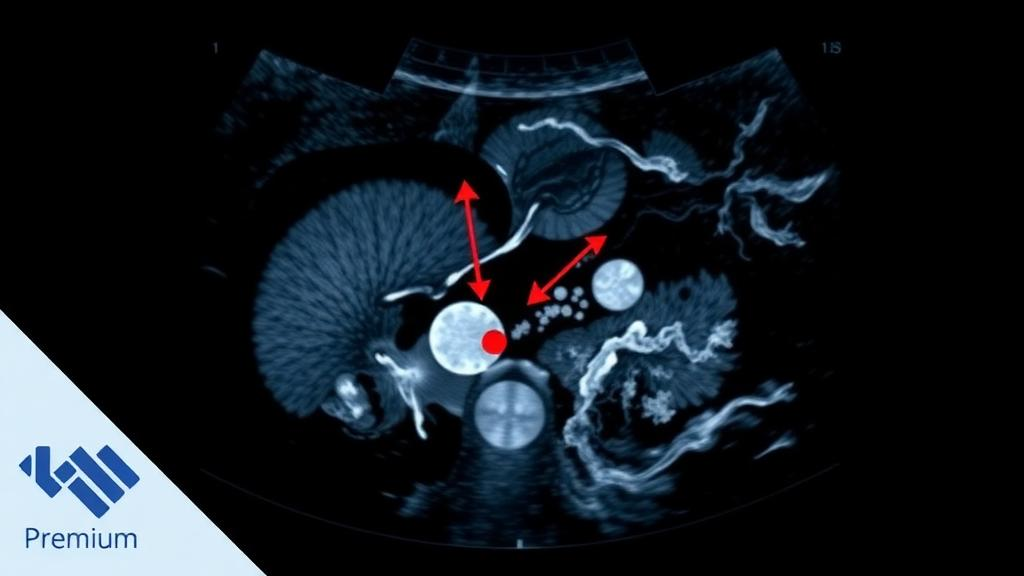
Deep inside the liver, small dead patches of tissue known as solitary necrotic nodules have long been among the most treacherous impostors in medical imaging. They look, on many scans, alarmingly like cancer. Yet a new study from the First Hospital of Jilin University in Changchun, China, published in BMC Medical Imaging, has catalogued their telltale signatures in unprecedented detail, offering radiologists a practical playbook for telling a benign scar from a life-threatening tumour without reaching for a biopsy needle.
The research team, led by Lili Liu and Dezhi Zhang, analysed 87 necrotic liver lesions in 81 consecutive patients scanned between December 2014 and March 2018. The group included 32 men and 49 women with a mean age of 51.2 years. Rather than relying on a single diagnostic method, the investigators confirmed each diagnosis through a layered approach: histopathology in eight cases, contrast-enhanced CT or MRI combined with follow-up in thirteen, and ultrasound follow-up in the remaining sixty. This careful case mix gave the team a rare window into one of hepatology’s most enigmatic findings.
The star technology of the study is contrast-enhanced ultrasound, or CEUS, a technique that injects microscopic gas-filled bubbles into the bloodstream and tracks them in real time as they flood through liver tissue. Because these microbubbles remain confined to blood vessels, they act as exquisitely sensitive tracers of perfusion. A malignant tumour, hungry for blood, lights up and fades in characteristic patterns; a dead, avascular nodule stays stubbornly dark. The technique involves no ionising radiation and can be performed at the bedside, making it an attractive first-line tool in liver lesion work-ups worldwide.
What the Chinese team found was strikingly consistent. The lesions, with a median diameter of 26 millimetres and a range from 7 to 60 millimetres, were overwhelmingly irregular in shape: 77.0 percent, or 67 of the 87 lesions, lacked a clean round outline. Among these, 55 displayed a tortuous, cord-like configuration, resembling twisted strands rather than compact masses. Even more intriguing was a subtle sign on conventional grey-scale ultrasound: central hyperechoic foci, bright echoes tucked into the middle of the lesion, arranged in patterns the authors describe as equal-sign-like or core-type, which appeared in 18.4 percent of nodules.
On CEUS, the nodules split cleanly into two behavioural camps. Just over half, 55.2 percent, showed no enhancement whatsoever in any phase of the contrast study, a signature of truly dead, bloodless tissue. The remaining 44.8 percent displayed an arterial-phase rim of hyperenhancement around a persistently dark centre, suggesting a living inflammatory or fibrous border wrapped around the necrotic core. The median thickness of that enhancing rim was 3.1 millimetres, but in 11 of the 39 rim-enhancing lesions, more than a quarter of the group, the rim measured 5 millimetres or thicker.
That rim thickness turned out to be far more than a curiosity. Lesions with thick rims were dramatically more likely to show washout of contrast during the portal venous phase, occurring in 45.5 percent of thick-rim lesions compared with just 3.6 percent of the rest, a statistically significant association with a phi correlation coefficient of 0.522. Washout, the fading of contrast from a lesion after its initial uptake, is classically an ominous sign associated with malignancy, particularly hepatocellular carcinoma. Knowing that a benign necrotic nodule can produce the same behaviour when its fibrous border is thick could spare patients unnecessary alarm and invasive procedures.
The shape of the nodule itself also carried diagnostic information. Round-like lesions were far more likely than irregular ones to contain central microcystic structures, seen in 25.0 percent versus none of the irregular lesions, a difference that was highly significant with a phi value of 0.452. They were also far likelier to harbour those central hyperechoic foci, present in 60.0 percent of round lesions compared with only 6.0 percent of irregular ones. Additionally, thick-rim lesions underwent appreciable enlargement of their apparent size after contrast injection in 72.7 percent of cases, against 28.6 percent of thin-rim lesions, reflecting the way an enhancing rim dramatically redefines the visible boundary of a lesion.
Statistically, the team subjected their data to rigorous analysis. Two blinded radiologists independently reviewed every conventional ultrasound and CEUS study, with disagreements settled by a senior radiologist in consensus sessions. Group comparisons employed chi-square and Fisher’s exact tests for categorical variables, t-tests and the Mann-Whitney U test for continuous data, and the phi coefficient to quantify the strength of associations between imaging features. The ethics committee of the First Hospital of Jilin University approved the retrospective design and waived the requirement for individual written consent, in line with the Declaration of Helsinki.
The clinical stakes are considerable. A solitary lesion discovered in the liver triggers an anxious differential diagnosis that spans metastatic cancer, hepatocellular carcinoma, abscess, haemangioma and focal nodular hyperplasia. Solitary necrotic nodules, which are thought to arise from prior injury, infection, or vascular insult that leaves behind a coagulated island of dead hepatocytes, sit benignly within this list but frequently masquerade as something sinister. Misreading one can lead to biopsies, surgeries and months of surveillance; mistaking a tumour for one can be catastrophic. Precise imaging criteria are therefore not an academic luxury but a direct safeguard for patients.
The authors conclude that solitary necrotic nodules do exhibit characteristic ultrasound and CEUS features, and that a tortuous cord-like morphology combined with central equal-sign-like echogenic foci may actively support the diagnosis. Their observation that a thick arterial rim of 5 millimetres or more correlates with pronounced portal-phase washout and a visible increase in lesion size after contrast offers what they call a novel exploratory perspective on the imaging characterisation of these nodules, one they argue deserves clinical attention. As contrast-enhanced ultrasound continues its global expansion, studies like this one are quietly transforming the humble ultrasound suite into one of the most powerful diagnostic arenas in modern medicine.
Subject of Research: Contrast-enhanced ultrasound characterization of solitary necrotic nodules of the liver
Article Title: Solitary necrotic nodule of the liver: a single-centre retrospective CEUS study of 87 lesions
Article References: Liu, L., Zhou, Y., Li, J., Wang, D., Sui, M., Zhu, Y., Chen, C., He, H., & Zhang, D. (2026). Solitary necrotic nodule of the liver: a single-centre retrospective CEUS study of 87 lesions. BMC Medical Imaging. https://doi.org/10.1186/s12880-026-02796-0
Image Credits: AI Generated
DOI: 10.1186/s12880-026-02796-0
Keywords: liver, solitary necrotic nodule, contrast-enhanced ultrasound, CEUS, radiology, diagnostic imaging, washout, hepatocellular carcinoma, ultrasound, necrosis, BMC Medical Imaging, Solitary
Cite Scienmag News
Ophelia Keating. (October 14, 2026). Hidden Liver Lesions Reveal Their Secrets to Contrast Ultrasound in Landmark Study. Scienmag. https://scienmag.com/hidden-liver-lesions-reveal-their-secrets-to-contrast-ultrasound-in-landmark-study/
Ophelia Keating. "Hidden Liver Lesions Reveal Their Secrets to Contrast Ultrasound in Landmark Study." Scienmag, 14 October 2026, https://scienmag.com/hidden-liver-lesions-reveal-their-secrets-to-contrast-ultrasound-in-landmark-study/. Accessed 14 October 2026.
Ophelia Keating. "Hidden Liver Lesions Reveal Their Secrets to Contrast Ultrasound in Landmark Study." Scienmag. October 14, 2026. https://scienmag.com/hidden-liver-lesions-reveal-their-secrets-to-contrast-ultrasound-in-landmark-study/


