


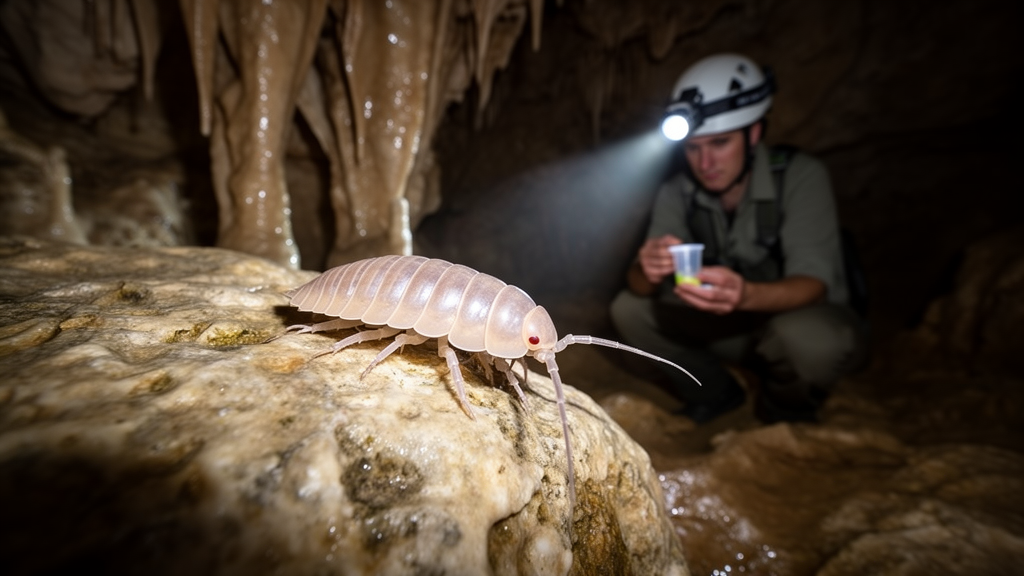
Deep beneath the limestone landscapes of eastern Spain and the Balearic Islands, a family of small crustaceans has been quietly rewriting its own history. A new study published in Subterranean Biology describes a new genus and two new species of cave-dwelling woodlice belonging to the family Philosciidae, a group of terrestrial isopods better known from the tropics than from European caves. The research, based on specimens collected over nearly six decades of biospeleological surveys, also resolves long-standing taxonomic puzzles that have confused specialists for more than a century.
Philosciidae is one of the most diverse families within Oniscidea, the suborder of crustaceans commonly called woodlice or pill bugs. It currently includes 114 genera, most of them monotypic, and 503 valid species. The vast majority inhabit the intertropical zone, with representatives in the Neotropical, Afrotropical and Pacific regions. In Europe, North Africa and the Middle East, only about 60 species in ten genera have been described, and just four of those genera contain strictly subterranean or cave-dwelling species. This rarity in the Holarctic makes every new discovery in the region scientifically significant.
The new genus, Iberoscia, was erected to accommodate Iberoscia zaragozai, a blind, unpigmented woodlouse found in caves across Catalonia, Murcia and the Valencian Community. The genus name derives from the ancient Greek Iber, referring to the inhabitants of the Iberian Peninsula, combined with the suffix oscia after Philoscia. The species was named posthumously after Spanish arachnologist Juan Antonio Zaragoza-Miralles, who contributed greatly to the knowledge of Iberian cave fauna. The species had previously circulated informally under the unpublished name Anaphiloscia iberica, which must now be regarded as a nomen nudum because it never met the formal requirements of the International Code of Zoological Nomenclature.
Iberoscia zaragozai exhibits a unique combination of morphological characters among European Philosciidae. Males reach 3.4 millimetres and females 4 millimetres in length. The body lacks any trace of pigment, and the dorsum is covered with cup-shaped scale-setae arranged in distinctive rows. The first antenna bears maraca-like aesthetascs, each with three spherical terminations, a feature not seen in any other European genus of the family. The maxilliped endite carries a knob-like penicil, a character otherwise known mainly from tropical genera such as Ischioscia, Pseudophiloscia and Androdeloscia. The genital papilla is distally bifurcate, and the pleopods lack respiratory structures, consistent with life in oxygen-poor subterranean environments.
The second new species, Paractenoscia sendrai, comes from Cova de Sa Caperulla on the island of Ibiza in the Balearic archipelago. It is named after Spanish biospeleologist and entomologist Alberto Sendra-Mocholí, who collected the type series. The genus Paractenoscia was previously known only from a single troglobiont species, Paractenoscia cavernicola, described from Morocco in 2015. The new record therefore extends the genus into the Ibero-Balearic region for the first time and strengthens biogeographic links between southern Iberia, the Balearic promontory and North Africa.
Paractenoscia sendrai reaches 5.8 millimetres in males and 6 millimetres in females. Like Iberoscia zaragozai, it is blind and unpigmented, with a semi-circular pleotelson and uropods whose endopod and exopod are inserted almost at the same level. It can be distinguished from its Moroccan relative by an enlarged claw-like ungual seta on the pereopodal dactyli rather than an enlarged inner claw, a distally bifurcate genital papilla, differences in the shape of scale-setae, and long pointed posterior tips on the seventh pereon epimera reaching half the third pleon-tergite. Two additional Paractenoscia specimens from Valencia, designated sp. A and sp. B, clearly belong to the genus but differ from all known species. Because only female specimens are available, the authors refrained from formally describing them until males or additional material can be examined.
The study also resolved a mystery that has persisted since 1907. Anaphiloscia simoni was described by Emil Racovitza from a single female specimen collected in a cavity on Mallorca, meaning the male sexual characters remained unknown for more than a century. Using topotypical and near-topotypical specimens from Mallorca, Dragonera, Cabrera and Menorca, the researchers fully illustrated a male for the first time. The species shows sexual dimorphism on the fifth segment of the antennal peduncle, which is slightly thicker in adult males. Comparisons with published illustrations of the male of Anaphiloscia sicula from Sicily revealed that Arcangeli’s original specimen was clearly immature, measuring less than 2 millimetres, and that the mouthparts and pleopods of both species are identical. Anaphiloscia sicula is therefore proposed as a subjective junior synonym of Anaphiloscia simoni.
A second synonymy concerns the monotypic genus Parachaetophiloscia, established in 1990 for Parachaetophiloscia levantina from the eastern Iberian Peninsula. According to the original diagnosis, Parachaetophiloscia differed from Chaetophiloscia only in the number of penicils on the right mandible and in pleotelson shape. Re-examination of the syntypes revealed that one male preparation still preserves remains of a second penicil next to the molar process, which had probably been lost during dissection. A newly collected specimen from the type locality confirmed the same mandibular morphology as Chaetophiloscia. The only remaining difference, the shape of the telson, was judged insufficient to justify separate genera. Parachaetophiloscia is now proposed as a subjective junior synonym of Chaetophiloscia, and the species becomes Chaetophiloscia levantina comb. nov. The authors note that the recently erected genus Aracenoscia from southwestern Spain differs from Chaetophiloscia only in pleon shape and the position of noduli laterales, warranting further assessment before any synonymy is proposed there.
Terrestrial isopods are widely regarded as excellent biogeographic indicators because of their limited dispersal capacity, and troglobitic species in temperate regions often represent relict lineages of ancient faunal origins. Paleogeographic evidence suggests that the Baetic-Rif massif once formed a land bridge between North Africa, southern Iberia and the Balearic promontory. The presence of Paractenoscia in both the Maghreb and eastern Iberia may reflect historical connectivity during the Messinian or possibly earlier periods. The distribution of cave-dwelling Philosciidae in the region appears geographically restricted, concentrated in southwestern and Mediterranean areas of the Iberian Peninsula and the Balearic archipelago, with no subterranean representatives reported from central, northern or western Spain or Portugal.
The study significantly increases the known diversity of Philosciidae in the Ibero-Balearic region and suggests that regional diversity has been underestimated. From a systematic perspective, resolving relationships within the family remains challenging because many genera are monotypic and several traits traditionally used to delimit genera appear variable within them. Molecular data could help clarify these relationships but remain scarce for the group. The recognition of previously overlooked or misidentified cave-dwelling species highlights the need for further integrative taxonomic work, and the authors anticipate that continued biospeleological surveys across the Iberian karst will reveal additional hidden diversity in this ancient lineage of subterranean crustaceans.
Subject of Research: Taxonomy and biogeography of subterranean Philosciidae isopods from the Iberian Peninsula and Balearic Islands
Article Title: Subterranean Philosciidae from Spain with the description of a new genus and two new species ( Crustacea , Isopoda , Oniscidea )
Article References: Garcia, L., Miralles-Núñez, A., & Cruz-Suárez, A. (2026). Subterranean Philosciidae from Spain with the description of a new genus and two new species (Crustacea, Isopoda, Oniscidea). Subterranean Biology, 56, 1-28. https://doi.org/10.3897/subtbiol.56.180999
Image Credits: AI Generated
DOI: 10.3897/subtbiol.56.180999
Keywords: Philosciidae, Oniscidea, terrestrial isopods, cave biology, new species, Iberian Peninsula, Subterranean, Spain, description, genus, species, Crustacea
Cite Scienmag News
Margaret Porter. (October 17, 2026). Hidden Cave Woodlice Reveal New Genus and Species in Spain. Scienmag. https://scienmag.com/hidden-cave-woodlice-reveal-new-genus-and-species-in-spain/
Margaret Porter. "Hidden Cave Woodlice Reveal New Genus and Species in Spain." Scienmag, 17 October 2026, https://scienmag.com/hidden-cave-woodlice-reveal-new-genus-and-species-in-spain/. Accessed 17 October 2026.
Margaret Porter. "Hidden Cave Woodlice Reveal New Genus and Species in Spain." Scienmag. October 17, 2026. https://scienmag.com/hidden-cave-woodlice-reveal-new-genus-and-species-in-spain/


