


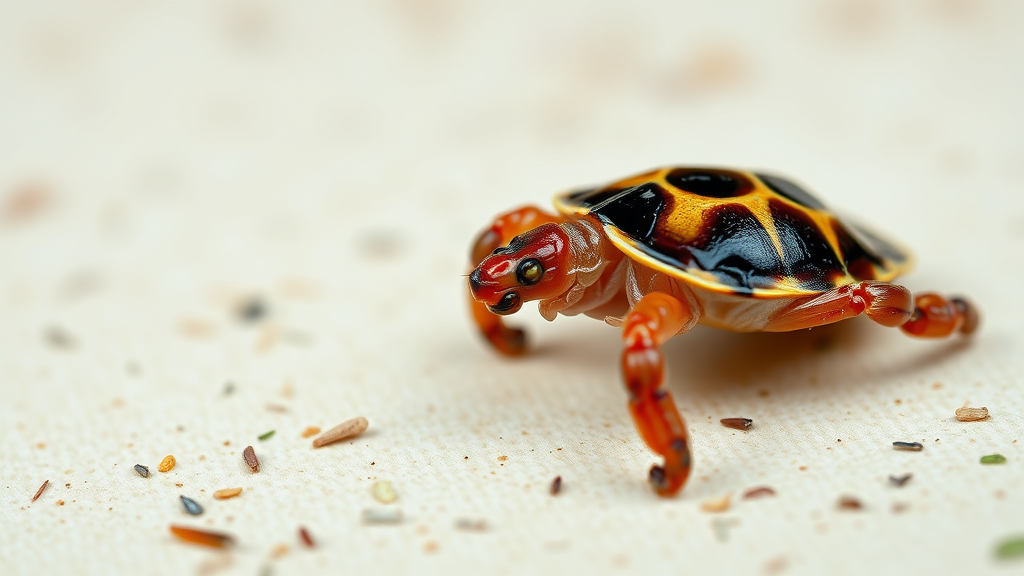
Deep in the steppes of Central Anatolia, a quiet microbial drama is unfolding on the backs of tortoises. Researchers at Niğde Ömer Halisdemir University have completed one of the most detailed molecular surveys yet of the bacteria living inside Hyalomma aegyptium, the distinctive hard tick that makes its home almost exclusively on spur-thighed tortoises. Their findings, published in Acta Parasitologica, deliver a first for the region: molecular evidence of Spiroplasma bacteria in these ticks, alongside a striking absence of Wolbachia, another famous endosymbiont that many scientists expected to find. The result adds an important piece to the growing puzzle of how ticks, microbes, and reptile hosts interact across the Mediterranean and Near East.
The study focused on Niğde province, a region of central Türkiye where tortoises roam freely and their parasites follow. The research team, led by Bilge Karatepe and Mustafa Karatepe of the Department of Biotechnology, together with Fatma Mutlu and Zeynep Ergüleş, examined 88 spur-thighed tortoises, Testudo graeca, a species whose conservation status makes every detail of its parasite burden relevant. From these animals they collected 184 adult ticks, 167 males and just 17 females, preserving each specimen in sealed bottles of 70 percent alcohol before carrying them to the laboratory for identification under a stereo microscope.
Every single tick turned out to be Hyalomma aegyptium, confirming the reputation of this species as the quintessential tortoise tick. The infestation pattern was itself informative. Ticks were found on 62 of the 88 tortoises examined, an infestation rate of 70.4 percent. When the researchers broke the data down by month, they discovered that infestation rates varied significantly across the season, a statistically robust pattern with a p value below 0.05. The sex distribution of ticks on infested hosts, however, showed no significant variation, suggesting that male and female ticks exploit their reptile hosts in broadly similar ways even though males vastly outnumbered females in the sample.
With the ticks identified and counted, the team turned to the molecular heart of the study. Rather than testing each tick individually, they organized the 184 specimens into 68 pools, with separate pools for male and female ticks collected from each tortoise. This pooling strategy is a standard and efficient approach in tick microbiology, allowing researchers to screen large numbers of arthropods for rare infections without running hundreds of separate reactions. DNA was extracted from each pool and subjected to polymerase chain reaction, or PCR, using primers specifically designed to amplify marker genes from two bacterial genera of great interest to tick biologists.
The first target was Wolbachia, arguably the most widespread endosymbiotic bacterium on Earth. Wolbachia infects an enormous range of arthropods, manipulating the reproduction of its hosts in ways that can skew sex ratios, kill males, or enable reproductive parasitism. Because of these dramatic effects, Wolbachia has become a darling of both evolutionary biology and pest control, engineered into mosquito populations to block the transmission of dengue and other viruses. The researchers targeted the wsp gene, a surface protein gene of about 610 base pairs that serves as a reliable molecular fingerprint for the bacterium. The outcome was unambiguous: not one of the 68 tick pools produced a Wolbachia amplification product. Only the positive control, supplied by Serap Aksoy of the Yale School of Public Health, yielded the expected 610 base pair band, confirming that the assay worked perfectly and that the negative results were real biology rather than technical failure.
The second target told a different story. The team used primers directed at the 16S ribosomal RNA gene of Spiroplasma, a roughly 1000 base pair region that serves as the gold standard barcode for identifying bacteria. Spiroplasma is a fascinating genus of spiral-shaped, wall-less bacteria in the class Mollicutes, relatives of Mycoplasma. These microbes are best known from insects and plants, where they can act as pathogens, mutualists, or reproductive manipulators. In some insect species, Spiroplasma strains are male killers, selectively destroying male embryos to favor their own transmission through infected females, a phenomenon documented in organisms such as the small brown planthopper. In ticks, Spiroplasma has been reported sporadically, and its ecological role remains poorly understood.
When the researchers ran their Spiroplasma assays, four of the 68 pools, or 5.8 percent, came back positive for Spiroplasma DNA. Every one of the positive pools originated from male ticks, an intriguing observation given that the sample was overwhelmingly male to begin with. The amplified 16S rDNA fragments were analyzed with molecular evolutionary software, allowing the team to characterize the endosymbionts genetically and confirm their identity as Spiroplasma species. This detection represents the first molecular evidence of Spiroplasma in Hyalomma aegyptium ticks in Central Anatolia, a region where tick microbiology has been studied far less intensively than in coastal or western parts of the country.
The absence of Wolbachia is arguably as interesting as the presence of Spiroplasma. The authors note that their null result is consistent with several recent studies reporting low or absent Wolbachia prevalence in ixodid, or hard, ticks. This pattern contrasts sharply with the situation in soft ticks and in many insects, where Wolbachia is common. The reasons remain debated. Some researchers suggest that the physiology of hard ticks, including their long feeding intervals and unique reproductive biology, may simply be inhospitable to Wolbachia colonization. Others point to the possibility that competitive exclusion by other endosymbionts, such as Coxiella-like or Francisella-like bacteria that frequently dominate tick microbiomes, keeps Wolbachia out. Whatever the mechanism, the growing consensus is that hard ticks are not the Wolbachia reservoirs that earlier assumptions based on insect data might have predicted.
The tortoise tick itself deserves attention as a microbial vehicle. Hyalomma aegyptium has been implicated as a long-term carrier of Coxiella burnetii, the agent of Q fever, and previous work in Türkiye and neighboring countries has detected Borrelia turcica, Rickettsia species, Ehrlichia, and the endosymbiont Candidatus Midichloria mitochondrii in these ticks. Because tortoise ticks feed intensively on reptiles and occasionally attach to other animals, understanding their endosymbiont community helps distinguish true pathogens from harmless or even beneficial residents. Endosymbionts can also shape vector competence, the ability of a tick to acquire, maintain, and transmit disease agents, so mapping which microbes are present is a prerequisite for assessing public health risk. The Niğde survey contributes to a broader effort, spanning studies from Algeria and Qatar to Israel and the Balkans, to catalog the microorganisms associated with this single tick species across its vast range.
For the tortoises themselves, the findings carry conservation implications. Testudo graeca is under pressure across its range from habitat loss and collection, and heavy tick burdens can impose physiological costs on already vulnerable populations. Epidemiological studies of tick infestation in spur-thighed tortoises have begun to unravel the demographic consequences of parasitism, and knowing which microbes circulate in the ticks adds a layer of understanding about disease dynamics in these reptile communities. The Niğde study, supported by the Scientific Research Projects Coordination Unit of Niğde Ömer Halisdemir University, also demonstrates the value of regional molecular surveillance. A single season of fieldwork in one Anatolian province produced a novel regional record for Spiroplasma and a robust negative result for Wolbachia, both of which refine the emerging global picture of tick microbiomes. As climate trends continue to alter the distribution and activity of ticks worldwide, baseline data like these will become ever more valuable for predicting where tick-borne agents may emerge next, and for separating the genuine threats from the hidden symbionts that simply ride along.
Subject of Research: Molecular detection and characterization of Spiroplasma and Wolbachia endosymbionts in Hyalomma aegyptium ticks infesting spur-thighed tortoises in Central Anatolia
Article Title: Molecular Characterization of Spiroplasma Endosymbionts in Ticks on Tortoises in Niğde Province, Türkiye
Article References: Karatepe, B., Karatepe, M., Mutlu, F., & Ergüleş, Z. (2026). Molecular Characterization of Spiroplasma Endosymbionts in Ticks on Tortoises in Niğde Province, Türkiye. Acta Parasitologica, 71(5), Article 224. https://doi.org/10.1007/s11686-026-01410-1
Image Credits: AI Generated
DOI: 10.1007/s11686-026-01410-1
Keywords: Hyalomma aegyptium, Spiroplasma, Wolbachia, tick endosymbionts, Testudo graeca, tortoise ticks, Niğde, Türkiye, PCR, 16S rDNA, Central Anatolia, tick microbiome
Cite Scienmag News
Morgan Morrow. (September 25, 2026). Hidden Bacteria in Tortoise Ticks: First Molecular Trace of Spiroplasma in Central Anatolia. Scienmag. https://scienmag.com/hidden-bacteria-in-tortoise-ticks-first-molecular-trace-of-spiroplasma-in-central-anatolia/
Morgan Morrow. "Hidden Bacteria in Tortoise Ticks: First Molecular Trace of Spiroplasma in Central Anatolia." Scienmag, 25 September 2026, https://scienmag.com/hidden-bacteria-in-tortoise-ticks-first-molecular-trace-of-spiroplasma-in-central-anatolia/. Accessed 6 October 2026.
Morgan Morrow. "Hidden Bacteria in Tortoise Ticks: First Molecular Trace of Spiroplasma in Central Anatolia." Scienmag. September 25, 2026. https://scienmag.com/hidden-bacteria-in-tortoise-ticks-first-molecular-trace-of-spiroplasma-in-central-anatolia/


