


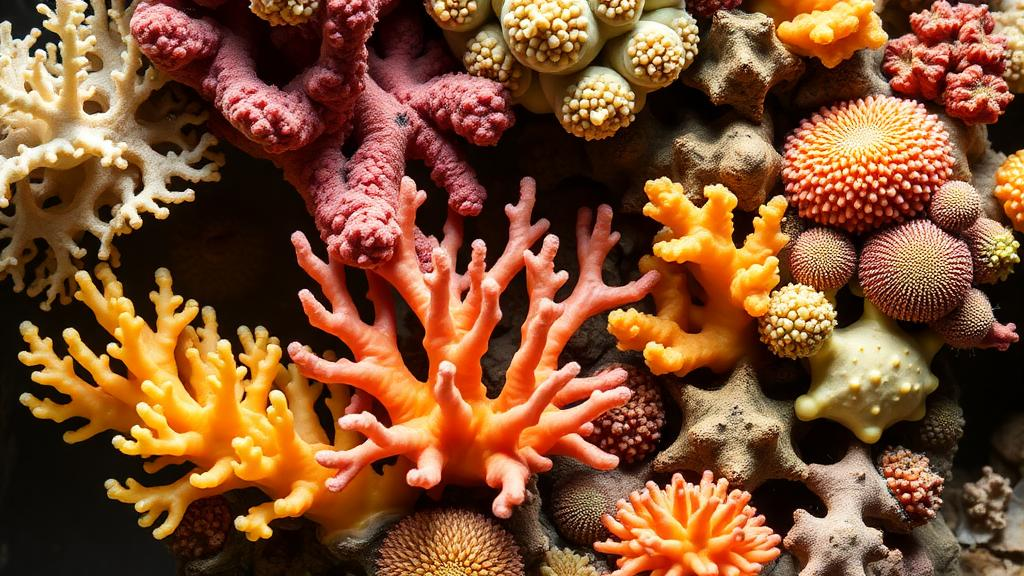
More than 50 kilometres south of Munich, in the Bavarian Alps near the village of Lenggries, a modest outcrop of marls and sandstones known as the Roßsteinalmen section has quietly delivered one of the richest windows into Middle Cenomanian reef life ever assembled. A newly published, revised and extended study of the coral fauna from this locality in the Northern Calcareous Alps more than doubles the species count reported a decade ago, documenting 98 species in 46 genera that together span 16 scleractinian superfamilies and two octocorallian families. The work, appearing in the journal Zitteliana, also describes one brand-new species, Enallhelia octasepta, named for its striking eight-fold septal symmetry.
The corals come from the Branderfleck Formation, a unit of upper Albian to lower Turonian age that preserves scattered relics of a once-widespread shallow marine facies across the Northern Calcareous Alps. At Roßsteinalmen, the roughly 150-metre-thick section consists of sandy marls and sandstones alternating with thick carbonaceous fine breccias, with the upper part dominated by coarse chaotic breccias interpreted as channel deposits. Planktonic foraminifera, including Rotalipora cushmani, pin the base of the section to the Middle to lower Upper Cenomanian, while orbitolinid foraminifera such as Conicorbitolina conica, which did not survive into the Late Cenomanian, confirm a Middle Cenomanian age for the marls and sandstones that host the corals.
Palaeogeographically, the Branderfleck Formation was deposited at the northern margin of the Austroalpine unit, on the southern border of the Penninic Ocean, on what was then the northern part of the Apulian plate. Palaeocurrent data point to a source area to the south, and the uplift of the Austroalpine northern border may be linked to the formation of an accretionary wedge during the nascent subduction of the Penninic Ocean. Water depths ranged from about 50 metres on the inner shelf at the base of the section to roughly 100 metres on the middle shelf in its upper part, placing the coral-bearing marls in a shallow but not reef-flat setting.
The new study is remarkable not only for its taxonomic richness but for the story of how the material came to light. The first revision of the fauna, published in 2013, described 39 species in 25 genera based largely on specimens collected by the private collector Otto Hölzl and housed in Munich. Shortly afterwards, additional material surfaced in the collections of the Bayerisches Landesamt für Umwelt – Geologie in Hof, and further specimens were found in the Museum für Naturkunde in Berlin, where they had been gathered by Josef Bruckmair and passed to the geologist and palaeontologist Werner Quenstedt. Surprisingly, the newly discovered material proved taxonomically quite different from what had already been described, and the authors can only speculate about why, perhaps because attractive specimens were picked out for one collection while bulk samples went to another, or because the material was collected at slightly different times, places or horizons.
In total, 240 coral specimens were included in the extended study, of which 220 could be identified at the species level. Nearly 200 thin sections in transversal and longitudinal orientation were prepared, scanned at an optical resolution of 6,400 dpi and converted to greyscale bitmaps with contrast enhancement. Corallite dimensions and septal counts were systematically measured for every specimen, with statistical values such as means, standard deviations and coefficients of variation calculated using the PaleoTax database system. The morphometric data were then compared against a reference database of approximately 28,920 coral specimens from the Triassic to the present, including about 8,200 type specimens, held at the Estación Regional de Noroeste of the Instituto de Geología, UNAM in Sonora, Mexico.
To place the Bavarian fauna in a global context, the team used a computer database of about 3,100 worldwide coral localities, grouping localities of the same age, basin or continental margin into 440 palaeo-provinces ranging from the Jurassic into the Palaeogene. Only firmly dated localities were included, and an independent province was created for the study area. The comparisons, carried out exclusively on specimens examined directly rather than on literature records, revealed that the Roßsteinalmen fauna shares its highest number of species, 16 out of 76, with the coral fauna from Cóbreces in the Basque-Cantabrian Basin of northern Spain, and shows clear affinities with Cenomanian faunas from the Prebetic zone, the Pelagonium and the Quillan Basin. The pattern indicates stronger connections to Tethyan rather than Boreal faunas.
The fauna also bridges time as well as space. Many of its species are shared with Aptian and Albian faunas of the Early Cretaceous, yet others also occur in the Late Cretaceous faunas of the Gosau Basin in Austria. Eight genera experienced a range extension thanks to the new material, five genera make their last appearance in the Middle Cenomanian, and three genera appear for the first time. Among the most striking range extensions are Cyathophoropsis, Enallhelia and Felixaraea, genera whose stratigraphical ranges now reach further forward or backward in time than previously documented.
Perhaps the most consequential finding concerns the great faunal turnover at the Cenomanian/Turonian boundary, an interval associated with a sea-level highstand and Ocean Anoxic Event 2. The study shows that this turnover was not marked by the sudden appearance of new faunal elements but rather by the disappearance of taxa. Some components of post-Cenomanian faunas already existed in the Cenomanian but were very rare, and the real increase in taxa took place during the Coniacian and Santonian. Although the fauna contains numerous genera that became widespread in the Late Cretaceous, its overall generic composition remains more closely related to late Early Cretaceous corals than to post-Cenomanian ones, confirming that the transition from Lower Cretaceous to Late Cretaceous coral assemblages was gradual and began well before the boundary itself.
The taxonomic revisions themselves tell a story of changing science. Since the 2013 publication, the first author visited numerous collections in Europe and the United States, studying the type material of Johannes Felix in Leipzig, Paul Oppenheim in Jerusalem and August Emanuel Reuss in Vienna. A new classification system for Cretaceous corals at the genus level, published in 2016, replaced the traditional suborders with superfamilies, which are covered by the International Code of Zoological Nomenclature and follow the type principle. Of the resulting 27 superfamilies, 22 are known from the Middle Cenomanian and 15 occur in the studied fauna. Many assignments changed as a result: specimens once called Actinastrea regularis are now Actinastrea subdecaphylla, material formerly assigned to Polytremacis is now placed in the extant genus Heliopora, and several species once separated under different names have been synonymised after their types were measured in detail.
The Roßsteinalmen fauna stands out as an exceptional record precisely because precisely dated Middle Cenomanian shallow-marine coral faunas are poorly reported worldwide; most large Cenomanian faunas belong to the lower or upper Cenomanian. The marly facies of the Branderfleck Formation, unlike the coastal transgressive or carbonate-ramp settings of other Cenomanian coral sites, offers a rare snapshot of a specific slice of time. The corals themselves are small, rarely exceeding five centimetres, and the abundance of solitary forms alongside colonial genera suggests unfavourable substrate conditions and limited light, yet these constraints clearly did not suppress species richness. The material is now curated in the Bayerisches Landesamt für Umwelt – Geologie in Hof, the Bayerische Staatssammlung für Paläontologie und Geologie in Munich and the Museum für Naturkunde in Berlin, ensuring that this Bavarian Alpine window into a 96-million-year-old sea will continue to inform our understanding of how coral ecosystems weathered one of the most dramatic intervals of the Cretaceous.
Subject of Research: Middle Cenomanian scleractinian and octocorallian coral fauna from the Branderfleck Formation in the Northern Calcareous Alps, Bavaria
Article Title: Middle Cenomanian coral fauna from the Roßsteinalmen (Northern Calcareous Alps, Bavaria, Southern Germany) – a revised and extended version
Article References: Löser, H., Werner, W., & Darga, R. (2023). Middle Cenomanian coral fauna from the Roßsteinalmen (Northern Calcareous Alps, Bavaria, Southern Germany) – a revised and extended version. Zitteliana, 97, 89-147. https://doi.org/10.3897/zitteliana.97.113796
Image Credits: AI Generated
DOI: 10.3897/zitteliana.97.113796
Keywords: Cenomanian, corals, Scleractinia, Northern Calcareous Alps, Branderfleck Formation, Cretaceous, palaeobiogeography, Tethys, faunal turnover, Bavaria, taxonomy, Heliopora
Cite Scienmag News
Margaret Porter. (October 16, 2026). Hidden Alpine Collection Reveals a 98-Species Coral Fauna from the Middle Cenomanian. Scienmag. https://scienmag.com/hidden-alpine-collection-reveals-a-98-species-coral-fauna-from-the-middle-cenomanian/
Margaret Porter. "Hidden Alpine Collection Reveals a 98-Species Coral Fauna from the Middle Cenomanian." Scienmag, 16 October 2026, https://scienmag.com/hidden-alpine-collection-reveals-a-98-species-coral-fauna-from-the-middle-cenomanian/. Accessed 16 October 2026.
Margaret Porter. "Hidden Alpine Collection Reveals a 98-Species Coral Fauna from the Middle Cenomanian." Scienmag. October 16, 2026. https://scienmag.com/hidden-alpine-collection-reveals-a-98-species-coral-fauna-from-the-middle-cenomanian/


