


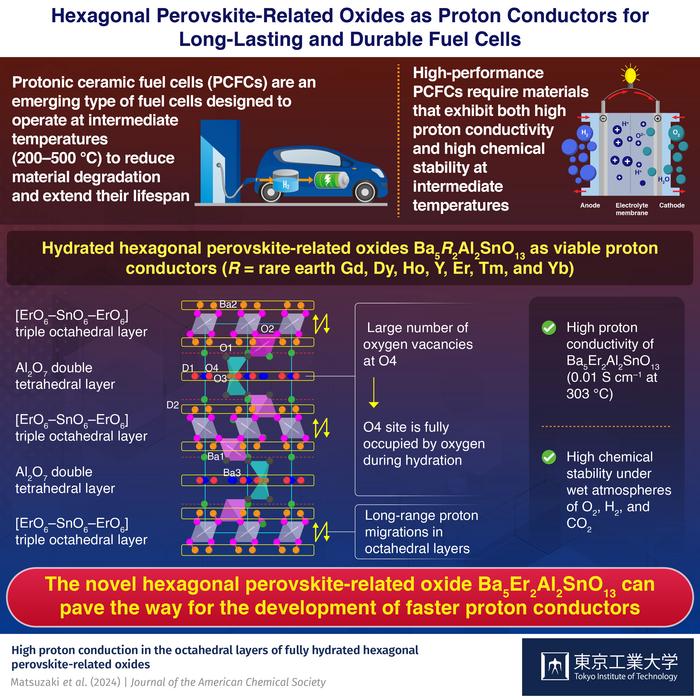
This study presents a significant advancement in fuel cell technology. Researchers from Tokyo Tech identified hexagonal perovskite-related Ba5R2Al2SnO13 oxides (R = rare earth metal) as materials with exceptionally high proton conductivity and thermal stability. Their unique crystal structure and large number of oxygen vacancies enable full hydration and high proton diffusion, making these materials ideal candidates as electrolytes for next-generation protonic ceramic fuel cells that can operate at intermediate temperatures without degradation.

Credit: Tokyo Institute of Technology
This study presents a significant advancement in fuel cell technology. Researchers from Tokyo Tech identified hexagonal perovskite-related Ba5R2Al2SnO13 oxides (R = rare earth metal) as materials with exceptionally high proton conductivity and thermal stability. Their unique crystal structure and large number of oxygen vacancies enable full hydration and high proton diffusion, making these materials ideal candidates as electrolytes for next-generation protonic ceramic fuel cells that can operate at intermediate temperatures without degradation.
Fuel cells offer a promising solution for clean energy by combining hydrogen and oxygen to generate electricity, with only water and heat produced as byproducts. They consist of an anode, a cathode, and an electrolyte. Hydrogen gas is introduced at the anode where it splits into protons (H+) and electrons. The electrons create an electric current, while the protons migrate through the electrolyte to the cathode, where they react with oxygen to form water. Most fuel cells are solid oxide fuel cells (SOFCs), which use oxide ion conductors as electrolytes. However, a major challenge with SOFCs is the high operating temperatures required, leading to material degradation over time. To address this, protonic ceramic fuel cells (PCFCs) that use proton-conducting ceramic materials as electrolytes are being explored. These fuel cells can operate at intermediate, more manageable temperatures of 200–500 °C. However, finding suitable materials that exhibit both high proton conductivity and chemical stability at these intermediate temperatures remains a challenge.
In a study published in the Journal of the American Chemical Society, researchers led by Professor Masatomo Yashima from Tokyo Institute of Technology (Tokyo Tech), in collaboration with researchers from Tohoku University, have made a significant breakthrough. They identified chemically stable hexagonal perovskite-related oxides Ba5R2Al2SnO13 (where R represents rare earth metals Gd, Dy, Ho, Y, Er, Tm, and Yb) as promising electrolyte materials with a high proton conductivity of almost 0.01 S cm⁻¹, which is notably higher than that of other proton conductors around 300 oC.
“In this work, we have discovered one of the highest proton conductors among ceramic proton conductors: novel hexagonal perovskite-related oxide Ba5Er2Al2SnO13, which would be a breakthrough for the development of fast proton conductors,” says Yashima.
The high proton conductivity of the material is attributed to the full hydration in highly oxygen deficient material with a unique crystal structure. The structure can be visualized as a stacking of octahedral layers and oxygen-deficient hexagonal close-packed AO3–δ (h’) layers (A is a large cation such as Ba²⁺ and δ represents the amount of oxygen vacancies). When hydrated, these vacancies are fully occupied by the oxygens from the water molecules to form hydroxyl groups (OH⁻), releasing protons (H⁺) which migrate through the structure, enhancing conductivity.
In their study, the researchers synthesized Ba5Er2Al2SnO13 (BEAS) using solid-state reactions. The material had a large amount of oxygen vacancies (δ = 0.2) and exhibited a fractional water uptake of 1, indicating its capacity for full hydration. When tested, its conductivity in a wet nitrogen environment was found to be 2,100 times higher than in a dry nitrogen environment at 356 °C. When fully hydrated, it achieved a conductivity of 0.01 S cm⁻¹ at 303 °C.
Moreover, the arrangement of atoms in the octahedral layers provides paths for proton migration, further increasing proton conductivity. In simulations of Ba5Er2Al2SnO13·H2O, the researchers studied proton movement in a 2×2×1 supercell of the crystal structure, represented by Ba40Er16Al16Sn8O112H16. This structure included two h’ layers and two octahedral layers. The researchers found that protons in the octahedral layer showed long-range migrations of protons, indicating fast proton diffusion.
“The high proton conductivity of BEAS is attributed to its high proton concentration and diffusion coefficient,” explains Yashima.
In addition to its high conductivity, the material is also chemically stable at the operating temperatures of PCFCs. Upon annealing the material under wet atmospheres of oxygen, air, hydrogen, and CO2 at 600 °C, the researchers observed no changes in its composition and structure, indicating the material’s robust stability and suitability for continuous operation without degradation.
“These findings open new avenues for proton conductors. The high proton conductivity via full hydration and fast proton migration in octahedral layers in highly oxygen-deficient hexagonal perovskite-related materials would be an effective strategy for developing next-generation proton conductors,” says Yashima. With its exceptional properties, this material could lead to efficient, durable, and lower-temperature fuel cells.
###
About Tokyo Institute of Technology
Tokyo Tech stands at the forefront of research and higher education as the leading university for science and technology in Japan. Tokyo Tech researchers excel in fields ranging from materials science to biology, computer science, and physics. Founded in 1881, Tokyo Tech hosts over 10,000 undergraduate and graduate students per year, who develop into scientific leaders and some of the most sought-after engineers in industry. Embodying the Japanese philosophy of “monotsukuri,” meaning “technical ingenuity and innovation,” the Tokyo Tech community strives to contribute to society through high-impact research.
Journal
Journal of the American Chemical Society
Method of Research
Experimental study
Subject of Research
Not applicable
Article Title
Journal of the American Chemical Society
Article Publication Date
25-Jun-2024
COI Statement
The authors declare no competing financial interest.
Cite Scienmag News
Victoria Harrison. (July 8, 2024). Hexagonal perovskite oxides: Electrolytes for next-generation protonic ceramic fuel cells. Scienmag. https://scienmag.com/hexagonal-perovskite-oxides-electrolytes-for-next-generation-protonic-ceramic-fuel-cells/
Victoria Harrison. "Hexagonal perovskite oxides: Electrolytes for next-generation protonic ceramic fuel cells." Scienmag, 8 July 2024, https://scienmag.com/hexagonal-perovskite-oxides-electrolytes-for-next-generation-protonic-ceramic-fuel-cells/. Accessed 5 September 2026.
Victoria Harrison. "Hexagonal perovskite oxides: Electrolytes for next-generation protonic ceramic fuel cells." Scienmag. July 8, 2024. https://scienmag.com/hexagonal-perovskite-oxides-electrolytes-for-next-generation-protonic-ceramic-fuel-cells/

