


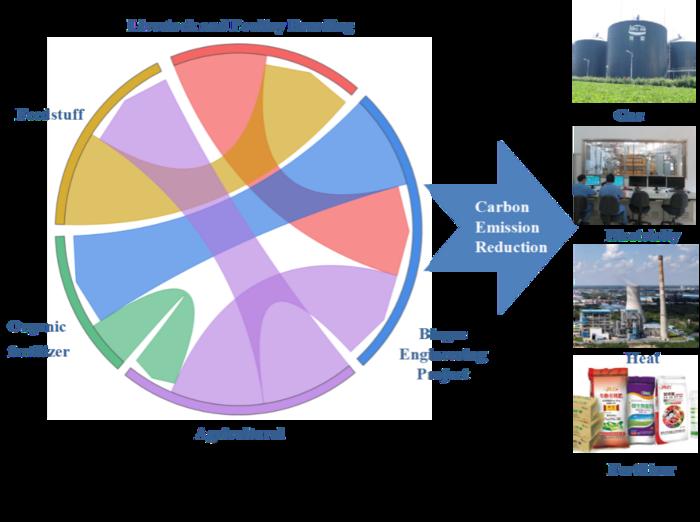
In an era of escalating environmental challenges and urgent climate action, Hengshui City in China is emerging as a beacon of innovation through its “zero-waste city” initiative. Published recently in the prestigious open-access journal Circular Economy, a groundbreaking study details an integrated model that ingeniously converts agricultural waste into multiple valuable outputs: biogas, electricity, heat, and organic fertilizer. This ecological circular system not only mitigates pollution but also antagonizes carbon emissions while stimulating sustainable economic growth — a rare symbiosis of environmental stewardship and technological progress.
Hengshui, a nationally recognized pilot city for zero-waste development, faces the colossal task of managing approximately four million tons of livestock manure each year. The study reveals how the city harnessed advanced anaerobic digestion technology backboned by sophisticated policy frameworks and institutional collaboration to transform this seemingly intractable waste stream into a closed-loop resource system. By doing so, Hengshui has substantially reduced reliance on fossil fuels and synthetic fertilizers, advancing broader sustainability objectives.
Core to the system is the ecological recycling model, which utilizes anaerobic digesters to convert manure into biogas. This biogas is then purified and injected into the local gas network, displacing significant quantities of fossil natural gas. Simultaneously, the process captures and repurposes the thermal energy released during digestion, promoting heat recovery within the agricultural and residential sectors. The nutrient-rich residue from the process is processed into high-quality organic fertilizer, replacing chemical fertilizers and enhancing soil health, thus completing the circular nexus of waste valorization.
Quantitative analysis confirms the remarkable efficacy of this integrated production approach. The project in Anping County, Hengshui achieved an annual greenhouse gas (GHG) reduction of over 87,000 tons of CO₂ equivalent, which translates into a reduction rate surpassing 64% of localized emissions from agricultural waste. This impressive figure derives largely from minimizing methane emissions typically emanating from untreated manure and curtailing fossil fuel combustion through renewable biogas. Importantly, these gains reflect careful mitigation of biogas leakage and emissions during manure storage and equipment operation, areas identified as critical hotspots for further emission control.
Economic indicators parallel these environmental successes. Since 2020, propelled by the zero-waste city construction, Hengshui’s agricultural waste utilization soared to over 90%, coinciding with a 21% regional GDP increase and more than 15% growth in fixed-asset investment within agriculture, forestry, animal husbandry, and fisheries. The synergy between circular waste utilization and regional economic vitality underscores the viability of green technologies in driving sustainable development.
Behind these technological and economic strides lies a sophisticated policy architecture encapsulated within the “1+N+13” framework. This institutional system blends centralized oversight with adaptive, localized strategies, fostering cross-sectoral collaboration essential for sustaining the biogas infrastructure and enhancing waste management protocols. The policy framework’s success underscores the critical role of coherent governance mechanisms in scaling circular economy interventions.
Methodologically, the research adopts the driving force-pressure-state-impact-response (DPSIR) model, analyzing a span from 2020 to 2023. This robust framework dissects the multifaceted interactions among economic growth, environmental stressors, and societal responses. Nineteen indicators across economic, environmental, and social dimensions were evaluated, and data were standardized utilizing the entropy weight – technique for order preference by similarity to an ideal solution (TOPSIS) method. This comprehensive approach quantified key variables such as GDP growth, livestock farming scale, and agricultural investment dynamics.
In addition, the team employed the Clean Development Mechanism (CDM)-approved methodology (AMS.III.D.ver.21) to rigorously assess greenhouse gas emission reductions stemming from the biogas utilization project. Such rigor in emission accounting fortifies the credibility of reported benefits, positioning Hengshui’s model as a replicable blueprint for zero-waste initiatives worldwide.
An insightful aspect of the study reveals the principal drivers of emission reductions stem from a confluence of economic expansion, enhanced employment, focused fixed-asset agricultural investments, and the development of standardized, large-scale livestock facilities. Nevertheless, persistent environmental governance pressures, particularly in air pollution control, present constraints, reflecting the complex balancing act faced during rapid urban and agricultural modernization.
Despite the glowing successes, challenges endure. Nutrient runoff associated with biogas-derived organic fertilizers poses a risk of eutrophication in adjacent water bodies if not meticulously managed. Dr. Lyu Pu, the paper’s corresponding author, emphasizes the critical need for precision application techniques and vigilant environmental monitoring to mitigate such unintended consequences. This highlights that sustainability is a dynamic process requiring continuous refinement.
From a global perspective, Hengshui’s circular economy model echoes and complements strategies pursued in regions like the European Union, Japan, and Singapore. Comparative examples include Surrey, Canada, where anaerobic digesters fuel municipal fleets, and Thailand’s “3Rs” (reduce, reuse, recycle) policy aligning remarkably with Hengshui’s approach. These convergences underscore a worldwide pivot toward systemic, integrated waste-to-resource paradigms as foundational pillars for circular economies.
Moreover, the ecological circular recycling system contributes to United Nations Sustainable Development Goals by fostering green employment opportunities and reducing chemical fertilizer dependency, which has palpable benefits for ecosystem integrity. The substitution of fossil fuels with renewable biomethane also enhances energy security and curtails carbon footprints, an accomplishment with far-reaching implications amid the global climate crisis.
In sum, Hengshui’s pioneering project demonstrates that agricultural waste — long regarded as an environmental liability — can be transformed into a multifaceted asset within a well-structured circular economy. Through technological innovation, policy coherence, and strategic investments, the city presents a scalable pathway toward synergistic pollution control and climate mitigation. The model’s ability to intertwine economic development with ecological resilience could inspire replication in diverse agroindustrial contexts worldwide, representing a keystone advancement in sustainable urban-rural integration.
News Publication Date:
18 March 2025
Web References:
https://www.sciencedirect.com/science/article/pii/S2773167725000056
https://www.sciencedirect.com/journal/circular-economy
http://dx.doi.org/10.1016/j.cec.2025.100130
Cite Scienmag News
Sloane Callahan. (April 16, 2025). Hengshui’s “Zero-Waste City” Initiative Showcases Agricultural Waste Innovation Driving Pollution Reduction and Climate Action. Scienmag. https://scienmag.com/hengshuis-zero-waste-city-initiative-showcases-agricultural-waste-innovation-driving-pollution-reduction-and-climate-action/
Sloane Callahan. "Hengshui’s “Zero-Waste City” Initiative Showcases Agricultural Waste Innovation Driving Pollution Reduction and Climate Action." Scienmag, 16 April 2025, https://scienmag.com/hengshuis-zero-waste-city-initiative-showcases-agricultural-waste-innovation-driving-pollution-reduction-and-climate-action/. Accessed 4 September 2026.
Sloane Callahan. "Hengshui’s “Zero-Waste City” Initiative Showcases Agricultural Waste Innovation Driving Pollution Reduction and Climate Action." Scienmag. April 16, 2025. https://scienmag.com/hengshuis-zero-waste-city-initiative-showcases-agricultural-waste-innovation-driving-pollution-reduction-and-climate-action/


