

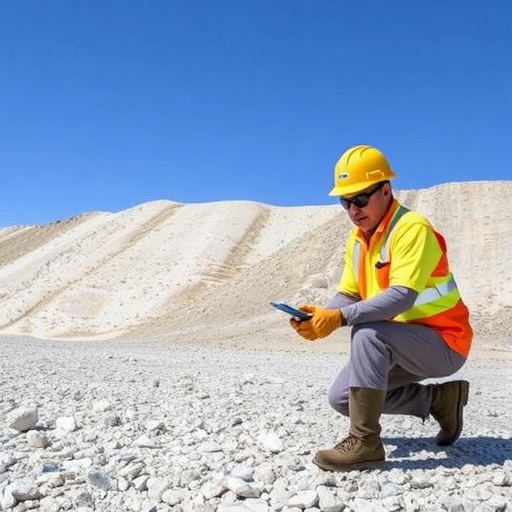
In a groundbreaking study that delves into occupational health hazards within the mining industry, researchers have unearthed concerning levels of heavy metal contamination in perlite quarries and the consequent exposure risk posed to quarry workers. The perlite mining sector, a critical supplier of this versatile volcanic glass used widely in construction, horticulture, and industrial applications, has long been considered relatively safe. However, the recent investigation by Turhan, Türkdoğan, Altuner, and colleagues challenges this perception by providing the first comprehensive analysis of heavy metal concentrations in perlite mining environments and their implications for human health.
The study meticulously sampled soil, air, and dust from several perlite quarry sites, revealing concentrations of heavy metals that not only exceed national environmental safety thresholds but also raise urgent questions about long-term occupational exposure risks. These metals, including arsenic, lead, cadmium, and chromium, are notorious for their toxicological profiles and persistence in the environment. Their bioaccumulation potential means that chronic exposure could significantly affect quarry workers’ health, potentially resulting in severe respiratory, neurological, and systemic conditions.
One of the critical findings is the detection of elevated particulate matter laden with these heavy metals in the immediate breathing zones of workers. The researchers utilized advanced air sampling techniques coupled with atomic absorption spectroscopy to quantify airborne metal particulates during various mining operations, including drilling, blasting, and crushing. Their data indicate that during active extraction periods, metal concentrations spike dramatically, far surpassing occupational exposure limits recommended by bodies such as the World Health Organization and the Occupational Safety and Health Administration.
The peril posed by these toxic metals extends beyond inhalation risks. The study also examined dermal exposure pathways by analyzing the dust deposited on the skin and clothing of workers. This comprehensive approach highlights the multifaceted nature of exposure in mining environments, where inhalation, ingestion via hand-to-mouth contact, and dermal absorption collectively contribute to the workers’ body burden of toxic metals. Notably, arsenic and cadmium present a high affinity for accumulating in human tissues, especially when combined exposure routes exist.
In delving deeper into the geochemical characteristics of perlite quarry regions, the researchers provided an innovative perspective on how natural mineral composition, combined with mining activities, can amplify metal mobilization. Perlite itself, though largely composed of silica, occurs in geological formations that contain trace amounts of metal-rich minerals. When disrupted during mining, these minerals weather and release their heavy metal constituents. Such an environmental context exemplifies how industrial exploitation of mineral deposits can inadvertently transform benign geological features into sources of environmental health hazards.
Moreover, this study’s findings underscore a crucial occupational health gap: the insufficient protective measures currently employed in perlite mining operations. Interviews and on-site observations reported limited use of personal protective equipment (PPE), inadequate ventilation systems, and a lack of routine environmental monitoring protocols. These shortcomings amplify the workers’ vulnerability, compounding the risk from metal-laden dust exposure. The authors advocate for immediate integration of comprehensive exposure mitigation strategies, including enforced PPE usage, dust suppression techniques, and regular health screenings.
The health implications detailed in the research resonate far beyond the perlite sector, reinforcing broader concerns about heavy metal exposure in mining industries worldwide. Chronic exposure to arsenic, lead, and other toxic metals is linked to an array of debilitating health outcomes—cancers, renal dysfunction, cognitive impairments, and cardiovascular diseases—all of which contribute to elevated morbidity and mortality rates among mining populations. The study’s rigorous toxicological assessments bring urgent attention to these occupational risks, emphasizing the need for policy interventions and workplace reforms.
Intriguingly, this research also opens avenues for environmental monitoring innovations. The authors employed cutting-edge analytical methods, such as inductively coupled plasma mass spectrometry (ICP-MS) and scanning electron microscopy (SEM), to trace the spatial distribution and particle morphology of heavy metals in the mining environment. This granular data not only aids in exposure assessment but provides a scientific foundation for designing targeted remediation and control measures tailored to specific quarry conditions.
In considering mitigation, the study highlights the potential benefits of adopting real-time air quality monitoring technologies and automated dust suppression systems within active perlite quarries. Employing such systems can reduce airborne metal particle concentrations significantly, thereby safeguarding worker health. Additionally, worker education programs on exposure risks and hygiene practices could substantially limit ingestion and dermal absorption pathways, further diminishing health hazards.
The environmental repercussions of heavy metal contamination also extend beyond occupational settings. The researchers point to concerns about potential leaching of metals into surrounding ecosystems, including groundwater and agricultural soils adjacent to quarry sites. This can lead to bioaccumulation in local flora and fauna, posing ecological risks and indirectly affecting community health. The study thus advocates for integrated environmental management plans that encompass both industrial and off-site contamination control.
Turhan et al.’s findings are a clarion call for the mining industry, regulatory agencies, and public health stakeholders to reevaluate current standards governing occupational safety in perlite extraction. The documented heavy metal exposure risks demand urgent policy reforms, enhanced monitoring protocols, and investment in worker health protection technologies. By illuminating an underrecognized danger lurking in a seemingly low-risk mining sector, the study paves the way for safer, more sustainable industrial practices.
This study’s rigor and comprehensive approach set a new benchmark for occupational health assessments in mineral extraction contexts. It bridges a critical knowledge gap by connecting geological assessments with industrial hygiene, toxicology, and environmental science, holistically addressing the complexities of mining-related heavy metal exposure. Its findings will undoubtedly inspire further research and informed interventions aimed at safeguarding the health of vulnerable worker populations globally.
In conclusion, the revelation of hazardous heavy metal concentrations in perlite quarries and the associated worker exposure constitute a significant public health concern that demands immediate attention. Implementation of stringent occupational safety measures, advanced monitoring technologies, and comprehensive environmental management strategies are imperative to mitigate these risks. As the mining industry continues to underpin various essential sectors, ensuring the health and safety of those at the forefront of extraction activities remains paramount. This pioneering research not only highlights hidden occupational dangers but also charts a path forward for protective action and improved industrial hygiene standards.
Subject of Research: Heavy metal contamination in perlite quarries and occupational exposure risks for workers.
Article Title: Heavy metals in perlite quarries and exposure of worker.
Article References:
Turhan, Ş., Türkdoğan, S., Altuner, E.M. et al. Heavy metals in perlite quarries and exposure of worker. Environ Earth Sci 85, 58 (2026). https://doi.org/10.1007/s12665-025-12654-x
Image Credits: AI Generated


