A simulated heatwave has exposed a striking split in how the two great branches of the microbial world respond to extreme heat. In a series of outdoor mesocosms on Lake Taihu, one of China’s largest and most ecologically important shallow lakes, researchers raised water temperatures by 8 degrees Celsius for ten days and then watched what happened over a 28-day experiment. The results, published in the journal Microbial Ecology, reveal that bacteria and other prokaryotes on one side, and microscopic eukaryotes on the other, follow fundamentally different trajectories of disruption and recovery. The finding matters because freshwater microbial communities underpin everything from nutrient cycling to the frequency of harmful algal blooms, and climate models predict that marine and lake heatwaves will become more frequent and more intense in the coming decades.
The team, led by Jiayi Dong and Yue Lin of Shanghai Ocean University together with colleagues at the Nanjing Institute of Geography and Limnology of the Chinese Academy of Sciences, used high-throughput sequencing to track the identities and abundances of organisms across the experiment. But they went well beyond simple species counts. By combining phylogenetic community-assembly analysis with co-occurrence network construction and graph-theoretic measures of structural robustness, they were able to ask not just who was present, but how the communities were assembled and how resilient their internal architecture was to further perturbation. This three-pronged approach is increasingly seen as the gold standard for distinguishing genuine ecological reorganization from mere statistical noise in sequencing data.
The first major result concerns diversity, and here the two domains parted ways almost immediately. Prokaryotic alpha diversity, a measure of how many bacterial and archaeal types coexist in a sample, showed strong treatment-associated changes, and notably these changes were most pronounced during the recovery phase rather than during the heatwave itself. Eukaryotic alpha diversity, by contrast, showed no comparable decline. Yet the eukaryotic communities were not untouched: their composition, the specific mixture of species present, remained displaced from the pre-heatwave state even as overall diversity held steady. This dissociation between diversity and composition is a classic signature of functional turnover, where one set of species is replaced by another of similar richness but different identity, and it suggests that eukaryotic communities may absorb thermal shocks without losing species while still shifting in character.
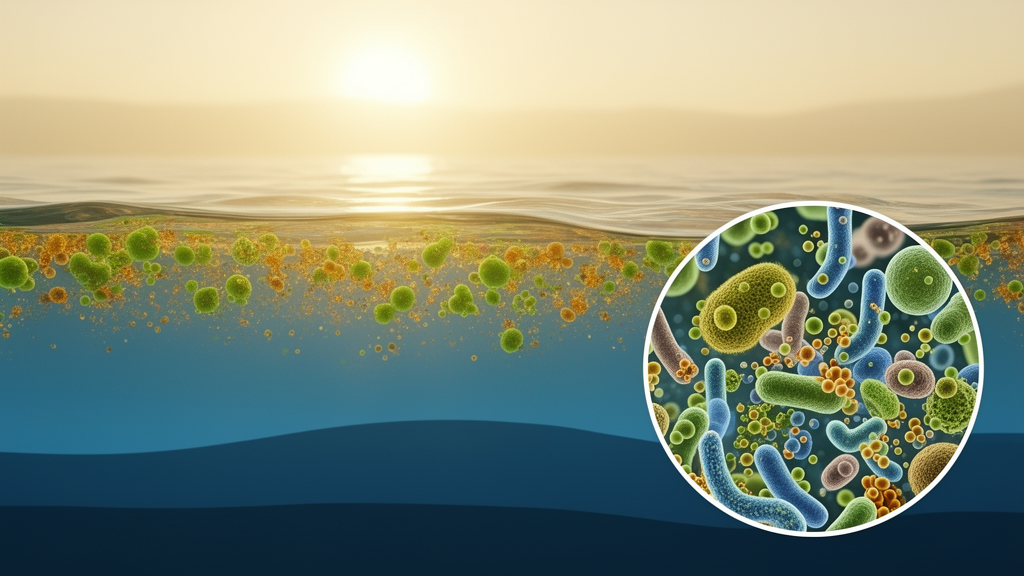
Perhaps the most eye-catching number in the study comes from the cyanobacteria. These photosynthetic bacteria, many of which form the nuisance blooms that plague eutrophic lakes worldwide, increased from just 8 percent of the prokaryotic community to 47 percent during the recovery period. That nearly sixfold expansion coincided with a decline in zooplankton, the microscopic grazers that normally keep cyanobacterial populations in check. The authors are careful in their interpretation: the pattern is consistent with weakened top-down control, in which fewer grazers allow cyanobacteria to proliferate, but the study design does not demonstrate this mechanism directly. Even so, the implication is sobering. If heatwaves suppress grazers and thereby release cyanobacteria from biological constraint, a single extreme thermal event could seed bloom conditions that persist long after temperatures return to normal.
Beneath these compositional shifts lies a deeper question that has animated microbial ecology for years: what processes govern which species persist in a community? Is it deterministic niche filtering, where the environment selects for particular traits, or stochastic processes such as dispersal limitation, where species fail to arrive simply because they cannot move fast enough? The researchers addressed this using the beta nearest taxon index, or betaNTI, a null-model statistic that compares observed phylogenetic turnover against what would be expected if communities were assembled at random. The answers were again domain specific. Prokaryotes showed a pronounced redistribution toward the null-model category classified as dispersal limitation, suggesting that after the heatwave, the bacterial community was increasingly shaped by which organisms could physically reach and colonize the disturbed habitat.
The eukaryotic pattern was subtler but no less informative. Eukaryotic betaNTI values shifted toward more positive values, but against a background in which this particular assembly category already contributed heavily. In other words, eukaryotic communities were already dominated by processes that push betaNTI positive, typically interpreted as variable selection or dispersal limitation depending on the framework, and the heatwave amplified rather than created this tendency. The contrast implies that the two domains operate under different assembly regimes even in the same water column, and that a thermal perturbation pushes them further apart rather than converging them onto a shared response. For ecologists trying to predict how lake ecosystems will respond to climate change, this is a warning that single-domain studies, which remain common, may miss half the story.
The co-occurrence networks added yet another layer of insight. These networks treat microbial taxa as nodes and statistically inferred ecological associations as edges, producing a map of the community’s putative interaction structure. The heatwave-associated networks contained more nodes and more edges than their control counterparts, indicating that the thermal disturbance expanded and densified the web of inferred relationships. A denser network is not automatically a healthier one; in some contexts, added connections reflect stress-induced cross-feeding or shared responses to a common disturbance rather than stable mutualisms. But the structural change is unambiguous: the heatwave did not merely add or remove species, it rewired the community’s interaction architecture.
Robustness analysis then tested what those structural changes would mean under future stress. The researchers simulated random node removal, a standard stress test that mimics the progressive loss of species, and tracked how quickly the network’s normalized natural connectivity declined. The prokaryotic heatwave network lost connectivity more rapidly than its control counterpart, meaning the bacterial community emerging from the heatwave was structurally more fragile, more prone to cascading disintegration as species were lost. The eukaryotic networks told a different story: their robustness trajectories were broadly similar between heated and control treatments. The asymmetry is striking. The domain that showed the more dramatic compositional response, with its cyanobacterial surge, also produced the more vulnerable network, while the eukaryotes, whose diversity barely budged, maintained structural integrity.
The authors are explicit about the limits of their inference, and that restraint is itself noteworthy in a field prone to overinterpretation. The study, they write, reveals contrasting short-term responses and recovery dynamics of prokaryotic and eukaryotic communities to an extreme thermal event, but it does not imply unmeasured life-history or evolutionary mechanisms. Co-occurrence edges are statistical associations, not confirmed interactions, and the mesocosm setting, while far more realistic than a laboratory flask, cannot fully reproduce the hydrodynamics and catchment influences of a whole lake. The zooplankton decline and cyanobacterial expansion are correlated, not causally linked, within this dataset. Such caveats do not weaken the study; they define precisely what it shows and what remains to be tested.
What the study does establish is enough to reshape how freshwater ecologists think about heatwave impacts. Recovery, not the disturbance itself, may be when microbial communities are most transformed, as the prokaryotic diversity changes and the cyanobacterial expansion both peaked after temperatures had normalized. The two domains of life respond on different clocks and through different assembly mechanisms, so monitoring programs that track only bacteria, or only eukaryotes, will systematically misjudge ecosystem vulnerability. And structural fragility, measured through network connectivity, may be a more sensitive early-warning indicator than diversity alone, since the prokaryotic networks flagged danger even as species counts suggested partial recovery. As lake heatwaves grow more frequent under continued warming, experiments like this one, conducted in the open air on a real lake with all its messy complexity, will be essential for anticipating which waters tip toward blooms and which bounce back. The message from Lake Taihu is that the answer depends on which half of the microbial world you are watching.
Subject of Research: Contrasting prokaryotic and eukaryotic microbial community responses to a simulated heatwave in Lake Taihu mesocosms
Article Title: Contrasting Prokaryotic and Eukaryotic Responses to a Simulated Heatwave: Community Assembly and Co-Occurrence Network Reorganization in Lake Taihu Mesocosms
Article References: Dong, J., Lin, Y., Tang, H., Zhang, W., Wang, L., & Deng, J. (2026). Contrasting Prokaryotic and Eukaryotic Responses to a Simulated Heatwave: Community Assembly and Co-Occurrence Network Reorganization in Lake Taihu Mesocosms. Microbial Ecology. https://doi.org/10.1007/s00248-026-02899-9
Image Credits: AI Generated
DOI: 10.1007/s00248-026-02899-9
Keywords: heatwave, microbial ecology, Lake Taihu, prokaryotes, eukaryotes, community assembly, co-occurrence network, cyanobacteria, mesocosm, freshwater, climate change, network robustness
Cite Scienmag News
Morgan Morrow. (October 9, 2026). Heatwaves Reshape Lake Microbes in Surprisingly Different Ways. Scienmag. https://scienmag.com/heatwaves-reshape-lake-microbes-in-surprisingly-different-ways/
Morgan Morrow. "Heatwaves Reshape Lake Microbes in Surprisingly Different Ways." Scienmag, 9 October 2026, https://scienmag.com/heatwaves-reshape-lake-microbes-in-surprisingly-different-ways/. Accessed 9 October 2026.
Morgan Morrow. "Heatwaves Reshape Lake Microbes in Surprisingly Different Ways." Scienmag. October 9, 2026. https://scienmag.com/heatwaves-reshape-lake-microbes-in-surprisingly-different-ways/