

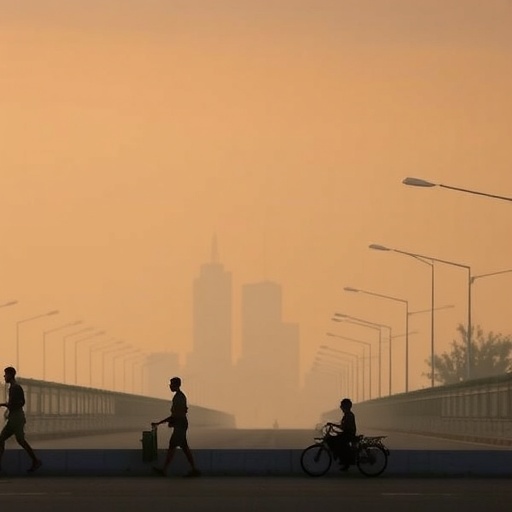
Rising suicide rates in the United States have triggered an urgent quest to untangle the complex interplay of factors driving this disturbing trend. Among the many suspected contributors, environmental stressors such as extreme heat and air pollution have emerged as significant elements that might influence short-term suicide risk. While each has been studied individually, recent research illuminates the compounded impact when these two factors coexist, especially during the hot summer months. This novel study offers vital insights into how heat and air quality interact to elevate the risk of suicide, providing a deeper understanding that could inform prevention strategies.
The core focus of the investigation is the combined effect of wet bulb globe temperature (WBGT), a nuanced metric that quantifies heat stress by including humidity, wind speed, and solar radiation, alongside levels of nitrogen dioxide (NO₂), a toxic air pollutant primarily emitted by fossil fuel combustion in vehicles and power plants. Unlike traditional temperature measurements, WBGT offers a physiologically relevant indicator of thermal stress experienced by the human body. By scrutinizing data over 16 years covering more than 7,500 suicide cases in Utah, researchers sought to quantify how fluctuations in these environmental variables correspond with suicide mortality.
Their findings reveal a sobering reality: as WBGT climbs, so does suicide risk. Specifically, for every 9-degree Fahrenheit increase in this comprehensive heat index, suicide risk rises by approximately 5%. This association intensifies markedly during spring and summer months—from late March through late September—when ambient temperatures typically peak. Such seasonal sensitivity underscores the critical role of heat stress in influencing mental health outcomes and highlights periods of heightened vulnerability that may require focused intervention.
However, the study’s insights become profoundly troubling when considering the role of nitrogen dioxide (NO₂). While NO₂ alone does not uniformly predict increased suicide risk during warmer months, its interaction with high WBGT dramatically escalates danger. Data indicate a strong synergistic effect: during the warm season, when NO₂ concentrations soar, the same 9°F rise in WBGT correlates with nearly a 50% increase in suicide risk. This multiplicative effect suggests that heat stress and polluted air form a perilous combination that exacerbates underlying mental health struggles.
During colder seasons, the researchers observed a distinct pattern. High NO₂ levels were consistently associated with increased suicide risk regardless of temperature conditions. This reveals that air pollution poses a persistent threat independent of heat stress in cooler months, emphasizing the year-round mental health implications of deteriorating air quality. Declaring causality remains premature, yet these correlations advocate for heightened attention to environmental factors in suicide prevention frameworks.
The implications of these findings stretch beyond epidemiological insights, demanding a reevaluation of public health policies. Historically, air quality management and heat mitigation have been treated as separate spheres from mental health initiatives. This research challenges that paradigm by proposing that environmental interventions—even those aimed at reducing carbon emissions and urban heat—could contribute tangibly to reducing suicide incidences. Policymakers might therefore consider integrating mental health metrics into climate resilience and pollution control strategies.
Adding an additional layer of complexity, the study’s authors highlight the evolving context of environmental risk factors, particularly in regions like Utah where wildfire seasons have intensified since the data collection period ended in 2016. Wildfires lead to spikes in fine particulate matter and nitrogen oxides, potentially rendering the current findings a conservative estimate of risk. Increased seasonal volatility in pollutant levels could forge novel patterns of interaction with heat stress, necessitating continuous monitoring and adaptive research to unravel these dynamic relationships.
In the realm of personalized interventions, the team envisions future research that merges environmental data with genetic profiling to decode individual susceptibility. Genetic predispositions to suicide might interact intricately with environmental stressors, offering predictive capabilities that could revolutionize timing and targeting of preventive measures. If successful, such integrative approaches could foster breakthroughs in precision mental health care, enabling timely supports aligned with cyclical environmental risks.
Despite the urgent need to broaden the scope of suicide research, the authors caution the scientific community against overinterpretation. The observed associations do not confirm direct causation; rather, they represent complex interrelations warranting thorough exploration. Psychosocial, economic, and biological factors undoubtedly weave into the fabric of risk, demanding multidisciplinary attention to forge comprehensive solutions.
This investigation also underscores the critical importance of short-term windows in suicide risk. The fortnight preceding suicide attempts or death may represent a period of acute environmental sensitivity, where interventions might exert maximal impact. Recognizing environmental triggers within this timeframe could enhance clinical vigilance and community-based support systems, ultimately saving lives.
Researchers advocate for integrating environmental health measures within suicide prevention policies, an approach previously sidelined. Urban planners, environmental regulators, and mental health professionals are urged to collaborate to address the escalating challenges posed by climate change and pollution. As global temperatures rise and air pollution persists, understanding and mitigating their mental health consequences becomes not only a scientific imperative but a societal obligation.
In conclusion, the intertwining of heat stress and air pollution delineates a new frontier in suicidology. This study illuminates how environmental adversities act in tandem to exacerbate psychological distress, especially amid rising global temperatures and escalating fossil fuel emissions. By expanding the lens of suicide risk to encompass environmental factors, the research prompts a vital rethinking of prevention strategies that encompass climate mitigation, air quality improvement, and personalized mental health care approaches. Through such integrated efforts, it may be possible to alleviate some of the silent suffering driven by the unseen forces of our changing environment.
Subject of Research: People
Article Title: Independent and interactive effects of wet bulb globe temperature and air pollution exposures on suicide mortality
News Publication Date: 21-Feb-2026
Web References:
- Environment International article: https://www.sciencedirect.com/science/article/pii/S0160412026001108
- DOI: http://dx.doi.org/10.1016/j.envint.2026.110152
Image Credits: Kristan Jacobsen / University of Utah Health
Keywords: Suicide, Risk assessment, Climate change, Air pollution, Mental health, Environmental stresses


