

Saturday, May 2, 2026
Science
No Result
View All Result
  • Login
  • HOME
  • SCIENCE NEWS
  • CONTACT US
  • HOME
  • SCIENCE NEWS
  • CONTACT US
No Result
View All Result
Scienmag
No Result
View All Result
Home Science News Climate

Heat’s effects on police and judges

May 14, 2024
in Climate
Reading Time: 2 mins read
0
Behrer Figure 1
66
SHARES
601
VIEWS
Share on FacebookShare on Twitter
ADVERTISEMENT

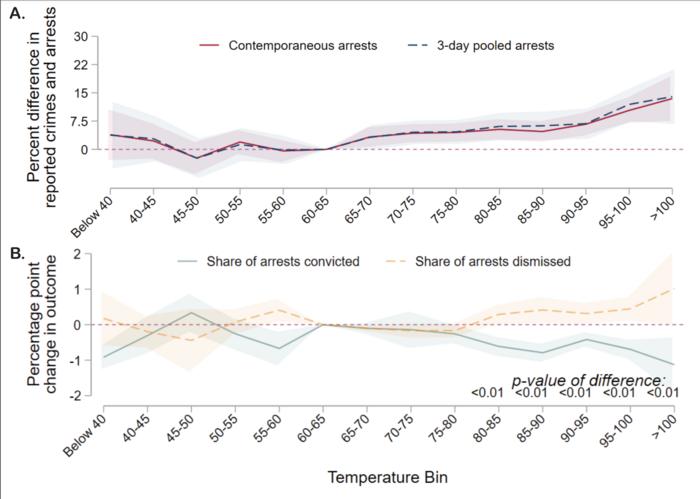
High temperatures affect the decision-making of police officers and judges. Previous research has shown that heat can increase criminal activity, with the leading theory proposing that heat reduces emotional control and increases aggression. A. Patrick Behrer and Valentin Bolotnyy investigate the effects of heat on the behavior of those who respond to criminal activity. The authors analyzed records of 10 million arrests across the state of Texas from 2010 through 2017, along with the legal outcomes that followed each arrest. These data were merged with daily temperature data. Police made fewer arrests per reported crime on the hottest days in the sample, and these arrests were more likely to be dismissed in court, suggesting that more of the hot-day arrests were difficult to justify legally. Judges dismissed fewer cases, issued longer prison sentences, and levied higher fines when ruling on hotter-than-average days. Heat did not exert a meaningful influence on the decisions of prosecutors. According to the authors, unless measures like air-conditioning and increased staffing and teamwork are used, climate change is likely to worsen police and judicial decision-making in places like Texas through an increased frequency of hot days. 

Behrer Figure 1

Credit: Behrer et al

High temperatures affect the decision-making of police officers and judges. Previous research has shown that heat can increase criminal activity, with the leading theory proposing that heat reduces emotional control and increases aggression. A. Patrick Behrer and Valentin Bolotnyy investigate the effects of heat on the behavior of those who respond to criminal activity. The authors analyzed records of 10 million arrests across the state of Texas from 2010 through 2017, along with the legal outcomes that followed each arrest. These data were merged with daily temperature data. Police made fewer arrests per reported crime on the hottest days in the sample, and these arrests were more likely to be dismissed in court, suggesting that more of the hot-day arrests were difficult to justify legally. Judges dismissed fewer cases, issued longer prison sentences, and levied higher fines when ruling on hotter-than-average days. Heat did not exert a meaningful influence on the decisions of prosecutors. According to the authors, unless measures like air-conditioning and increased staffing and teamwork are used, climate change is likely to worsen police and judicial decision-making in places like Texas through an increased frequency of hot days. 


Journal

PNAS Nexus

Article Title

Heat and law enforcement

Article Publication Date

14-May-2024

Share26Tweet17
Previous Post

Optimal redistribution of nitrogen fertilizer among countries

Next Post

A new perspective reviews pork’s place in global sustainable healthy diets

Related Posts

Expanding Climate Targets: Distributional Effects Beyond CO2 — Climate
Climate

Expanding Climate Targets: Distributional Effects Beyond CO2

May 1, 2026
From Net Zero Goals to Paris Agreement Progress
Climate

From Net-Zero Goals to Paris Agreement Progress

April 22, 2026
Ocean Warming Dulls Sea Land Breezes in Megacities
Climate

Ocean Warming Dulls Sea-Land Breezes in Megacities

April 17, 2026
Stronger Currents Boost Stratification, Cool Shelf Seas
Climate

Stronger Currents Boost Stratification, Cool Shelf Seas

April 15, 2026
Small Wetlands’ Big Role in Global Methane
Climate

Small Wetlands’ Big Role in Global Methane

April 8, 2026
From Least Cost to SDG Optimal Climate Mitigation Allocation
Climate

From Least-Cost to SDG-Optimal Climate Mitigation Allocation

April 7, 2026
Next Post
National Pork Board Logo

A new perspective reviews pork’s place in global sustainable healthy diets

  • Mothers who receive childcare support from maternal grandparents show more parental warmth, finds NTU Singapore study

    Mothers who receive childcare support from maternal grandparents show more parental warmth, finds NTU Singapore study

    27639 shares
    Share 11052 Tweet 6908
  • University of Seville Breaks 120-Year-Old Mystery, Revises a Key Einstein Concept

    1042 shares
    Share 417 Tweet 261
  • Bee body mass, pathogens and local climate influence heat tolerance

    677 shares
    Share 271 Tweet 169
  • Researchers record first-ever images and data of a shark experiencing a boat strike

    540 shares
    Share 216 Tweet 135
  • Groundbreaking Clinical Trial Reveals Lubiprostone Enhances Kidney Function

    527 shares
    Share 211 Tweet 132
Science

Embark on a thrilling journey of discovery with Scienmag.com—your ultimate source for cutting-edge breakthroughs. Immerse yourself in a world where curiosity knows no limits and tomorrow’s possibilities become today’s reality!

RECENT NEWS

  • Family Health Needs of Disabled Elders Explored
  • Mcu Controls Bone Growth Through Mitochondrial Calcium
  • Physical Disorders, ADLs, Cognition, Depression in Nursing Homes
  • Precise Spatiotemporal Cardiac Repair and Regeneration

Categories

  • Agriculture
  • Anthropology
  • Archaeology
  • Athmospheric
  • Biology
  • Biotechnology
  • Blog
  • Bussines
  • Cancer
  • Chemistry
  • Climate
  • Earth Science
  • Editorial Policy
  • Marine
  • Mathematics
  • Medicine
  • Pediatry
  • Policy
  • Psychology & Psychiatry
  • Science Education
  • Social Science
  • Space
  • Technology and Engineering

Subscribe to Blog via Email

Success! An email was just sent to confirm your subscription. Please find the email now and click 'Confirm Follow' to start subscribing.

Join 5,146 other subscribers

© 2025 Scienmag - Science Magazine

Welcome Back!

Login to your account below

Forgotten Password?

Retrieve your password

Please enter your username or email address to reset your password.

Log In
No Result
View All Result
  • HOME
  • SCIENCE NEWS
  • CONTACT US

© 2025 Scienmag - Science Magazine
