


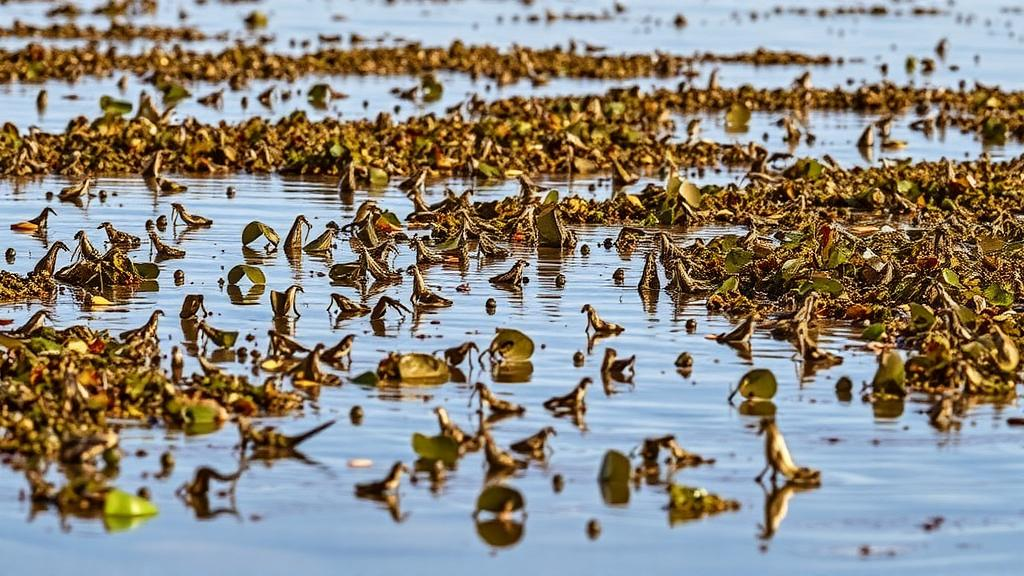
When six separate heat waves struck northern Portugal between the summers of 2021 and 2022, something unusual began drifting through the upper reaches of the Minho River estuary: dense mats of decaying waterweed, torn loose and floating downstream. That visible warning sign prompted researchers from the University of Porto, CIIMAR and the Aquamuseu do Rio Minho to launch a twelve-month investigation into how extreme heat reshapes the foundations of an estuarine food web. Their findings, published in Discover Ecology, reveal a striking asymmetry in vulnerability. At the river’s mouth, the native brown alga Fucus ceranoides barely flinched as temperatures climbed. Nineteen kilometres upstream, however, the established exotic macrophyte Egeria densa lost biomass steadily, and the invertebrate communities sheltering in both plants suffered collapses in diversity and abundance that could foreshadow long-term ecological change.
The study period was anything but ordinary. Portugal endured an unusually dry stretch in which every month except March recorded below-average precipitation, and the Portuguese Institute for the Ocean and Atmosphere logged six distinct heat waves between September 2021 and September 2022. Following World Meteorological Organisation guidelines, the researchers classified heat waves as periods lasting at least two consecutive days with maximum temperatures five degrees Celsius above the mean. The events they documented ranged from six to sixteen days in duration, and remarkably, one occurred in December 2021, demonstrating that extreme heat no longer respects seasonal boundaries. This relentless sequence of thermal shocks, layered on top of chronic drought, created a natural experiment that the team could exploit by sampling monthly across a full year.
The Minho River estuary, which forms roughly forty kilometres of the border between Portugal and Spain, is a mesotidal, partially mixed system that tends toward a salt wedge during high flows. The researchers selected two dominant submerged plants anchored at opposite ends of the salinity gradient. Fucus ceranoides, a brown alga typical of sheltered rocky estuaries from northern Portugal to Norway, grows on rocks near the river mouth in the polyhaline zone. Egeria densa, a submerged macrophyte native to subtropical South America that first appeared in the international section of the Minho in the early 1990s, forms dense monospecific mats along the upper estuary’s tidal freshwater zone. Because Egeria densa’s downstream distribution stops at the oligohaline-limnetic boundary, roughly sixteen kilometres from the mouth, saline intrusion during dry months poses a constant threat to its foothold.
Monthly sampling from September 2021 to September 2022 was conducted at low tide, with five replicate quadrats of 0.1 square metres collected by hand for each plant. In the laboratory, the team removed, sorted and counted every associated invertebrate to the lowest taxonomic level possible, then dried plant and animal material at sixty degrees Celsius for forty-eight hours to determine dry weight. Ash-free dry mass was obtained by burning samples in a muffle furnace at 550 degrees Celsius. In parallel, a multi-parameter probe recorded water temperature, salinity, dissolved oxygen, pH, conductivity and oxidation-reduction potential at each site, while suspended organic matter was quantified by filtering one-litre water samples through pre-weighed glass fibre filters. Statistical treatment included UPGMA clustering with Bray-Curtis similarity to group months by environmental and faunal composition, Kendall’s rank correlations for non-normal data, and Kruskal-Wallis tests with Dunn post hoc comparisons for biomass differences.
The environmental data told a clear story of stress. In the lower estuary, water temperature ranged from 10.9 degrees Celsius in January to 20.6 degrees in June, and salinity swung dramatically from 13.55 in March to 37.18 in September 2021. Upstream, conditions were harsher still: temperatures spanned 7.7 degrees in November to 25.3 degrees in August, and an August salinity peak of 0.16, modest by marine standards but anomalous for a freshwater zone, contrasted with values of 0.04 to 0.08 in other months. Oxidation-reduction potential, a proxy for the chemical redox state of the water, dipped in every heat wave month in the lower estuary and collapsed to 87.1 millivolts in July upstream, far below the 228 to 348 millivolts seen otherwise. Cluster analysis confirmed that July and August stood apart environmentally from all other months.
Against this backdrop, the two plants responded in opposite ways. Fucus ceranoides biomass varied little, averaging 589.77 grams of dry weight per square metre, with a November maximum of 770.71 and a July minimum of 429.4. The only significant differences separated April and July from most other months, and no correlations emerged between algal biomass and any measured environmental variable. The authors attribute this resilience to the euryhaline tolerance of a species adapted to daily tidal salinity fluctuations, noting that similar biomasses were recorded in a survey of the same site a decade earlier. Egeria densa, by contrast, declined relentlessly, falling from 289.9 grams of dry weight per square metre in October 2021 to just 84.8 by September 2022, with significant decreases from March onward. Its biomass correlated positively with pH and suspended organic matter but negatively with water temperature, suggesting that despite the species’ reputation for tolerating warm water, abrupt heat waves push it beyond its limits in estuarine conditions.
The invertebrate communities living within these plants proved even more sensitive than the plants themselves. In the Fucus zone, thirteen species were recorded, including the exotic barnacle Austrominius modestus, and diversity dipped during the December, July and August heat waves. Yet one species bucked the trend spectacularly: the amphipod Echinogammarus marinus, whose abundance and biomass peaked during the hottest months, driving annual abundance to 461.68 individuals per square metre, nearly double the figure from the 2011-2012 survey. This adaptable euryhaline crustacean appears poised to thrive under climate change, potentially released from predation as the shore crab Carcinus maenas declined. Upstream, the Egeria beds hosted twenty-three species, nine of them exotic, including two, the snail Ferrissia californica and the leech Barbronia weberi, recorded in the estuary for the first time. Total invertebrate counts upstream plummeted from 2,490 individuals in June to just 106 in September, and the number of taxa collapsed in the final month.
Perhaps the most provocative finding concerns which animals flourished amid the chaos. The exotic gastropods Physella acuta and Menetus dilatatus surged in abundance during the December and May heat waves, confirming earlier evidence that non-native freshwater snails tolerate elevated temperatures better than European natives. However, both species crashed when salinity rose in the upper estuary during summer, with Menetus dilatatus abundance negatively correlated with salinity and Physella acuta biomass negatively correlated with temperature. Other freshwater residents fared worse: the bryozoan Paludicella articulata and the mite Lebertia insignis were both strongly and negatively correlated with rising temperatures, while several species, including the planarian Girardia sinensis and the damselfly Ischnura elegans, depended directly on Egeria densa biomass for their persistence. As the macrophyte withered, so did the animals that rely on it as habitat.
The broader implications reach beyond a single river. Salt intrusion in estuaries is projected to increase worldwide, and prolonged heat waves reduce river flow, amplifying saline penetration into upstream habitats. The study suggests that while compensatory mechanisms such as functional redundancy and species replacement can buffer communities against moderate disturbances, increasingly severe heat waves disrupt these safety nets, leaving freshwater assemblages vulnerable to lasting structural change. In the Minho, the synergy of heat and salinity appears to favour a small cast of hardy generalists, including invasive snails and one opportunistic amphipod, at the expense of the diverse communities that healthy submerged vegetation supports. The authors caution that because sampling covered only one exceptional year, continuous monitoring is needed to establish baseline biomass levels for Egeria densa and to separate seasonal abundance cycles from genuine extreme-event impacts. Controlled experiments on Fucus ceranoides temperature tolerance would further sharpen predictions. For estuary managers across the Iberian Peninsula and beyond, the message is stark: the plants that anchor these ecosystems are not equally equipped for a hotter world, and the animals that depend on them will inherit whatever the heat leaves behind.
Subject of Research: Effects of marine and freshwater heat waves on estuarine macrophytes and their associated invertebrate fauna in the Minho River estuary
Article Title: Effects of heat wave events on the brown alga Fucus ceranoides and on the established exotic species Egeria densa and associated fauna in the Minho river estuary (NW Iberian Peninsula)
Article References: Gomes, N., Sousa-Pinto, I., & Antunes, C. (2025). Effects of heat wave events on the brown alga Fucus ceranoides and on the established exotic species Egeria densa and associated fauna in the Minho river estuary (NW Iberian Peninsula). Discover Ecology, 1(1), Article 4. https://doi.org/10.1007/s44396-025-00004-x
Image Credits: AI Generated
DOI: 10.1007/s44396-025-00004-x
Keywords: heat waves, estuarine ecology, Fucus ceranoides, Egeria densa, invasive species, invertebrates, salinity intrusion, climate change, Minho River, macrophytes, biodiversity, NW Iberian Peninsula
Cite Scienmag News
Sloane Callahan. (October 2, 2026). Heat Waves Reshape Life in a European Estuary, Hitting Invasive Waterweed Hard. Scienmag. https://scienmag.com/heat-waves-reshape-life-in-a-european-estuary-hitting-invasive-waterweed-hard/
Sloane Callahan. "Heat Waves Reshape Life in a European Estuary, Hitting Invasive Waterweed Hard." Scienmag, 2 October 2026, https://scienmag.com/heat-waves-reshape-life-in-a-european-estuary-hitting-invasive-waterweed-hard/. Accessed 4 October 2026.
Sloane Callahan. "Heat Waves Reshape Life in a European Estuary, Hitting Invasive Waterweed Hard." Scienmag. October 2, 2026. https://scienmag.com/heat-waves-reshape-life-in-a-european-estuary-hitting-invasive-waterweed-hard/


