


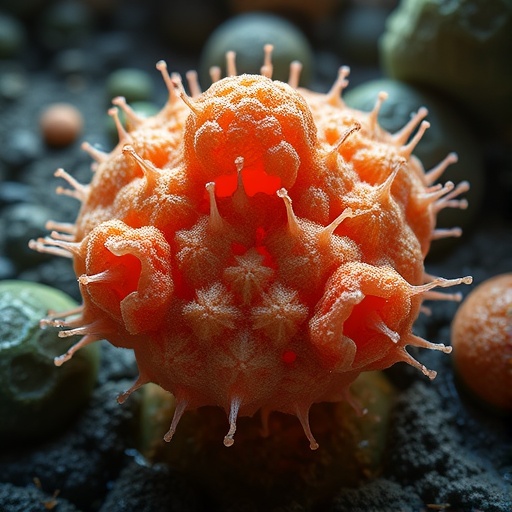
In the seemingly inhospitable environment of hyperthermophilic composting, where temperatures soar to nearly 87 degrees Celsius, one would expect microbial life to be extinguished. Yet, a newly published study reveals that certain microbial communities not only survive but thrive, orchestrating a remarkable biological defense at the molecular level. Scientists from Northeastern University, China Medical University, and the University of Tokyo have decoded the intricate protein remodeling processes that enable these microbes to withstand extreme heat stress, fundamentally reshaping our understanding of microbial resilience and biotechnology applications.
This breakthrough, detailed in a recent article in Environmental Science and Ecotechnology, centers on the vital role of heat shock proteins (HSPs) — molecular chaperones that painstakingly repair and stabilize damaged enzymes within thermophilic bacteria. These chaperones act in a highly coordinated sequence to identify misfolded proteins, utilizing energy from ATP to refold and protect essential enzymes. The study illustrates how the molecular players dnaJ, dnaK, and groEL work in tandem, administering a stepwise rescue operation that preserves catalytic functions critical for microbial survival at temperatures approaching boiling point.
The researchers leveraged cutting-edge metagenomic analyses to investigate microbial communities sampling compost heat gradients, capturing the dynamic community succession from typical thermophiles to hyperthermophiles. This ecological transition is driven by rapid heat escalation that reaches 87 °C within a mere 24 hours, forcing a community-wide adaptation. Dominant genera such as Bacillus, Thermobifida, and Truepera emerged as thermal specialists, displaying metabolic shifts that emphasize translation and amino acid metabolism while suppressing mobile genetic elements to safeguard genome integrity under duress.
At the crux of their survival strategy lies the molecular architecture of their proteins, particularly enzymes from Truepera radiovictrix, which exhibit pronounced structural rigidity and resistance to denaturation. Molecular dynamics simulations reveal that these enzymes maintain a dense network of hydrogen bonds and compact hydrophobic cores, preventing the unraveling typically induced by intense thermal conditions. This finding elucidates a mechanistic basis for protein thermostability, inviting a reconsideration of enzyme design principles for industrial uses requiring high operational temperatures.
The triad of heat shock proteins operates in a hierarchical and ATP-driven choreography. The chaperone dnaJ serves as an initial sensor, detecting aberrant folding patterns and targeting such proteins for repair. Subsequently, dnaK, energized by ATP hydrolysis, stabilizes these misfolded segments, preventing aggregation. Finally, groEL encapsulates the substrate protein within its cavity, providing a secluded environment for proper folding to be restored. This multi-tiered refolding cycle acts as a molecular lifeline, sustaining enzymatic activity and cellular homeostasis during prolonged hyperthermophilic exposure.
The functional implications of this chaperone network extend beyond mere survival. By maintaining enzyme conformation and catalytic capacity, these microbial communities ensure continuous biodegradation and energy production critical for composting efficiency. Therefore, the microbial consortium’s resilience directly impacts organic waste transformation rates, enhancing sterilization effectiveness and reducing composting timescales. These insights reveal a natural blueprint for developing thermotolerant bioprocessing systems capable of withstanding industrial high-temperature regimes.
“The genes encoding these chaperones are not simply survival tools but part of a sophisticated, genome-encoded communal strategy for life at the thermal limits,” explained Professor Tong Zhu, the study’s lead researcher. This revelation reframes notions of microbial adaptation, emphasizing evolution not just as a product of single gene changes but as an orchestrated network response at the proteomic and community levels. Such an understanding could revolutionize microbial engineering by enabling the rational design of microbial consortia with embedded thermotolerance.
Beyond composting, the findings harbor far-reaching implications for biotechnological innovation. Engineered thermophilic enzymes inspired by these naturally evolved systems could dramatically improve the robustness of industrial biocatalysts used in bioenergy production, fermentation processes, and pharmaceutical manufacturing. The principle of harnessing ATP-dependent protein refolding systems offers an unprecedented route to stabilize proteins prone to heat-induced denaturation, potentially reducing costs and increasing yields in processes traditionally limited by enzyme instability.
From an evolutionary biology perspective, this study also illuminates pathways of molecular adaptation in extremophiles, organisms that push the known envelope of life’s thermal tolerance. By dissecting the protein-level mechanisms that underpin survival in near-boiling environments, the research offers clues on how early life forms may have endured primordial hydrothermal settings. This molecular resilience hints at broader astrobiological implications, guiding the search for life in similarly extreme extraterrestrial habitats.
The metagenomics approach integrated with molecular dynamics simulations represents a powerful interdisciplinary methodology. It bridges large-scale ecological data with atomistic structural insights, affording a holistic view of microbial community function and protein behavior under environmental stress. This convergence empowers predictive modeling of microbial dynamics during composting and beyond, opening avenues for optimized system designs that balance microbial community stability with heightened thermotolerance.
An important ecological dimension lies in how mobile genetic elements are suppressed during hyperthermophilic composting, minimizing genomic instability—a crucial factor for sustaining function under high-stress conditions. This suppression ensures conservative genome maintenance, allowing thermophiles to focus metabolic resources on protein repair pathways, further reinforcing the survival advantage afforded by chaperone networks.
Ultimately, this pioneering investigation sheds light on the remarkable teamwork embedded at microscopic scales, where individual molecular machines collaborate seamlessly to overcome environmental extremes. The collective function of heat shock proteins in hyperthermophilic communities highlights nature’s engineering prowess, offering a template for synthetic biology efforts aiming to recreate or enhance such resilience. In a world increasingly dependent on sustainable waste management and bioindustrial processes, leveraging this knowledge holds promise for greener, more efficient technologies.
This discovery underscores the fundamental role of protein homeostasis in life’s persistence amidst thermodynamic challenges, showcasing the adaptability and ingenuity of microbial life. The unveiled chaperone-mediated thermotolerance mechanisms not only elevate our understanding of microbial ecology and molecular biology but also open transformative pathways to harness extremophile biology for human benefit, redefining the limits at which life—and industry—can sustainably operate.
News Publication Date: 20-Oct-2025
References:
DOI: 10.1016/j.ese.2025.100630
Keywords
Molecular dynamics
Cite Scienmag News
Bethany Barker. (November 7, 2025). Heat-Resistant Microbes Uncover Molecular Secrets Behind Nature’s Ultimate Recycling System. Scienmag. https://scienmag.com/heat-resistant-microbes-uncover-molecular-secrets-behind-natures-ultimate-recycling-system/
Bethany Barker. "Heat-Resistant Microbes Uncover Molecular Secrets Behind Nature’s Ultimate Recycling System." Scienmag, 7 November 2025, https://scienmag.com/heat-resistant-microbes-uncover-molecular-secrets-behind-natures-ultimate-recycling-system/. Accessed 4 September 2026.
Bethany Barker. "Heat-Resistant Microbes Uncover Molecular Secrets Behind Nature’s Ultimate Recycling System." Scienmag. November 7, 2025. https://scienmag.com/heat-resistant-microbes-uncover-molecular-secrets-behind-natures-ultimate-recycling-system/


