


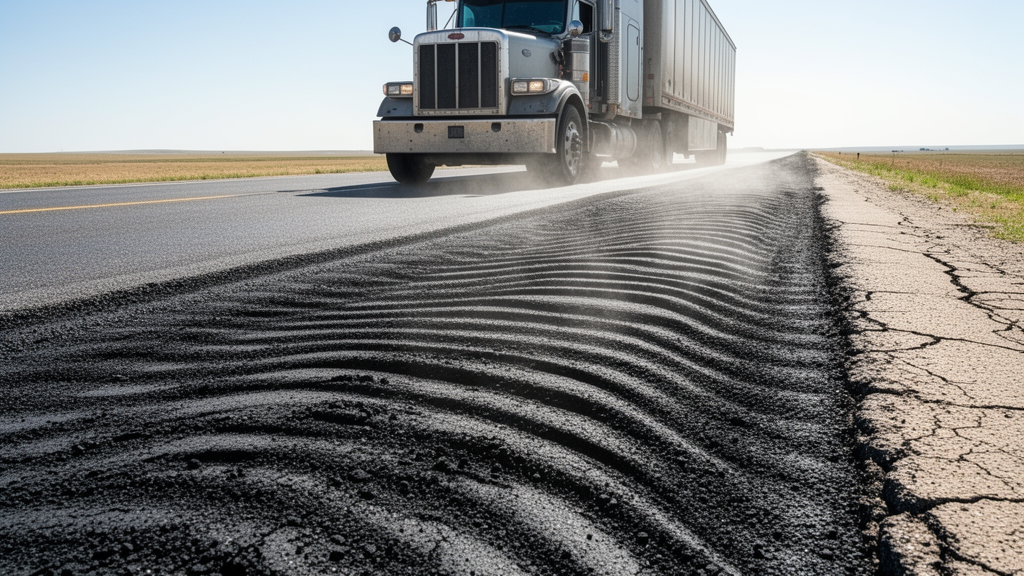
Rutting in asphalt pavement has long been treated as a problem with two separate culprits: scorching summer temperatures that soften the binder, and overloaded trucks that squeeze the structure harder than it was designed to bear. A new numerical and laboratory study of steel-slag asphalt pavement now shows that these two factors do not simply add up. Under the harshest combination tested, the deformation exceeded the sum of the individual effects by a measurable margin, revealing a genuine synergistic amplification that standard single-factor testing would miss.
The research, published in Frontiers in Materials, was carried out by a team from transportation institutions in Inner Mongolia and Shandong, China, led by Rui Deng and corresponding author Wenyang Han. Their motivation was practical: Inner Mongolia experiences wide temperature swings, and summer pavement surfaces can reach temperatures at which asphalt mixtures lose much of their stiffness. The team wanted to know how these stresses interact when they arrive together, and whether the interaction follows a predictable, linear pattern.
The material at the center of the study carries its own sustainability story. Steel slag, a dense and angular by-product of steelmaking, was used to replace 30 percent of the natural coarse aggregate by mass in three asphalt mixtures: the fine-graded AC-13 surface course, the AC-20 middle course, and the coarse AC-25 lower course. Only particles retained on the 4.75-millimeter sieve were used, after natural aging to reduce the volume instability associated with free lime and periclase in the slag.
The processed slag showed favorable properties for aggregate interlocking, including an apparent relative density of 3.39, a crushing value of 13.9 percent, and an asphalt adhesion grade of 5. To simulate the pavement, the researchers built a three-dimensional finite element model in ABAQUS representing a typical semi-rigid base structure: 60 millimeters of AC-13, 60 millimeters of AC-20, and 80 millimeters of AC-25 asphalt over a 200-millimeter cement-stabilized crushed-stone base, a graded crushed-stone subbase, and a compacted subgrade. The asphalt layers were treated as viscoelastic-plastic materials governed by the Bailey–Norton creep law, whose parameters were back-calculated from laboratory rutting tests at 60 and 70 degrees Celsius, with the 65-degree values interpolated.
The underlying layers were modeled as linear elastic, retaining their stiffness so that the support and stress-redistribution effects of the semi-rigid base system were preserved even though their own permanent deformation was neglected. Validation came from laboratory wheel-tracking tests. Single-layer specimens of each mixture were tested for dynamic stability, and a three-layer composite specimen with the same layer thicknesses as the model was tested for total rut depth at a contact pressure of 1.0 megapascal.
All relative errors in dynamic stability stayed below 10 percent, and at 70 degrees Celsius the predicted and measured 60-minute rut depths were 8.96 and 9.18 millimeters respectively, a relative error of just 2.4 percent. The authors note an important limitation: the model was validated mainly at approximately 1.0 megapascal, so the 0.8 and 1.2 megapascal cases represent numerical extensions of a validated framework rather than directly verified conditions. The simulation matrix covered three uniform temperatures, 60, 65, and 70 degrees Celsius, crossed with three contact pressures, 0.8, 1.0, and 1.2 megapascals, for nine full-factor combinations, each simulated for 180 minutes.
The 60-minute rut depth served as the primary index for comparison with the laboratory tests. The single-factor results were striking on their own. Temperature acts mainly by degrading material properties, while load acts mainly by raising the internal stress level, and both proved to be dominant drivers.
The nonlinear behavior emerged clearly when the two factors were combined. To quantify the interaction, the team introduced a coupling influence coefficient: the ratio of the actual rut-depth increment under a combined condition to the sum of the increments produced by temperature and pressure acting separately, with the mildest case, 60 degrees and 0.8 megapascals, as the reference. In other words, only when severe loading was paired with elevated temperature did the combined damage outpace the linear sum of its parts.
The mechanism behind this amplification lies in the shear response of the asphalt layers. The researchers extracted the maximum shear stress in each layer and compared it with temperature-dependent shear strengths measured in laboratory shear tests, defining a shear stress ratio for each layer. A ratio slightly above unity does not indicate outright shear failure, the authors caution, but rather a nearly exhausted shear-strength reserve.
Under most conditions the AC-20 middle layer controlled the critical response, but under the most severe combination the critical layer shifted to the AC-13 surface course, signaling that flow-dominated deformation was migrating upward. The layered accounting of deformation reinforced this picture. For pavement engineers, the practical message is that rutting evaluation under hot climates and heavy traffic cannot rely on single-factor tests alone.
The findings give designers of steel-slag asphalt pavements a quantitative basis for assessing high-temperature, heavy-traffic performance, and they highlight the middle course as the layer to watch, while warning that in the most extreme conditions the surface course may become the weakest link.
Subject of Research: Nonlinear rutting evolution in steel-slag asphalt pavement under coupled high-temperature and heavy-load conditions
Article Title: Nonlinear evolution and influencing mechanism of rutting in asphalt pavement under coupled high-temperature and heavy-load conditions
Article References: Deng, R., Wei, J., Li, H., Niu, L., Chen, L., Han, W., Qin, M., & Wei, S. (2026). Nonlinear evolution and influencing mechanism of rutting in asphalt pavement under coupled high-temperature and heavy-load conditions. Frontiers in Materials, 13, 1985464. https://doi.org/10.3389/fmats.2026.1985464
Image Credits: AI Generated
DOI: 10.3389/fmats.2026.1985464
Keywords: asphalt pavement, rutting, steel slag, finite element analysis, Bailey–Norton creep, high temperature, heavy load, shear stress ratio, semi-rigid base, coupling effect, viscoplastic deformation, pavement design
Cite Scienmag News
Denise Maddox. (October 27, 2026). Heat and Heavy Trucks Team Up to Warp Asphalt Roads in Nonlinear Ways. Scienmag. https://scienmag.com/heat-and-heavy-trucks-team-up-to-warp-asphalt-roads-in-nonlinear-ways/
Denise Maddox. "Heat and Heavy Trucks Team Up to Warp Asphalt Roads in Nonlinear Ways." Scienmag, 27 October 2026, https://scienmag.com/heat-and-heavy-trucks-team-up-to-warp-asphalt-roads-in-nonlinear-ways/. Accessed 27 October 2026.
Denise Maddox. "Heat and Heavy Trucks Team Up to Warp Asphalt Roads in Nonlinear Ways." Scienmag. October 27, 2026. https://scienmag.com/heat-and-heavy-trucks-team-up-to-warp-asphalt-roads-in-nonlinear-ways/


