


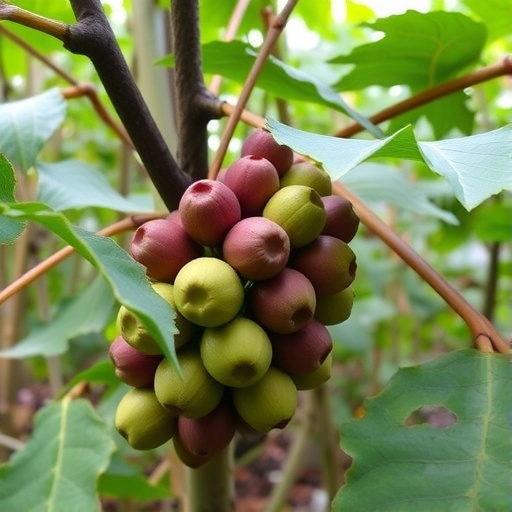
Across tropical agrarian landscapes, cacao cultivation faces mounting challenges owing to accelerating climate variability that threatens the stability of yields and the quality of the final harvest. In the global quest to sustain cacao productivity—integral not only to livelihoods but the cherished production of chocolate—a recent pioneering study conducted by researchers at Hasanuddin University in Indonesia unveils a nuanced agroforestry approach that melds ecological insight with practical farming techniques. This investigation, focusing on the deployment of multistrata shade systems composed of coconut, banana, and Gliricidia sepium, elucidates how intricate soil-leaf-physiology couplings enhance the resilience of cacao plants amid environmental stressors.
The study zeroes in on South Sulawesi, a key cacao-producing region, where the interplay of heat stress, erratic rainfall patterns, and prolonged dry spells jeopardizes crop health and productivity. Recognizing that monoculture cultivation exacerbates vulnerability, Professor Risma Neswati and her team explored how integrating specific shade tree species can not only buffer cacao plants against harsh climatic impacts but also optimize plant-soil nutrient dynamics. Employing two high-yielding cacao clones, MCC 02 and Sulawesi 2, the researchers analyzed various shading regimes to discern their influence on soil fertility, microclimate stabilization, and photosynthetic efficiency of cacao leaves.
Crucially, the study unpacks the synergistic effects of multistrata shading, highlighting how layered canopies interspersed with coconut, banana, and Gliricidia sepium create a microenvironment that attenuates temperature extremes. This microclimatic modulation reduces direct radiation exposure, thus mitigating evapotranspiration rates and conserving soil moisture content. Quantitative assessments revealed enhanced soil nitrogen concentrations and an elevated capacity for nutrient retention under these shade configurations, underpinning the complex biochemical exchanges governing soil fertility and plant growth.
On the physiological front, the investigation delved into leaf chlorophyll metrics as a proxy for photosynthetic aptitude and plant health. The data compellingly showed that cacao leaves thriving beneath mixed shade exhibited higher chlorophyll content, indicative of optimized light absorption and utilization. This enhancement in photosynthetic pigment density under shade conditions translated into more effective water regulation mechanisms within the plant, a vital trait for sustaining growth during intermittent droughts and variable precipitation regimes characteristic of climate-disturbed environments.
Furthermore, differentiation between cacao clones revealed genotype-specific responses to shade intensity. While MCC 02 flourished under moderate shade, Sulawesi 2 demonstrated improved growth with denser cover, advocating for cultivar-tailored agroforestry designs. Such findings empower farmers to fine-tune shading strategies that harmonize clone-specific needs with local microclimatic conditions, thereby fostering both yield stability and superior bean quality. The multilayered shade structure not only facilitates physiological homeostasis but also accelerates phenological milestones, augmenting early fruit development and canopy expansion.
Beyond plant-centered benefits, the study underscores shade trees’ multifunctional role in ecosystem service provision. Their litterfall acts as a continuous natural mulch, enriching the topsoil organic matter and curbing erosion. This organic layer fosters microbial diversity and nutrient cycling intricacies essential for soil health. Additionally, strategic pruning and spatial management of shade trees amplify air circulation, reducing pathogen pressure while preserving the microclimate advantages. Such integrative farm management practices exemplify adaptive agroecological frameworks pivotal for climate-smart agriculture.
Aligning with the United Nations Sustainable Development Goals, particularly those targeting sustainable agriculture (SDG 2) and climate action (SDG 13), this research advocates for scalable, nature-driven approaches to smallholder cacao farming. By anchoring agronomic innovation in biodiverse, multilayered systems, it charts a course toward mitigating climate-induced yield volatility. The implications transcend Indonesia’s borders, offering transferable models adaptable to other tropical cacao regions encountering similar climactic challenges.
While the initial findings illuminate promising pathways, the researchers prudently call for longitudinal studies across diverse agroecological zones and seasons to capture variations in shade tree-cacao interactions fully. Such research endeavors would deepen understanding of temporal dynamics, pathogenic interplay, and soil microbiome shifts under multistrata shade regimes. In addition, exploring socioeconomic parameters and farmer adoption trends would bridge ecological insights with actionable policy frameworks, ensuring robust implementation.
In sum, the Hasanuddin University team’s exploration of multistrata shade structures reveals how a symbiotic coupling of soil, leaf physiology, and environmental buffers fosters climate resilience in cacao hedgerows. This research not only advances agronomic science but also imbues smallholder practices with resilience-oriented strategies essential for sustaining the future of cacao—one of the planet’s most beloved crops. As climate uncertainties loom large, such integrative agroforestry systems present a beacon of sustainable innovation, enhancing productivity while safeguarding ecosystem integrity.
News Publication Date: 11 March 2026
Web References:
- https://link.springer.com/article/10.1007/s10457-026-01444-4
- http://dx.doi.org/10.1007/s10457-026-01444-4
References:
Neswati, R., et al. (2026). Multistrata shade structures soil–leaf–physiology coupling and enhances climate resilience in smallholder cacao hedgerows. Agroforestry Systems, Volume 100. DOI: 10.1007/s10457-026-01444-4.
Keywords
Agriculture, Agroforestry, Climate change, Environmental sciences, Soil science, Crop science, Sustainable development, Ecology, Plant sciences, Food production
Cite Scienmag News
Sloane Callahan. (April 28, 2026). Hasanuddin University Study Uncovers Key Insights for Enhancing Climate Resilience in Smallholder Cacao Farms. Scienmag. https://scienmag.com/hasanuddin-university-study-uncovers-key-insights-for-enhancing-climate-resilience-in-smallholder-cacao-farms/
Sloane Callahan. "Hasanuddin University Study Uncovers Key Insights for Enhancing Climate Resilience in Smallholder Cacao Farms." Scienmag, 28 April 2026, https://scienmag.com/hasanuddin-university-study-uncovers-key-insights-for-enhancing-climate-resilience-in-smallholder-cacao-farms/. Accessed 4 September 2026.
Sloane Callahan. "Hasanuddin University Study Uncovers Key Insights for Enhancing Climate Resilience in Smallholder Cacao Farms." Scienmag. April 28, 2026. https://scienmag.com/hasanuddin-university-study-uncovers-key-insights-for-enhancing-climate-resilience-in-smallholder-cacao-farms/


