


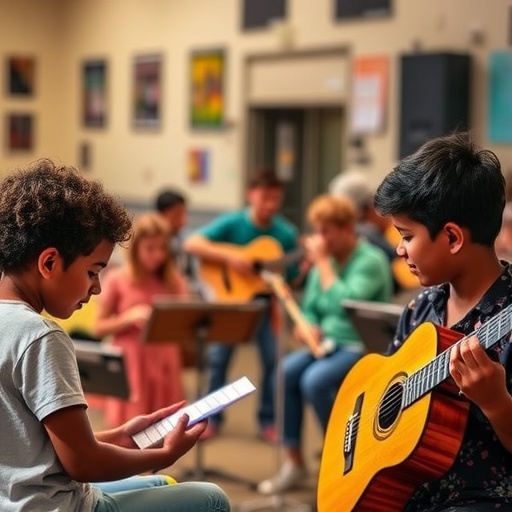
Improving the mental health and overall wellbeing of young people has emerged as a critical global objective, with suicide tragically becoming the third leading cause of death among individuals aged 15 to 29 worldwide, as reported by the World Health Organization. This alarming public health concern is inextricably linked to the rising prevalence of youth mental illness. In light of these challenges, innovative, community-based interventions that transcend traditional clinical approaches are essential. One such promising avenue comes from a recent study conducted by Dr. Jason Goopy, Senior Lecturer in Music Education at Edith Cowan University, which explores the transformative potential of community music education programs (CMEPs) in regional Australia.
Dr. Goopy’s groundbreaking research delves into how CMEPs foster psychological wellbeing among adolescents and young adults who face adversities. Unlike conventional school music programs that often prioritize career trajectories in music, these community initiatives are designed to be accessible and inclusive, removing barriers related to previous musical training or socioeconomic status. By providing free access to music education, especially focused on creative songwriting, these programs double as informal life education platforms, empowering participants with vital skills for navigating challenging life circumstances.
The study is rooted in self-determination theory (SDT), a robust psychological framework that identifies three innate psychological needs essential for human flourishing: relatedness, competency, and autonomy. Dr. Goopy and his research team adopted qualitative methods, including participant observation and semi-structured interviews with both youth participants and program facilitators, to understand the nuanced ways community music engagement addresses these needs. This methodological approach allowed for an in-depth examination of how music-learning environments can nurture a sense of belonging, self-efficacy, and volitional control among vulnerable youth.
Central to the success of these CMEPs is the creation of a “family-like” atmosphere characterized by non-judgmental acceptance, inclusion, and meaningful social connection. This positive environment fosters relatedness, enabling young people to form trusted peer relationships and connect with supportive adults who act as role models. The facilitators’ roles extend beyond music instruction; they model healthy life strategies and guide participants through both musical and personal development, addressing competency needs by enabling continuous skill acquisition and confidence building.
Autonomy is equally emphasized within this community music context. Participants are encouraged to take ownership of their learning journeys through personalized goal setting, particularly in songwriting projects that reflect their stories and aspirations. This approach empowers them to exert control over their creative expressions and life paths, instilling a critical sense of accomplishment and purpose that can counteract feelings of helplessness often associated with trauma and mental health challenges.
These findings position community music education not merely as an artistic enrichment activity but as a vital psychosocial intervention capable of satisfying core psychological needs integral to wellbeing. By situating music learning in community settings rather than institutionalized, competitive frameworks, the program disrupts the conventional pipeline toward professional music careers and instead democratizes access to its therapeutic potential. This paradigm shift exemplifies how the arts can innovate approaches to youth mental health and foster resilience.
The implications of Dr. Goopy’s study are further underscored by a complementary investigation into trauma-informed positive music education (TIPE), which blends trauma-informed care principles with strengths-based positive psychology frameworks. This approach tailors music education to support healing and growth among youth impacted by trauma by promoting self-regulation, relational competence, and psychological resourcefulness through creative modalities like songwriting and collaborative storytelling. Integration of TIPE principles enhances CMEPs’ capacity to address complex emotional needs with sensitivity and efficacy.
Collectively, this body of research articulates a compelling case for the mental health sector, educators, and community organizations to invest in and expand CMEPs as scalable, non-medical, and cost-effective strategies for youth wellbeing. The model leverages the universal appeal of music to reach marginalized populations and counteract social isolation, thereby contributing to preventive mental health interventions on a population level. The personalization of musical goals alongside life skills education ensures relevance and sustainability of positive outcomes.
The urgency to innovate interventions is particularly salient in regional and rural settings where access to traditional mental health services may be limited. CMEPs provide an embedded, accessible space for young people to engage creatively and emotionally, building resilience and social capital within their local communities. This community-rooted approach also aligns with contemporary understandings of public health that emphasize social determinants and holistic wellbeing.
In conclusion, Dr. Goopy’s research elucidates the multifaceted role of community music education as a vital component in fostering adolescent and young adult wellbeing, especially for those navigating challenging life circumstances. By fulfilling fundamental psychological needs in supportive, inclusive environments, CMEPs extend beyond artistic development to become transformative life interventions. This innovative use of music education offers a scalable blueprint for enhancing mental health outcomes and empowering young people to flourish through creative expression and social connection.
As mental health challenges among youth continue to proliferate globally, these findings herald a paradigm shift in how society conceptualizes and deploys music education within community settings. By reconceptualizing music as a tool for psychological growth and empowerment rather than solely as a vocational path, CMEPs represent a forward-thinking, inclusive model that promises to enhance the futures of young people across diverse contexts.
Cite Scienmag News
Courtney Benton. (March 25, 2026). Harnessing Community Music Education as a Vital Strategy for Youth Wellbeing. Scienmag. https://scienmag.com/harnessing-community-music-education-as-a-vital-strategy-for-youth-wellbeing/
Courtney Benton. "Harnessing Community Music Education as a Vital Strategy for Youth Wellbeing." Scienmag, 25 March 2026, https://scienmag.com/harnessing-community-music-education-as-a-vital-strategy-for-youth-wellbeing/. Accessed 3 September 2026.
Courtney Benton. "Harnessing Community Music Education as a Vital Strategy for Youth Wellbeing." Scienmag. March 25, 2026. https://scienmag.com/harnessing-community-music-education-as-a-vital-strategy-for-youth-wellbeing/


