


May 20th, Genoa (Italy) – The Genetics of Cognition research group coordinated by Francesco Papaleo at the Istituto Italiano di Tecnologia (IIT-Italian Institute of Technology) has discovered a brain network present in animals and humans which allows to recognize others’ emotions. These findings, published in the journal Nature Neuroscience, pave the way to develop new, more effective therapeutic strategies for neurodevelopmental conditions, such as schizophrenia or autism, wherein such social functions are impaired.

Credit: IIT-Istituto Italiano di Tecnologia
May 20th, Genoa (Italy) – The Genetics of Cognition research group coordinated by Francesco Papaleo at the Istituto Italiano di Tecnologia (IIT-Italian Institute of Technology) has discovered a brain network present in animals and humans which allows to recognize others’ emotions. These findings, published in the journal Nature Neuroscience, pave the way to develop new, more effective therapeutic strategies for neurodevelopmental conditions, such as schizophrenia or autism, wherein such social functions are impaired.
Recognizing and responding appropriately to the emotions expressed by others is a fundamental skill of animals, as it enhances their ability to interact effectively with their counterparts, thereby increasing the probability of survival. Despite its importance, the brain mechanisms underlying this process remain largely unknown, even in humans.
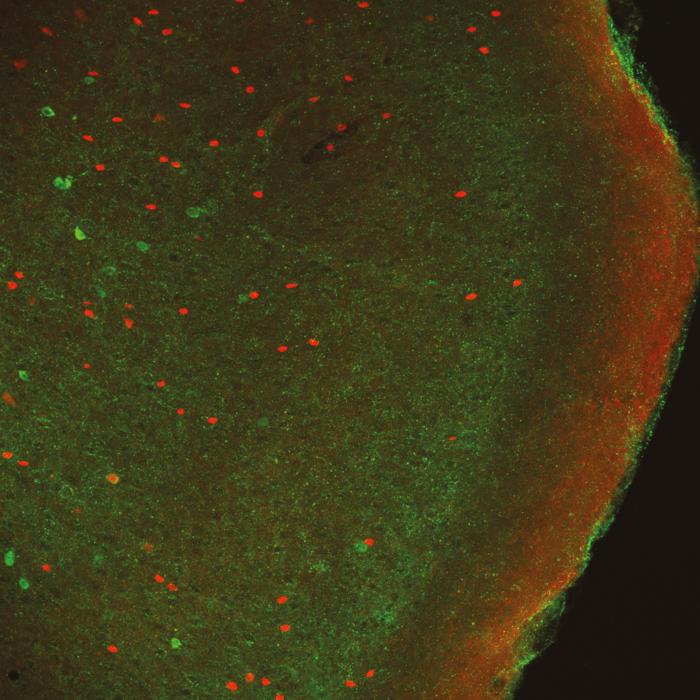
Using state-of-the-art techniques, Papaleo’s team discovered a brain circuit which is involved in these socio-cognitive processes and which has never been studied previously. It consists of a group of specific neuronal cells that connects two brain areas, distant one from each other: the prefrontal cortex and the retrosplenial cortex.
In humans, the function of this connection was tested through an experiment involving more than 1,000 participants on a volunteer basis. Each subject had to watch a screen where faces with angry, happy or neutral expressions were projected. During the test, researchers recorded their brain activity with magnetic resonance imaging techniques to see which areas of the brain were activated. The results confirmed a correlation between the activity of the two brain circuit areas, the prefrontal cortex and the retrosplenial cortex, and the recognition of emotions.
“We are excited by these new results because they deepen our understanding of the brain circuits that encode and, therefore, make us react to the others’ emotions – stated Francesco Papaleo, coordinator of the Genetics of Cognition laboratory at IIT – we would like to have a broader view of the way these mechanisms work, particularly how they are altered in psychiatric and neurodevelopmental disorders”.
“Current drugs for treating neurodevelopmental conditions are not selective, affecting many types of neurons without distinction – said Anna Monai, researcher in the Genetics of Cognition laboratory – the idea is to develop therapeutic strategies targeted toward specific brain circuits, so as to decrease side effects while increasing treatment efficacy”.
The study was conducted in collaboration with the Functional Neuroimaging laboratory coordinated by Alessandro Gozzi of the Center for Neuroscience and Cognitive Systems IIT in Rovereto, Italy; the Optical Approaches to Brain Function laboratory coordinated by Tommaso Fellin of the Center for Human Technologies IIT in Genoa, Italy; the Department of Biomedical and Biotechnological Sciences of the University of Catania, Italy; and the Center for Population Neuroscience and Stratified Medicine, Institute for Science and Technology of Brain-inspired Intelligence of Fudan University (Shanghai).
Journal
Nature Neuroscience
Method of Research
Experimental study
Subject of Research
People
Article Title
Cortico-cortical transfer of socially derived information gates emotion recognition
Article Publication Date
20-May-2024
Cite Scienmag News
Cassandra Pierce. (May 20, 2024). Happy or angry, how the brain recognize emotions. Scienmag. https://scienmag.com/happy-or-angry-how-the-brain-recognize-emotions/
Cassandra Pierce. "Happy or angry, how the brain recognize emotions." Scienmag, 20 May 2024, https://scienmag.com/happy-or-angry-how-the-brain-recognize-emotions/. Accessed 4 September 2026.
Cassandra Pierce. "Happy or angry, how the brain recognize emotions." Scienmag. May 20, 2024. https://scienmag.com/happy-or-angry-how-the-brain-recognize-emotions/

