


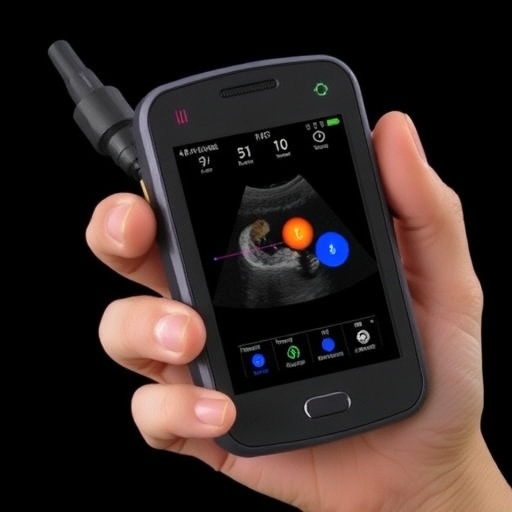
In recent years, the convergence of optical and ultrasonic technologies has revolutionized biomedical imaging, offering unprecedented insights into physiological and pathological processes. Among the forefront of these innovations stands a groundbreaking handheld photoacoustic microscopic probe that integrates a transparent ultrasound transducer with a fiber scanner, marking a monumental leap in the realm of minimally invasive diagnostic tools. Developed by a team led by researchers Ha, Kim, Lee, and colleagues, this device, detailed in their upcoming publication in Nature Communications, embodies the pinnacle of precision engineering and biophotonic sophistication, promising to redefine clinical and research imaging paradigms.
Photoacoustic microscopy, a hybrid imaging technique that synergizes the richness of optical contrast with the depth resolution of ultrasound detection, has rapidly ascended as a fundamental modality in modern biomedical investigations. The principle is elegant yet powerful: pulsed laser light is absorbed by biological chromophores, producing localized thermoelastic expansion that in turn generates ultrasound waves detectable by sensitive transducers. These acoustic signals are then translated into high-resolution images revealing structures such as microvasculature, melanin distribution, and cellular assemblies. However, most existing systems face constraints due to bulky components and limited portability, which hinder their widespread clinical translation.
Addressing these challenges head-on, the research group engineered a transparent ultrasound transducer (TUT) embedded seamlessly within a handheld probe architecture. Traditional piezoelectric transducers, while vital for ultrasound detection, often obstruct the illuminating optical path, complicating alignment and decreasing efficiency. The researchers’ breakthrough involved fabricating an optically transparent piezoelectric membrane capable of transmitting both the incident laser pulses and the resultant acoustic signals through its substrate without compromising sensitivity. This transparent geometry enables coaxial light delivery and ultrasound detection, substantially simplifying the probe’s optical and acoustic pathways.
Central to the device’s design is its integration with a fiber scanner—a compact, high-speed optical fiber-based scanning mechanism that raster-scans the illumination beam across the tissue surface. This fiber scanner efficiently modulates the position of the laser focus, allowing the probe to capture high-resolution images across a defined field of view. Unlike conventional mechanical scanning stages or MEMS mirrors, the fiber scanner offers enhanced durability, rapid response, and superior spatial precision in a compact footprint, essential for real-world handheld applicability.
The synergy between the TUT and the fiber scanner culminates in an imaging probe that is both lightweight and ergonomic, a feature critical for clinical practitioners who require nimble tools capable of delivering volumetric data swiftly and reliably. The probe’s housing is meticulously designed to ensure user comfort and maneuverability, opening new opportunities for point-of-care diagnostics across diverse clinical settings—ranging from dermatology to oncology and vascular studies. Moreover, the compact design does not sacrifice performance, as the device maintains high sensitivity and resolution that rival bench-top systems.
One of the most striking technical feats of this device is its capacity for real-time imaging. By leveraging the fiber scanner’s rapid beam steering and the TUT’s uninterrupted optical axis, the probe captures live photoacoustic images with high frame rates, thus facilitating dynamic monitoring of biological functions. This real-time capability is transformative for assessing blood oxygenation fluctuations, detecting subtle morphological changes, or guiding interventions with immediate feedback.
The material science underpinning the transparent ultrasound transducer is a compelling narrative in itself. The team employed innovative piezoelectric polymers or composite materials that combine transparency with adequate piezoelectric coefficients to generate and receive ultrasound waves effectively. This choice of material balanced the optical clarity and acoustic performance while ensuring biocompatibility and mechanical resilience, critical for in vivo applications.
Device calibration and signal processing algorithms further augment the system’s robustness. Sophisticated acoustic signal reconstruction and noise suppression techniques are embedded within the imaging software to enhance contrast and resolution. By implementing adaptive beamforming and spectral unmixing methods, the probe discerns different tissue chromophores and structural features with striking specificity, thereby enriching the diagnostic potential.
Validation experiments presented by the researchers underscore the probe’s capability in visualizing microvascular networks with microscopic resolution. In preclinical models, the handheld system elucidated vascular morphologies and oxygen saturation levels, demonstrating its suitability for detecting early-stage pathological changes such as tumor angiogenesis or ischemic lesions. Its portability allowed imaging in complex anatomical locations previously inaccessible by conventional photoacoustic platforms.
Moreover, the probe’s transparent ultrasound transducer confers a unique advantage in multimodal imaging integration. Its optical transparency permits seamless combination with other optical modalities like fluorescence microscopy or optical coherence tomography within a single device, enabling comprehensive tissue characterization that encompasses structural, functional, and molecular information.
From a translational perspective, this handheld photoacoustic microscopic probe embodies a shift toward democratized medical imaging, where high-end diagnostic capabilities become accessible beyond specialist laboratories. The device’s compact size and operational simplicity invite deployment in resource-limited settings, telemedicine, and even intraoperative environments where rapid, accurate imaging guides clinical decisions and improves patient outcomes.
Furthermore, the innovation holds promise for personalized medicine. By allowing repeated, non-invasive imaging at the bedside, it facilitates longitudinal monitoring of disease progression or therapeutic efficacy at a cellular and tissue microenvironment level. This capability aligns well with emerging trends in targeted therapies and precision diagnostics, where dynamic tissue responses inform treatment tailoring.
The implications of this technology also ripple into fundamental biological research. Investigators can harness the handheld probe to study physiological phenomena such as neurovascular coupling, inflammatory processes, or wound healing in living organisms with minimal disturbance. The high spatial and temporal resolution combined with portability bestows experimental flexibility, accelerating discoveries that translate to clinical innovations.
As with any nascent technology, challenges remain to be addressed. The research team acknowledges the ongoing pursuit to enhance the acoustic sensitivity of the transparent transducer to rival conventional opaque devices fully. Similarly, expanding the field of view and penetration depth without compromising resolution is a key objective, motivating continued refinement in optical and acoustic engineering.
Integration with wireless data transmission and compact power sources also represents an avenue for future development, envisioning a truly untethered imaging system that further liberates clinical workflows. Artificial intelligence-driven image analysis pipelines may complement hardware advances, automating interpretation and quantification to bolster diagnostic accuracy and reduce operator dependency.
In conclusion, the introduction of a handheld photoacoustic microscopic probe with an integrated transparent ultrasound transducer and fiber scanner signifies a landmark achievement in biomedical optics and ultrasound engineering. By seamlessly blending optical transparency, mechanical agility, and acoustic sensitivity, the device unlocks new vistas for non-invasive, high-resolution imaging that is practical, portable, and profoundly impactful. As the field eagerly anticipates its clinical and research deployment, this innovation heralds a new era in precision bioimaging that bridges technological sophistication with real-world applicability.
Cite Scienmag News
Ophelia Keating. (December 31, 2025). Handheld Photoacoustic Probe Merges Ultrasound, Fiber Scanner. Scienmag. https://scienmag.com/handheld-photoacoustic-probe-merges-ultrasound-fiber-scanner/
Ophelia Keating. "Handheld Photoacoustic Probe Merges Ultrasound, Fiber Scanner." Scienmag, 31 December 2025, https://scienmag.com/handheld-photoacoustic-probe-merges-ultrasound-fiber-scanner/. Accessed 5 September 2026.
Ophelia Keating. "Handheld Photoacoustic Probe Merges Ultrasound, Fiber Scanner." Scienmag. December 31, 2025. https://scienmag.com/handheld-photoacoustic-probe-merges-ultrasound-fiber-scanner/


