


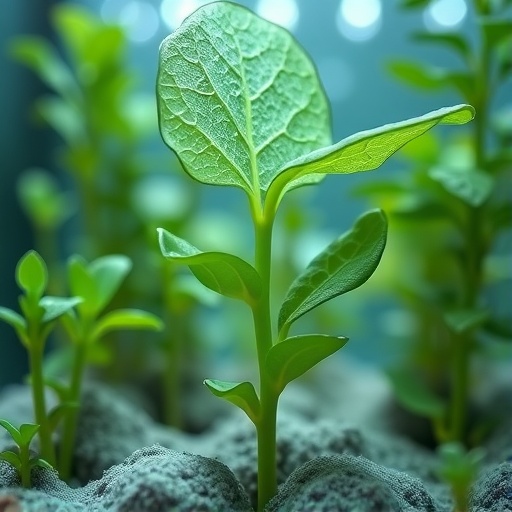
In a groundbreaking study published in Nature, researchers have unveiled a complex interplay between oxidative stress and hypoxia signaling in plants, revealing how hydrogen peroxide (H₂O₂) can repurpose oxygen (O₂) sensing pathways to modulate the plant’s molecular response after oxygen deprivation. This discovery challenges longstanding views on how plants integrate signals from reactive oxygen species (ROS) and low oxygen environments, carrying wide implications for our understanding of plant stress physiology and adaptation.
The core of this investigation centered on a group of transcription factors known as ERFVIIs, well-established regulators of hypoxia-responsive genes (HRGs). Traditionally, the stabilization and activity of ERFVIIs are tightly controlled by oxygen availability, dictating the expression of genes critical to survival during low-oxygen stress. However, paradoxically, the researchers found that H₂O₂—a prominent reactive oxygen species generated during oxidative stress—stabilizes these factors, thereby conflicting with prior observations that reoxygenation rapidly represses hypoxia-inducible genes.
To directly address these discrepancies, the study employed Arabidopsis seedlings subjected to a gradient of oxygen conditions combined with treatments that provoke oxidative stress via tert-butyl hydroperoxide (TBHP). The expression patterns of ERFVII-regulated genes showed a marked upregulation under hypoxia but were sharply reduced upon reoxygenation, consistent with classical oxygen sensing. Remarkably, TBHP treatment suppressed the induction of these hypoxia-responsive genes under low oxygen, implying that ROS signaling can selectively counteract the hypoxia response.
Further qPCR analyses confirmed the specificity of this suppression. While HRGs were downregulated upon oxidative stress, genes involved in general oxidative stress responses were upregulated, demonstrating that the transcriptional machinery remained fully functional and that the plants were indeed experiencing oxidative stress. Moreover, the redox state’s influence was underscored by the partial reversal of this inhibition upon supplementation with ascorbate, a known antioxidant, highlighting a nuanced relationship between cellular redox balance and gene expression during hypoxia.
At the molecular level, HRG expression is orchestrated through the binding of ERFVIIs to hypoxia-responsive promoter elements (HRPEs). To elucidate whether TBHP-induced oxidative stress interferes with this transcriptional regulation, transgenic Arabidopsis lines engineered with synthetic promoters containing HRPE repeats driving luciferase reporters were analyzed. The data revealed that hypoxia-induced transcriptional activation via HRPEs was significantly dampened by TBHP treatment, indicating that ROS signaling impedes ERFVII-mediated transactivation at the promoter level.
Chromatin immunoprecipitation (ChIP) assays added further nuance to this picture. Utilizing a GFP-tagged truncated RAP2.12 ERFVII variant, the team assessed binding to promoters of canonical hypoxia and oxidative-stress-responsive genes. Intriguingly, TBHP treatment did not broadly diminish ERFVII binding to these promoters, except for a modest reduction at the LBD41 locus. This suggests that ROS-mediated repression is not simply attributable to hindered DNA binding but potentially involves modulation of ERFVII’s transactivation capability.
Probing deeper into the mechanistic underpinnings, the researchers explored whether any known ERFVII co-factors played a role in this repression but found no evidence implicating HRA1 in this context. They then focused on dissecting RAP2.12, a key ERFVII member, by generating various truncated protein constructs lacking conserved motifs responsible for transcriptional activation. These constructs were expressed in an erfVII knockout background to assess their role under oxidative stress during hypoxia.
Remarkably, truncation variants missing the final 18 amino acids—corresponding to a well-characterized transcriptional activation domain (CMVII-5)—failed to exhibit repression of select HRGs upon TBHP treatment. Similarly, deletion of additional conserved motifs further abrogated the repression response. These results pinpointed the CMVII-8 motif as essential for mediating ROS-dependent inhibition of HRG transcription, revealing a previously unappreciated domain critical for integrating redox signals into hypoxia signaling pathways.
The study provides compelling evidence that elevated ROS levels during oxidative stress after hypoxia exposure repurpose the plant’s oxygen-sensing machinery, modulating ERFVII function in a way that suppresses classical hypoxia responses. This rewiring likely helps the plant fine-tune its gene expression to navigate the complex landscape of fluctuating oxygen and redox conditions encountered in natural environments.
Beyond advancing fundamental plant biology, these findings carry significant potential applications. Understanding how ROS influences hypoxia signaling pathways could inform crop engineering strategies aimed at enhancing tolerance to environmental stressors such as flooding or drought, conditions in which tissue oxygen availability and oxidative stress are tightly intertwined. Manipulating the identified ERFVII domains or redox-sensitive regulatory mechanisms may thus pave the way for developing stress-resilient plants.
Moreover, the crosstalk between ROS and oxygen sensing unveiled in this study resonates with broader biological themes, as oxidative stress and hypoxia sensing are conserved processes across kingdoms. Elucidating such regulatory circuits in plants contributes to a growing appreciation of the intricate signaling networks governing cellular adaptation and survival under stress.
In conclusion, this landmark research redefines the paradigm of plant hypoxia responses by demonstrating that hydrogen peroxide does not merely represent a damaging by-product of metabolism but acts as a critical signal that reshapes oxygen sensing after hypoxia. The discovery that oxidative cues can selectively suppress ERFVII-regulated hypoxia genes through modulation of specific transcriptional activation domains opens new frontiers in understanding and manipulating plant stress response pathways.
As environmental challenges such as climate change increasingly exert pressure on global agriculture, insights into the sophisticated molecular dialogues between ROS and oxygen sensing will be invaluable. This study marks a significant leap forward in unveiling the molecular choreography plants employ to survive and adapt, holding promise for innovative approaches to crop improvement and sustainable food production.
Cite Scienmag News
Juliet Wilcox. (April 23, 2026). H2O2 Hijacks Plant O2 Sensing Post-Hypoxia. Scienmag. https://scienmag.com/h2o2-hijacks-plant-o2-sensing-post-hypoxia/
Juliet Wilcox. "H2O2 Hijacks Plant O2 Sensing Post-Hypoxia." Scienmag, 23 April 2026, https://scienmag.com/h2o2-hijacks-plant-o2-sensing-post-hypoxia/. Accessed 4 September 2026.
Juliet Wilcox. "H2O2 Hijacks Plant O2 Sensing Post-Hypoxia." Scienmag. April 23, 2026. https://scienmag.com/h2o2-hijacks-plant-o2-sensing-post-hypoxia/


